New Launch - India Real Estate Report 2026.

Services
Knowledge Hub
Resources
Tools

Ask Pulse Ai
©PropTech Pulse 2025, All rights reserved.


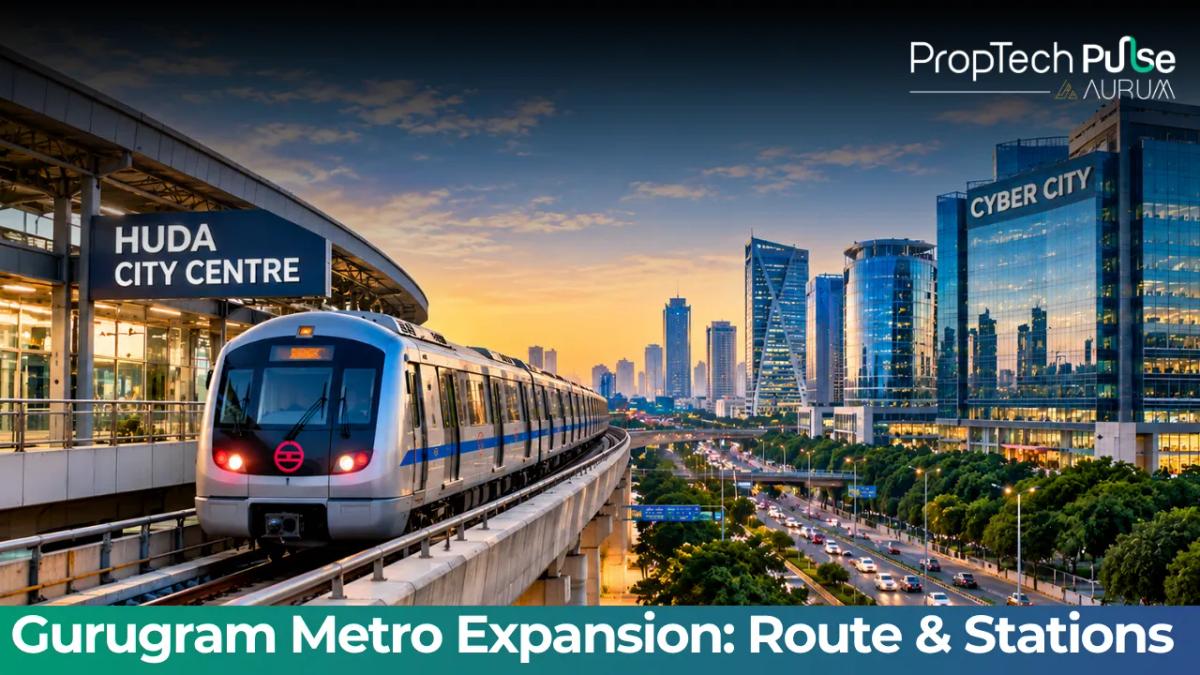
Millennium City Centre used to serve as the southern terminus of Delhi Metro’s Yellow Line. Renamed in July 2023, it now anchors a newly sanctioned intra-city rail network. The Union Cabinet approved a 28.5 km route with 27 stations at ₹5,452.72 crore. Groundwork has already started.
This loop stitches Old Gurugram directly to Cyber Hub. Execution timelines lock in exactly four years from the date of sanction.
Current Reality: Millennium City Centre (Formerly HUDA City Centre) Metro Station
Quick answer
The former huda city centre metro station was officially renamed Millennium City Centre in July 2023. It remains the Yellow Line terminus in Gurugram and offers direct access to Fortis Hospital, Unitech Business Park, and Max Super Speciality Hospital. The station also serves as the starting node for the newly approved intra-city loop.
Millennium City Centre handles heavy footfall daily. Situated where NH-48 meets the arterial roads feeding Subhash Chowk and Palam Vihar, the station funnels commuters toward three main zones. You have the healthcare stretch anchored by Fortis and Max. Corporate campuses of Unitech and DLF follow close behind. Dense residential pockets fill out the rest.
Parking logistics remain tight during peak hours. That congestion explains why the new transit plan matters so much. Commuters avoiding crossroad bottlenecks won’t need shared autos once the above-ground track opens.
| Feature | Details |
|---|---|
| Status | Fully operational since June 2010 |
| Line | Yellow Line (Delhi Metro) |
| Parking capacity | ~500 two-wheeler / ~150 four-wheeler spaces (varies by zone) |
| Nearby commercial hubs | Fortis MultiSpecialty Hospital, Unitech Business Park, Max Super Speciality Hospital |
| ATM & retail availability | Multiple banking ATMs and convenience outlets across all concourse levels |
| Commute overlap | Direct Yellow Line access + upcoming intra-city loop integration |
Commuters tracking proximity to a metro station and apartment pricing models consistently factor in exit density. Millennium City Centre scores high on both fronts today. Last-mile connectivity drives the current rating.
The real estate upside multiplies once the upgraded network opens. Properties sitting within walking distance of the HUDA City Centre metro integration tend to appreciate faster. Developers stop competing on road quality. They start competing on direct rail access instead.
The Sanctioned Masterplan: Connecting Old & New Gurugram via Rail
Gurugram’s urban sprawl suffers from a structural disconnect. Old Gurugram holds mature societies, established schools, and legacy commercial strips. Cyber City and Golf Course Road carry corporate employment and premium supply. Traffic on DLF Boulevard and Sohna Road peaks well past eight in the morning.
The approved plan solves this friction. It creates a continuous above-ground rail ring rather than another radial line pointing back to Delhi.
| Parameter | Specification |
|---|---|
| Total corridor length | 28.50 km |
| Number of stations | 27 |
| Estimated project cost | ₹5,452.72 crore |
| Construction mode | Fully above-ground, standard gauge (1,435 mm) |
| Design speed | 80 kmph | Average operational speed: 34 kmph |
| Execution deadline | 4 years from date of Union Cabinet sanction |
Routing strategy drove these specific choices. The route starts at Millennium City Centre and moves west into Sector 45. It then threads through Palam Vihar and Udyog Vihar.
A second arc passes east past MG Road, connecting to Cyber Hub and DLF Phase 1–4. Finally, it swings south to intersect Dwarka Expressway before returning to the origin.
Keeping the track above ground avoids land acquisition battles. Ninety percent of the footprint rests on government-owned parcels. Only ten percent touches private land.
This design shift means execution skips lengthy lease transfers. Phase 1 delays disappear completely. Top real estate developers operating in Gurugram have already adjusted site approvals. They accommodate future station footprints. This speeds up final mile handoffs between infrastructure and housing.
Step-by-Step Route Breakdown: 27 Stations Mapped
Traffic divides naturally into three demand clusters. Old Gurugram sees the highest residential concentration. Udyog Vihar functions as an industrial and mid-sized commercial hub. Cyber City anchors high-density office space and premium rentals. The station sequence aligns directly with these flows.
- Sector 45 to Sector 26 stretch: Stations serve Palam Vihar, Bhattu Kalan, and Sikanderpur. These areas currently rely on overcrowded feeder buses and informal shared vehicles. The loop introduces predictable commute times for residents heading toward corporate zones.
- Udyog Vihar to MG Road arc: Stops include sectors aligned with warehousing, light manufacturing, and mid-market offices. Commuters switch from surface-level cargo routes to dedicated rail corridors, reducing freight-passenger conflict during evening rush hours.
- Cyber Hub to Golf Course Road connection: Stations cluster near DLF Cyber City, Tower 4E, and the IT/BPO belt. High-capacity elevators and wider staircases handle simultaneous inbound and outbound passenger flows, preventing platform congestion that plagued older termini.
Local rates for areas adjacent to Cyber City show steady baselines. Adding a rail link compresses last-mile friction. Historical data shows yields lift 1.5 to 2 percentage points within half a kilometre of new stops.
Buyers eyeing the huda city centre metro expansion should watch rental cycles stabilize once construction hits sixty percent completion.
The Dwarka Expressway Spur & Multi-Modal Transit Nodes
A major component stands out immediately. The dedicated spur linking the main loop to Dwarka Expressway taps into Sector 55 and Sector 56 intercept points.
Future commercial developments will gain dual access to highway freight and commuter rail. Depot connectivity routes maintenance facilities along this southern spine. Daily operations stay clear of central business districts.
Dwarka Expressway advantage: Commercial plots near the spur will enjoy dual access to highway freight movement and commuter rail. Developers targeting logistics, co-working, or mixed-use schemes should monitor land banks within 800 metres of the projected interchange nodes.
Multimodal interfaces extend beyond the loop itself. At Sector 22, the corridor intersects the RRTS track linking Gurugram to Delhi’s Aerocity.
Passengers transferring from rapid regional trains step directly onto the intra-city service. A national railway link also sits within nine hundred metres of Sector 5. Freight overlap benefits industrial operators relying on container deliveries alongside employee commutes.
Construction Phases & Probable Opening Window
Geotechnical surveys finished ahead of schedule. Piling foundations for viaduct spans started across multiple segments simultaneously. Sequential phase deployments usually delay projects by eighteen months.
That timeline gets cut significantly here. Full-EPC contracts cover track laying, signalling, SCADA integration, and station fit-outs. Standard gauge compatibility ensures rolling stock feeds broader NCR networks later.
That four-year clock leaves little room for extensions. Monsoon damage or utility relocations must stay within baseline projections. Current work tracks at roughly 15 to 18 percent completion overall.
Physical closure between outer terminals typically finishes around month thirty-eight. Commissioning tests require six to eight months for safety certification. Late 2030 or early 2031 marks the realistic opening window. Quarterly progress reports from the implementing authority will confirm the exact date.
Property Value Implications Along the Alignment
Old Gurugram faces strict supply constraints. Vacant plots sit behind age-restricted societies or low-rise independent houses.
Builders who redevelop structures near upcoming transit nodes capture premium pricing. Elevator-equipped units with basement parking sell faster. Investors tracking rental cycles should monitor yield compression. Master-planned societies stabilize once construction reaches the sixtieth percentile.
Udyog Vihar offers higher land depth. Zoning remains stricter though. Residential conversion requires clearances through HMDA parameters and local municipal committees. Projects securing early RERA registration attract stronger institutional buyer interest. Compliance running ahead of construction milestones lowers risk pricing. Rates and trends dashboard filters out speculative listings. Buyers compare entry prices against historical appreciation curves before locking capital.
Cyber City absorbs institutional capital at scale. Serviced apartments and flex-office conversions dominate new launches. Rental demand ties to IT hiring cycles more than GDP growth. Buyers financing these purchases must model cash flow under fixed-wage retention brackets. Peak vacancy scenarios drain yields fast.
Before You Invest: What to Check Now
Track actual foundation pouring rather than brochure promises. Raised viaduct shadows create temporary dust patterns and noise.
These factors depress nearby rents for eighteen to twenty-four months. Properties facing away from the track experience less disruption. Verify encumbrance certificates against current municipal boundaries first. Confirm OC eligibility timelines with the executing agency.
Cross-reference station footprints with approved setback requirements immediately. If pre-construction pricing hinges on your deal, lock builder EMI terms before moving funds.
Frequently asked questions
Has HUDA City Centre metro station been renamed?
Yes. The station was officially renamed Millennium City Centre in July 2023 as part of a broader naming convention update for Delhi Metro lines crossing multiple jurisdictions. The physical layout, exits, and commuter amenities remain unchanged, and it continues to function as the Yellow Line terminus in Gurugram.
What is the exact route and number of stations for the loop?
Covering 28.5 kilometres across twenty-seven stops, the approved alignment begins at Millennium City Centre. It moves west through Sectors 45 to 26, threads into Udyog Vihar and MG Road, wraps past Cyber Hub and DLF phases, swings south to link Dwarka Expressway, and completes the circuit back to the origin. The entire corridor sits above ground.
When will the new Gurugram metro loop open to passengers?
That four-year execution window starts from the Union Cabinet approval date. Geotechnical work finished early. Piling runs across multiple segments simultaneously. Physical track closure typically finishes around month thirty-eight. Testing and safety certification add six to eight months, placing the public opening window in late 2030 or early 2031.
Does Millennium City Centre metro have parking and ATMs?
Designated parking accommodates approximately five hundred two-wheelers and fifteen hundred four-wheelers across marked zones. Banking ATMs operate on the concourse and platform levels. Multiple retail kiosks stock daily essentials. Capacity adjusts during peak train arrivals. Arriving thirty minutes before scheduled departures usually guarantees available spots.
How does the Gurugram metro connect to RRTS and airport lines?
Passengers interchanging at Sector 22 step directly onto the RRTS corridor that links Gurugram to Aerocity. National railway freight and passenger links sit within nine hundred metres of Sector 5, handling industrial movements alongside commuter flows. Future integration protocols will enable unified ticketing between regional rapid services and the intra-city loop once regulatory clearance concludes.
Sources
- HMRTC Official Portal: Project cost, station count, gauge specification, land pool ratio, and execution timeline (accessed October 2026)
- Delhi Metro Rail Corporation: Yellow Line operational history and terminal station launch records (accessed October 2026)
- Ministry of Housing and Urban Affairs: Union Cabinet sanction summary and funding allocation details (accessed October 2026)
Enjoyed this blog article? Visit PropTech Pulse for more interesting blogs.





Ask Pulse Ai anything about real estate

Unlock the Latest in Real Estate
News, Infographics, Blogs & More! Delivered to your inbox.

