New Launch - India Real Estate Report 2026.

Services
Knowledge Hub
Resources
Tools

Ask Pulse Ai
©PropTech Pulse 2025, All rights reserved.


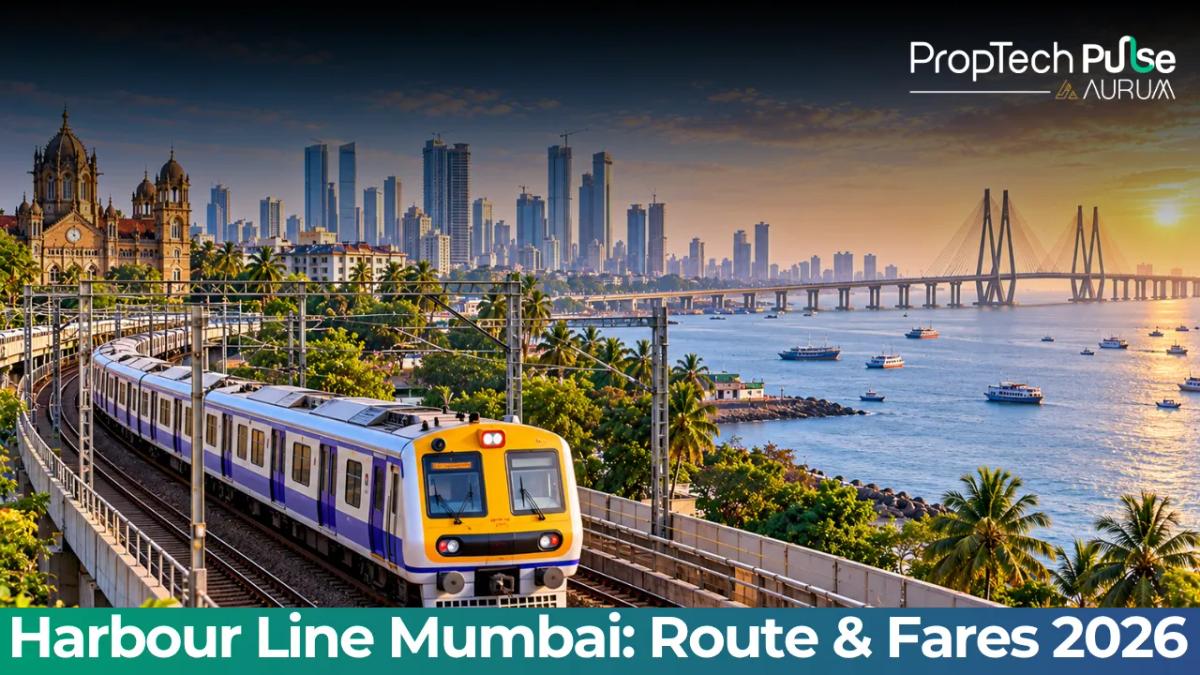
The harbour line mumbai acts as the city's eastern rail lifeline. It connects Navi Mumbai, the eastern suburbs, and Salsette Island directly to South Mumbai's financial districts.
Spanning three termini, CSMT, Panvel, and Goregaon, the line covers roughly 73 kilometres and hosts 35 stations. Operating from four in the morning till just after midnight, it moves over a million daily passengers between residential zones and employment hubs like Lower Parel, BKC, and Nariman Point.
Harbour line route map and terminals
Quick answer
The harbour line mumbai spans 35 stations across three termini: CSMT, Panvel, and Goregaon. It splits at Wadala Road station, with one branch heading southeast to Navi Mumbai (Panvel) and the other curving northwest across Salsette Island to Goregaon. Trains run daily from roughly 4:00 AM to 1:00 AM.
Buying property near the tracks or optimising a daily commute requires looking past simple station lists. The real value lies in three specific factors: the track split at Wadala Road, transfer bottlenecks during rush hour, and ongoing infrastructure upgrades.
The line carries two distinct branches serving different micro-markets. Knowing how they connect to monorails and metro lines dictates the actual worth of a flat in these areas.
The railway uses a split model. Trains leave CSMT, travel north through South Mumbai, and cross the Mahim Causeway. They hit Wadala Road, where the route formally divides.
The southeastern leg heads toward Navi Mumbai and terminates at Panvel. The northwestern leg travels past Bandra and Versova, crossing the creek back to reach Goregaon.
Homebuyers eyeing Nerul property investment or Versova flats need to understand this physical layout.
Navi Mumbai branch stations attract intense demand for close proximity to CBD Belapur office parks. Homes along the Goregaon arm offer easier access to the western industrial belt and Film City.
Rental investors targeting steady tenant pools usually prefer this corridor.
Key harbour line stations and interchanges
The line integrates tightly with the broader Mumbai transport grid. Passengers switch freely between the harbour line stations and the Central, Western, and Trans-Harbour lines. Navi Mumbai’s nodal stations connect directly to the Navi Mumbai Metro and the city’s monorail corridor, creating multi-modal routes that slash travel times significantly compared to road traffic.
| Station Name | Code | Zone / Area | Interchange Connections |
|---|---|---|---|
| Chhatrapati Shivaji Maharaj Terminus (CSMT) | CSTM | Mumbai (South) | Central Line, Trans-Harbour Line, Major bus terminal |
| Mulund | MLND | Mumbai (East) | Eastern Express Highway, Local buses, NCDMC link |
| Chembur | CHMR | Mumbai (East) | Eastern Express Highway, IT parks, Local buses |
| Wadala Road | WDLR | Mumbai (East) | Central Line, Kurla-Maskhdar Road link |
| Mahim Junction | MMMJ | Mumbai (West) | Western Line, Bus depot |
| Bandra Terminus | BDTS | Mumbai (West) | Western Line, Long-distance trains |
| Versova | VSOP | Mumbai (West) | Juhu beach area, Local buses |
| Goregaon | GVNG | Mumbai (West) | Western Line, Monorail hub |
| Sanpada | SNPD | Navi Mumbai | Major commercial complex, Local buses |
| Vashi | VASH | Navi Mumbai | Monorail, Navi Mumbai Metro, CBD markets |
| Nerul | NERL | Navi Mumbai | Monorail, Navi Mumbai Metro, Airport shuttle |
| Turbhe | TUHB | Navi Mumbai | Industrial estate, IT sector |
| Khedapada | KHED | Navi Mumbai | Residential pockets, Local roads |
| Panvel | PNFL | Raigdist (Raigarh) | Mainline CST-Panvel route, Mumbai-Pune highway, Bus terminus |
Nodal stations handle immense daily foot traffic. Belapur Police Line locality and Mulund move thousands of commuters every day.
When evaluating a flat, map the actual walking distance to the nearest exit instead of relying on a generic station name. A stop listed five hundred metres away often means a congested market walk adding fifteen minutes to your morning routine.
Understanding the harbour line timetable and fares
The revised timetable active for the fourth corridor in 2026 tightened headways between Belapur, Nerul, and Kharkopar. During morning peaks (7:30 AM to 10:00 AM), trains run at frequent intervals to clear accumulated crowds. Evening return traffic sees a similar spike between 6:00 PM and 8:30 PM, with additional special services dispatched from CSMT to prevent overcrowding.
Fare structures follow the standard suburban zoning model. A standard adult one-way ticket from Panvel to CSMT costs a fixed base amount plus regional adjustments.
The distance ranges from 38 kilometres in the city limits to roughly 70 kilometres on the outer branch. Monthly passes remain the most cost-effective option for professionals.
Commuters relying on the Trans-Harbour interchange to reach Andheri or Borivali often purchase combined passes to cover both the harbour and western routes.
Ticket tip: Keep your tokens and smart cards close during peak transfers. Scanning or handing over tickets takes extra seconds when the platform queue backs up, particularly at Mulund and Wadala Road stations.
Upcoming infrastructure projects reshaping the route
Two major developments will alter property demand along the harbour line route over the next few years.
The first is the ongoing Goregaon to Borivali extension project announced in March 2024. Construction is actively underway and targets completion by 2028.
Once finished, trains will run directly from the harbour branch into the northern suburbs. This eliminates reliance on the already congested Western Line for thousands of daily riders and pushes up rental yield expectations for apartments near Goregaon East and Malad stations.
The second shift involves railway planning at the state level.
Central Railway has floated proposals for dedicated EMU services linking Navi Mumbai directly to Pune via the Kurla-Vashi-Panvel-Karjat loop.
This roughly 170-kilometre passenger corridor connects Maharashtra's financial hub to emerging residential belts in Raigad and Thane. Connectivity triggers rapid valuation shifts in border towns and draws attention to developers near the eastern fringe.
Investors tracking these macro moves often consult resources on top builders in Thane 2026 to identify upcoming launches ahead of full service rollout.
Commuter tips for the harbour line
Peak hour friction defines the real experience of riding the harbour line mumbai. Transfer points become bottlenecks when trains from the Central Line and Harbour Line attempt to cross paths simultaneously. Wadala Road handles heavy merging traffic; board your platform car early, and avoid lingering near the gates if you intend to hop between lines.
Panvel-bound commuters face different challenges.
Crowds surge toward the front compartments at Sanpada and Vashi during the morning drive. If securing space is a priority, board at intermediate stations like Turbhe or Kharghar where capacity clears significantly.
South Mumbai-bound passengers find better luck boarding at Mahim or Lower Parel. Initial segments carry fewer passengers than those hailing from Panvel or Nerul.
Before you commit to a location near the line
Your choice should hinge on functional transit integration rather than simple physical closeness.
A property sitting near an interchange station like Vashi, Mahim, or Mulund consistently holds stronger resale value and rental velocity than a unit positioned closer to the end of the track.
When mapping affordability, compare rates against established hubs using the property investment in mumbai 2026 data, and benchmark specific micro-markets with the rates and trends tool to validate entry points.
Frequently asked questions
How many stations are there on the harbour line?
There are currently 35 operational stations on the Mumbai Harbour Line. These stations serve the densely populated zones of Mumbai Suburban district and the city of Navi Mumbai, connecting major employment hubs like Lower Parel and BKC to residential areas across multiple districts. Regular rolling stock rotates through these stops every ten to twenty minutes depending on the segment and time of day.
What is the last train timing on the harbour line?
Trains on the harbour line generally run from approximately 4:00 AM to 1:00 AM daily. The exact departure and arrival times vary depending on the origin terminus—whether it is CSMT, Panvel, or Goregaon—and the specific direction of travel. Passengers should check the latest Central Railway roster before undertaking late-night journeys to ensure accurate return schedules.
Where does the harbour line split from the central line?
The harbour line diverges from the main central line at Wadala Road station. Passengers arriving on the central line switch platforms here to board trains heading towards Navi Mumbai on the Panvel branch or Salsette Island on the Goregaon branch. This physical split defines the connection to the wider suburban network.
Is there an ac local train on the harbour line?
Currently, there are no air-conditioned local trains operating on the harbour line. All services are provided by standard non-AC EMU (Electric Multiple Unit) coaches. However, railway authorities frequently review demand patterns for premium suburban services, and future proposals may include AC rakes on high-density corridors once surrounding infrastructure upgrades are fully completed and validated.
Sources
- Maharashtra Government Infrastructure Development Department: Highway and railway expansion project notifications (accessed October 2026)
Enjoyed this blog article? Visit PropTech Pulse for more interesting blogs.





Ask Pulse Ai anything about real estate

Unlock the Latest in Real Estate
News, Infographics, Blogs & More! Delivered to your inbox.

