New Launch - India Real Estate Report 2026.

Services
Knowledge Hub
Resources
Tools

Ask Pulse Ai
©PropTech Pulse 2025, All rights reserved.


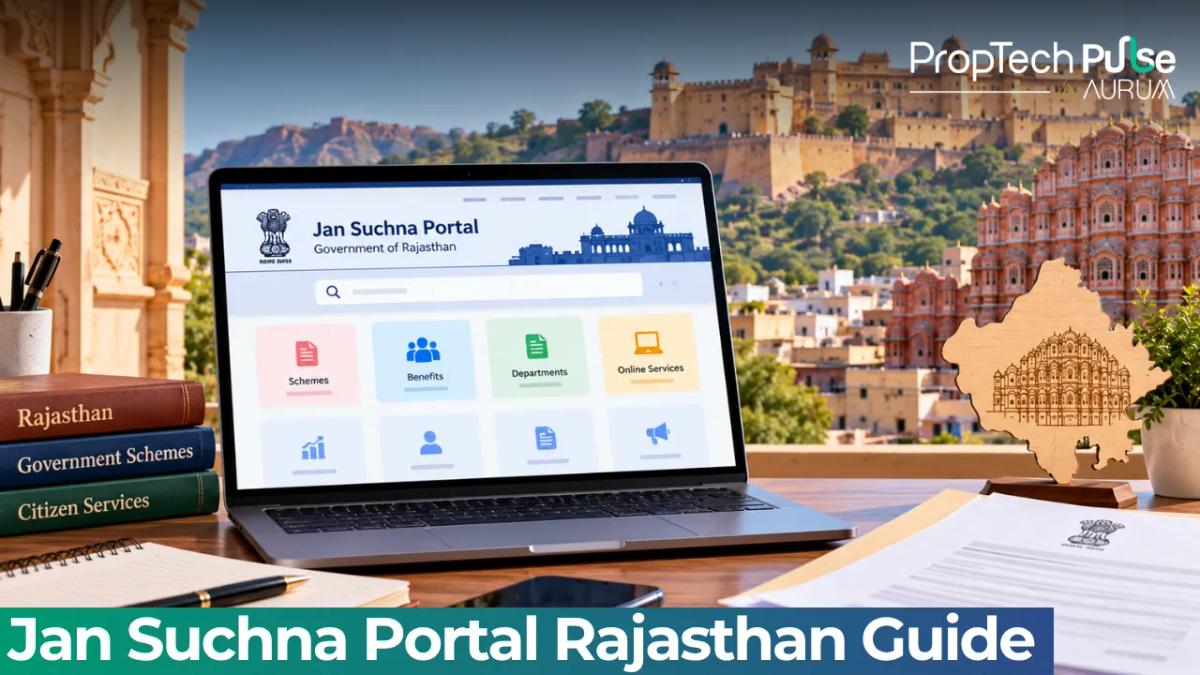
If you are looking for the jan suchna portal rajasthan, here is the direct answer: you do not need a jan soochna portal login to browse the platform.
Registered citizens can verify their eligibility for state welfare schemes, track subsidy disbursements, check scholarship statuses, and confirm pension payments entirely for free at jansoochna.rajasthan.gov.in. The interface works on basic smartphones. You simply enter your district code and scan a few dropdown menus to see what applies to you.
The portal replaced the old habit of filing Right to Information applications for basic public entitlements.
Instead of waiting days for a formal reply from a bureaucratic office, the Rajasthan government now publishes scheme data proactively. This shift saves time, but it also puts responsibility on you to actively search the directory. Data only moves to your screen when you request it.
What is the Jan Suchna Portal Rajasthan?
Quick answer
You can access all public government scheme lists on the jan soochna portal without logging in. The official website is jansoochna.rajasthan.gov.in. Simply select your district, choose a department, and view eligible schemes or check payment status directly on the dashboard.
This rajasthan jan soochna portal acts as a single window for state transparency. It fundamentally shifted operations from reactive requests to proactive publishing.
Residents no longer file formal RTI applications to find basic entitlements. Instead, the government publishes beneficiary criteria and payout schedules directly online. The backend pulls records from over 115 separate ministries. You get access to more than 330 active programs in one unified directory.
Navigating these schemes often feels like reading a hidden ledger. A student misses a scholarship window simply because the notice never reached their inbox. A farmer skips crop assistance while waiting for a radio bulletin.
The rajasthan jan soochna portal removes that guesswork entirely. Anyone can browse eligibility rules for free. No account creation stops you from seeing the baseline list. Families run this directory monthly to verify stipend payments.
How to Use the Jan Soochna Portal Services (Step-by-Step)
Using the interface requires no technical background. Because the goal is mass inclusion, the design prioritizes simple selection boxes over complex search filters. Here is exactly how to find the data you need.
Browsing Government Schemes by Department
The most common action on jan soochna services is simply scanning the list of available programs. Follow these steps:
- Select your location: On the homepage, click the dropdown for District and Panchayat/Village. This filters the schemes to show those applicable to your local jurisdiction.
- Pick a department: Browse the menu by sector, such as Agriculture, Social Justice, Health, or Urban Development. Clicking a department expands its specific portfolio.
- Review the criteria: Each scheme card displays the eligibility rules laid out by the administering ministry. Compare these against your personal profile.
Land-based welfare programs make up the largest share of the state budget. Cross-referencing your exact holding size against subsidy thresholds prevents silent rejections. Run your measurements through our unit converter for Rajasthan local measurements to match field records with official forms. Revenue offices track plots in bigha or kanal, whereas the scheme database uses hectares. Plugging raw numbers into the wrong slot triggers an instant system denial. Always stick to standard metrics when you input details into the state public schemes directory.
Verifying Eligibility and Beneficiary Status
Once you have identified a scheme, checking whether you or a family member is listed on the approved rolls requires an identification number. While you do not create a username for the portal, you do need either an Application ID or a unique biometric identifier.
- Go to the "Check Payment Status" or "Beneficiary List" tab near the top navigation bar.
- Enter the Application ID generated when you originally applied at the municipal office or through a Common Service Centre (CSC).
- Alternatively, input your Jan Aadhaar number if the specific department requires it for biometric matching.
- The system returns a simple green or red indicator showing active approval or pending review.
Green means the money has cleared the treasury stage. Red usually points to a mismatched bank account or a missing income certificate. Do not panic at a red flag immediately. Visit the originating department with your physical documents before assuming you are disqualified.
Important note on payments Checking the portal confirms eligibility, but it does not process funds. Disbursements happen strictly through Direct Benefit Transfer to the bank account linked to your original application. Keep your cancelled cheque handy when updating banking details offline.
New 2026 Features: Jan Aadhaar 2.0, AI Voice Search & WhatsApp
The platform moved beyond a static directory of PDFs last year. The 2026 technology upgrades specifically target digital barriers in semi-urban and rural districts where smartphone usage is high, but English typing and formal bureaucratic language remain hurdles.
AI Voice Search Integration
Typing long scheme titles frustrates many rural users. The upgraded jansoochna portal interface solves this with direct voice input. You speak your query in your local dialect, and the speech engine sorts it automatically. Search results stop flooding you with generic tags. Asking about village pensions orally delivers precise program links instantly. This adjustment bridges the gap between digital literacy and actual utility.
WhatsApp Chatbot Utilities
Rather than opening a browser app, citizens can now text specific commands to an official bot to trigger queries. By sending their application ID to the designated WhatsApp handle, the bot parses the backend database and replies with the current status of their claim. It also pushes proactive alerts, notifying a user when a previously rejected scholarship has been approved by the reviewing committee. Rural residents without constant data packs rely on these low-cost SMS equivalents to stay updated.
Jan Aadhaar 2.0 Interoperability
Fragmented login credentials used to clutter desktops across Rajasthan. The recent Aadhaar 2.0 update collapses those separate silos. Your village address, income tier, and occupation require verification only once at the Tehsil office. Accessing rajasthan jan suchna afterward lets the system pull those verified metrics automatically. You skip repetitive form filling entirely. Health cards, ration records, and education files sync invisibly behind the scenes.
If you are exploring housing assistance, understanding the broader framework is essential. For comprehensive details on national frameworks integrated here, refer to our breakdown of affordable housing schemes under PMAY.
Key Categories Covered on Rajasthan Jan Suchna Portal
To make the vast catalog manageable, the department-wise breakdown maps every citizen's needs to a specialized team. Below is a snapshot of the primary sectors driving traffic to the platform.
| Government Department | Scheme Category Focus | Who Qualifies? |
|---|---|---|
| Agriculture & Farmers Welfare | Crop insurance, direct cash transfers, irrigation subsidies | Farmers owning cultivable land below specified hectares |
| Social Justice & Community Welfare | Old age pensions, widow stipends, disability grants | Vulnerable groups meeting annual income caps |
| Revenue & Land Record | Land allotments, bhag distribution, mutation updates | Legitimate owners and scheduled caste beneficiaries |
| Health & Family Welfare | Maternity benefits, critical illness coverage, vaccination drives | All permanent residents with valid health cards |
| Education & Skill Development | Merit scholarships, hostel allowances, vocational training grants | Students enrolled in recognized boards with passing marks |
When utilizing these revenue services, developers and homeowners often verify if local infrastructure projects comply with state standards. It makes sense to simultaneously check a report on leading builders in Rajasthan in 2026 to understand how private sector compliance mirrors public transparency mandates.
Correcting Mismatches Before Checking Status
The digital directory only reflects what enters the civic database. Field staff often collect paper forms manually, and clerical errors slip into the master ledger constantly. A single digit wrong in a bank account number, or a panchayat code updated after amalgamation, breaks the entire verification chain. You cannot fix these gaps from your living room.
Head to your nearest E-Mitra centre or Common Service Kiosk with originals. Ask the operator to run a database reconciliation for the specific failing scheme. They upload your Jan Aadhaar number and push a correction flag to the block-level data team. The backend sync usually clears up within five business days. Never leave the kiosk without the printed receipt. That slip holds your updated reference number.
Before You Check Your Status Online
Data accuracy on the front end depends entirely on administrative hygiene on the back end. If your name appears misspelled, your village code is outdated, or your bank IFSC is incorrect, the portal will return "No record found," regardless of your actual eligibility.
Refreshing the screen endlessly wastes valuable minutes. Start by verifying that your phone number stays active inside your biometric profile. Next, visit the local service centre if your income declaration or land boundaries require updating. Update those fields physically first. Then revisit the portal forty-eight hours later to catch the new numbers. Civic databases lag slightly behind field corrections, but patience pays off.
Frequently asked questions
Do I need to register or login to use the Jan Soochna Portal?
No. Unlike banking or taxation platforms, the Jan Soochna Portal operates completely open. You do not need to create a username, verify an email address, or maintain a subscription to browse the full list of 330+ schemes. Registration is only necessary if you are acting as a field officer submitting data, not if you are a resident verifying your own entitlements.
Which government departments are covered on the Jan Soochna Portal?
The platform aggregates data from over 115 state departments. The highest volume comes from Agriculture and Farmers Welfare for crop subsidies. The Revenue Department handles land records and allocation grants. Social Justice and Community Welfare manages pension payouts. The Health Department oversees Ayushman Bharat benefits. Every active state initiative gets published to the public directory.
How can I check my Jan Aadhaar eligibility details online?
Navigate to the 'Search Beneficiary' or 'Payment Status' widget located prominently on the portal homepage. Input your 12-digit Jan Aadhaar number along with your assigned district and panchayat code. The system runs a backend lookup against the State Remote Monitoring System and displays your approved scheme categories in real-time without requiring any password.
What are the latest updates on Rajasthan Jan Suchna portal?
The 2026 rollout introduced significant accessibility features. The portal now supports AI-driven voice search, allowing users to dictate queries in local dialects instead of typing them. A dedicated WhatsApp chatbot has also gone live for push notifications on payment approvals. The migration from legacy SSID cards relies on the unified Jan Aadhaar 2.0, ensuring smoother data syncing across ministries.
Can I use Jan Soochna Portal services if I am illiterate?
Yes, the platform removed literacy as a barrier through multiple interfaces. Residents can utilize the new AI voice search button to verbally ask about pension or scholarship criteria. Alternatively, citizens can send a text message to the official WhatsApp bot to receive plain-language replies regarding their application status, completely bypassing the need to read or type complex forms.
Sources
- Jan Suchna Portal Rajasthan: Official directory of government schemes, department listings, and live status trackers (accessed October 2026)
- Pradhan Mantri Kisan Samman Nidhi (PM-KISAN): Official status check tool for central agriculture benefits accessible via state portals (accessed October 2026)
Enjoyed this blog article? Visit PropTech Pulse for more interesting blogs.





Ask Pulse Ai anything about real estate

Unlock the Latest in Real Estate
News, Infographics, Blogs & More! Delivered to your inbox.

