New Launch - India Real Estate Report 2026.

Services
Knowledge Hub
Resources
Tools

Ask Pulse Ai
©PropTech Pulse 2025, All rights reserved.


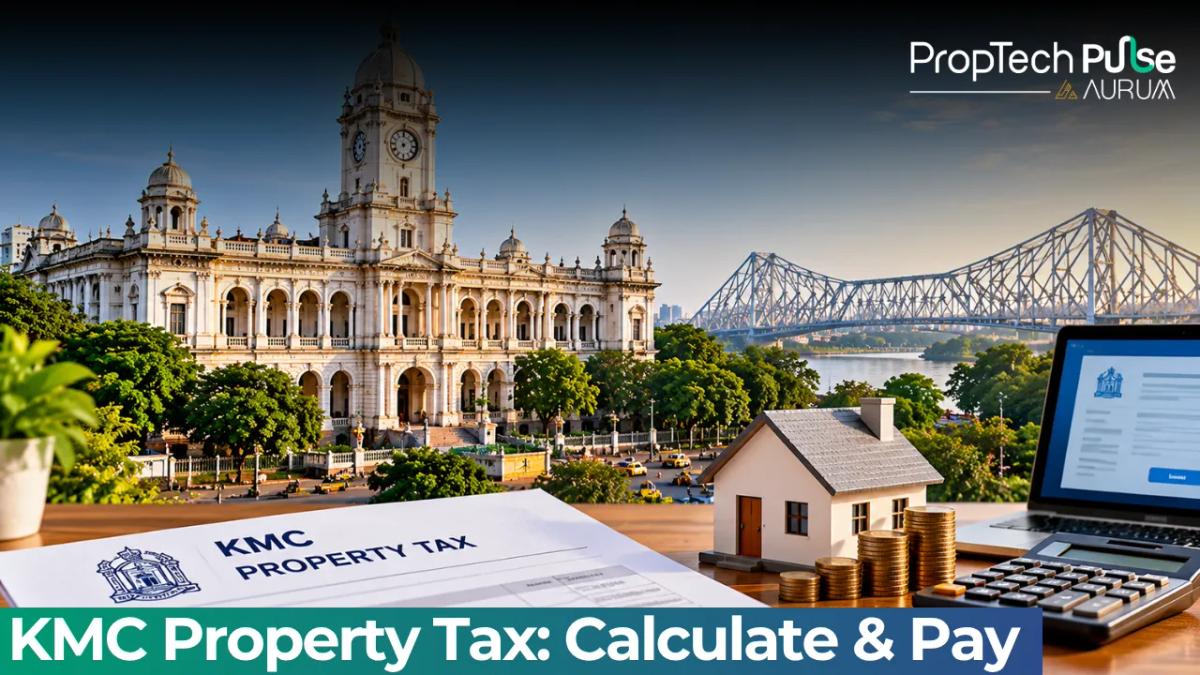
Finding your KMC assessee number usually triggers the biggest headache.
Without that unique identifier, the official portal returns nothing but a blank screen. Most residents get stuck at this gate before even attempting the tax formula or online payment.
Once you secure the number, the rest follows a predictable sequence. Recent waivers and interim hikes complicate the final calculation slightly.
What Is the KMC Property Tax Calculation Formula?
Quick answer
To calculate your KMC property tax, multiply the Base Unit Area Value by your carpet area, then apply location, usage, age, structure, and occupancy multipliers. Add any applicable Howrah Bridge tax, apply the current annual rate, factor in late fees or waivers, and subtract eligible rebates.
Kolkata relies entirely on the Unit Area Assessment framework. All properties across its 293 assessment blocks fall under this system.
Old tax demands do not reflect your actual liability today. The municipality recalculates periodically using updated land values.
The core calculation uses a single base value multiplied by five distinct factors.
Before running the math, you must pin down your exact property category first.
Then factor in the specific rates applied to your building’s age and structural composition.
Understanding Base Unit Area Value and Categories A to G
The foundation of the formula is the Base Unit Area Value. KMC divides the city into seven categories based on locational value, ranging from prime commercial zones to quieter outskirts.
| Category | Location Type |
|---|---|
| Category A | Prime commercial markets and central business districts |
| Category B | Major arterial roads and high-value residential pockets |
| Category C | Established urban areas with moderate footfall |
| Category D | Standard residential neighborhoods |
| Category E | Developing suburban zones with basic amenities |
| Category F | Outer suburbs and semi-urban fringes |
| Category G | Rural wards and peripheral townships outside strict city limits |
Owning a flat in Sector V automatically places you in Category A.
That identical footprint near Barasat drops you straight into Category F.
The BUAV serves as the raw baseline before location forces the multiplier to shift.
KMC assessors measure your carpet area rigorously. Balconies and verandahs often get excluded from the taxable square footage. Always verify which spaces the assessor actually counted.
The Multiplicative Factors Explained
- Location and Usage Multiplier: Commercial units always carry a higher weightage than residential ones, even if they share the exact same physical footprint.
- Age of Building: Older buildings see depreciation applied over time, reducing the taxable base. Conversely, newly constructed properties attract a full-age multiplier initially, often leading to higher initial demands.
- Structure Type: Reinforced Cement Concrete structures command a premium over brick-and-mortar or makeshift constructions due to better valuation assessments.
- Occupancy Factor: Properties rented out generate higher assessed values compared to owner-occupied homes.
- Ward Adjustments: Certain ward numbers have micro-level adjustments based on local infrastructure access.
Residential units always carry a lighter weightage than commercial buildings.
Older structures receive steady depreciation. New constructions attract full-age multipliers initially.
Reinforced cement concrete commands a premium over brick-and-mortar builds.
Rented properties generate higher assessed values than owner-occupied homes.
Micro-adjustments exist for specific ward numbers based on road quality and water access.
Multiplying these factors against the BUAV creates an Annual Rental Value.
The municipality converts that rental figure into a fixed tax rate.
Late fees attach instantly once the due date passes without action.
You can track standard municipal penalties to see exactly how interest compounds on unpaid bills.
Adding the Howrah Bridge Tax
This levy applies to a strict subset of central KMC wards.
Properties inside designated toll revenue zones face an extra mandatory charge.
Your title deed shows clearly if your ward triggers this surcharge.
Calculating the exact amount requires checking your latest demand letter.
The tax calculates progressively based on your annual rental value brackets. Higher rentals attract steeper toll contributions toward bridge maintenance.
How to Find Your KMC Assessee Number Online
Most residents get blocked immediately while searching the official site.
You simply lack the thirteen-digit Assessee Number required for account access.
This unique string links directly to your permanent digital ledger.
Lost your physical demand notice? Follow the lookup steps below.
Step-by-Step Portal Search Using Ward, Street and Premise No.
Launch the KMC citizen portal and open the property tax tab.
The interface requests three specific inputs right away.
Enter your ward number, which sits neatly on old receipts.
Type the street name exactly as locals pronounce it. Avoid shortcuts.
Input the premise number and press the search button.
The results page pops up your Assessee Number alongside outstanding dues.
Store this code securely. You will need it for every future login.
Sometimes the portal returns a generic error. This usually happens when premises were reconstructed or merged under newer numbering schemes. Visit your local ward office if the search fails repeatedly.
Current KMC Property Tax Rules: Waivers, Hikes and Rebates
Your visible bill amount hinges on two recent policy shifts.
Calculating liability for the 2025-26 financial year requires fresh percentages.
Ignore the discount templates circulating on social media. Official circulars dictate your exact payout.
August 2024 Waiver Policy for Late Payments
The administration introduced graded penalty relief in August 2024.
Defaulters delayed less than two years enjoy a ninety-nine percent penalty waiver.
Interest gets cut by half for those same early defaulters.
Properties overdue between two and five years receive a seventy-five percent penalty waiver.
You must manually accept these waivers inside the dashboard before paying.
Verify your waiver status in the account section first.
Unclaimed relief expires quickly. Delaying acceptance wastes your chance to reduce the total.
The 10% Interim Hike Starting April 2025
Standard five-yearly revisions pushed a ten percent hike across all categories.
This increase targets the Base Unit Area Value directly.
Your 2025 demand already includes this revision.
Municipal revenues finally align closer to current land rates.
Early payment incentives often vanish under the new hike.
Check the latest notices for explicit exceptions targeting vacant plots.
Concessions for Senior Citizens and Physically Challenged Owners
KMC retains dedicated provisions for vulnerable demographics.
Registered senior citizens qualify for substantial rebate allowances.
Physically challenged owners must upload disability certificates to claim reductions.
Uploading valid identity proof precedes final slip generation.
Senior citizen discounts in other municipalities show how regional bodies handle similar concessions.
Submit digital scans in PDF or JPG format to avoid rejection. Blurry uploads delay your approved rebate indefinitely.
How to Pay KMC Property Tax Online Safely
Securing the Assessee Number makes the final transfer straightforward.
Avoid third-party aggregators for municipal payments.
The official government channel remains completely fee-free.
Aggregators sometimes hide processing fees inside unclear terms.
Using the KMC Portal and Payment Options
Paste your Assessee Number into the dashboard to pull up your account.
Toggle to the correct assessment year immediately.
Legacy figures disappear once you select FY 2025-26.
Review the complete breakdown before transferring funds.
Settlement works through net banking, UPI, or credit cards.
Download the e-challan the instant clearance confirms.
Municipal servers occasionally lag during peak hours.
Your digital receipt remains your strongest protection against future disputes.
If the portal stalls mid-payment, wait thirty seconds before refreshing. Sudden double-clicks create duplicate pending transactions.
Closing decision rule
Double-check your property category before transferring funds.
Misreading it pushes the tax amount artificially high.
Paying a decade-old demand locks you into legacy penalties permanently.
Confirm the 2025 uplift appears on screen.
Accept the August waiver automatically if visible.
Use the official portal to sidestep service charges.
Frequently asked questions
How do I find my KMC property tax assesse number?
Log into the KMC citizen portal and navigate to the property tax enquiry tab. You must enter three specific details: your exact ward number, the precise street name without abbreviation, and your premises number. The ward number sits on old receipts. Once submitted, the system returns your registered thirteen-digit Assessee Number. Save this instantly, as the portal needs it for every subsequent action, including viewing dues and initiating payments.
What is the formula for calculating Kolkata municipal property tax?
The system uses the Unit Area Assessment model rather than older valuation methods. You start with the Base Unit Area Value tied to your location category. You multiply this base by five factors: the property's usage type, structural composition, age-based depreciation or appreciation, occupancy status, and the specific ward environment. This generates a standard rental equivalent. The municipal authority converts that figure into an annual tax rate, which forms the final payable amount before any extra surcharges are added.
Is there any concession or waiver on KMC property tax now?
The August 2024 policy introduced graded relief for past defaulters. Properties delayed for under two years enjoyed a ninety-nine percent penalty waiver and half-price interest. Those overdue between two and five years secured a seventy-five percent penalty cut and forty-five percent interest relief. Pay attention to the 2025 fiscal year now. A ten percent interim hike has already raised the base calculations. This leaves little room for traditional early payment discounts.
How do I pay Kolkata property tax online?
Access the official KMC taxpayer dashboard and paste your unique Assessee Number to pull up the account. Select the correct assessment year, ensuring you are looking at the revised 2025-26 rates rather than legacy figures. Verify the total sum displayed after auto-applying available waivers. Generate the transaction request and settle via direct net banking, UPI, credit card, or debit card. Immediately download the e-challan from the success screen to keep a permanent digital record of your clearance.
Sources
- Department of Municipal Affairs, Government of West Bengal: Municipal tax circulars and waiver notifications (accessed October 2026)
- Income Tax Department: Section 24(b) deductions on municipal taxes claimed in income filings (accessed October 2026)
Enjoyed this blog article? Visit PropTech Pulse for more interesting blogs.




Ask Pulse Ai anything about real estate

Unlock the Latest in Real Estate
News, Infographics, Blogs & More! Delivered to your inbox.

