New Launch - India Real Estate Report 2026.

Services
Knowledge Hub
Resources
Tools

Ask Pulse Ai
©PropTech Pulse 2025, All rights reserved.


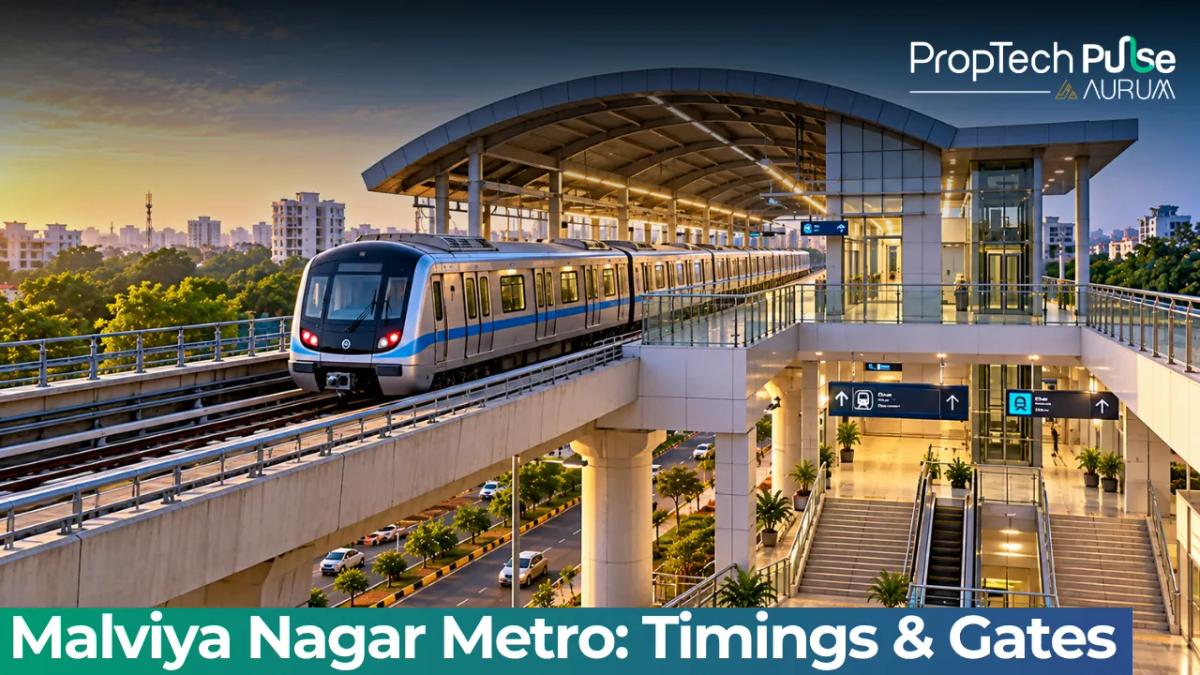
Mastering the exit layout at Malviya Nagar Metro Station cuts fifteen minutes off your rush-hour walk. Situated on Aurobindo Marg, the underground stop anchors everything from corporate runs to weekend shopping.
Gate 3 drops you onto Select Citywalk and Max Hospital floors, while Gate 1 threads straight into the quieter Geetanjali Enclave pockets. Picking the wrong door means fighting traffic at every crossing.
Malviya Nagar Metro Station on the Yellow Line
Quick answer
Malviya Nagar is an underground station on the Delhi Metro Yellow Line, located on Aurobindo Marg. Platform 1 serves trains heading towards Qutub Sarak and Millennium City Centre Gurugram, while Platform 2 serves trains towards Vishwavidyalaya and Samaypur Badli. The station has four surface exits, though Gate 2 remains permanently closed to the public.
Opened on 3 September 2010, the station sits geographically between Mandir Marg and Saket stations. The subterranean design places both platforms well below ground level, meaning commuters rely entirely on escalators or elevators to reach the concourse regardless of which entrance they choose.
Because Aurobindo Marg handles heavy commercial traffic, the layout efficiently separates pedestrian footfall from vehicular bottlenecks during evening rush hours.
Evaluating properties near the Malviya Nagar Metro Station requires understanding how Transit Oriented Development (TOD) policies have shaped the area.
The station precinct falls within the government's designated high-density zone, encouraging vertical construction rather than horizontal sprawl. If you are evaluating the area for investment or a family home, proximity to this hub directly influences rental demand and capital appreciation trajectories. You can check current Malviya Nagar property rates to see how flat prices shift across different pockets depending on their walking distance to the station.
Route Times and Direct Train Links
The Yellow Line cuts through central Delhi, making this station a direct route to the city's major employment hubs. You do not need to change trains for any of the following stops:
- Rajiv Chowk: roughly 35 minutes towards Vishwavidyalaya/Samaypur Badli.
- Kashmere Gate: roughly 40 minutes (interchange point for Blue, Red, and Violet lines).
- Sarojini Nagar: roughly 25 minutes towards Vishwavidyalaya/Samaypur Badli.
- Metro Shivaji Stadium: roughly 30 minutes.
- Maharani Bagh: roughly 15 minutes towards Qutub Sarak/Gurugram.
- MG Road: roughly 18 minutes towards Qutub Sarak/Gurugram.
- Middle Floor: roughly 20 minutes towards Qutub Sarak/Gurugram.
- Khilauri Kalan: roughly 30 minutes towards Qutub Sarak/Gurugram.
For investors tracking rental yields, homes within a 10-minute walk of the station typically command higher rents.
Young professionals working in Central Delhi or the Dhaula Kuan tech corridors prefer these addresses because reliable transit links reduce commute friction significantly. Shorter travel windows translate directly into higher willingness to pay monthly premiums.
Daily Train Timetables
DMRC publishes fixed timetables that run through the day, though first and last train arrival times fluctuate seasonally based on summer and winter daylight hours. On average, the daily service window looks like this:
- First Train (Towards Samaypur Badli/Vishwavidyalaya): Arrives shortly after 05:30 AM.
- Last Train (Towards Samaypur Badli/Vishwavidyalaya): Departs around 23:44 PM.
- First Train (Towards Gurugram/Qutub Sarak): Arrives around 06:40 AM.
- Last Train (Towards Gurugram/Qutub Sarak): Departs around 23:40 PM.
Frequency during peak morning hours between 08:00 and 10:00 AM drops to roughly two to three minutes between trains.
This reduced headway prevents platform overcrowding and keeps queue times manageable compared to off-peak slots. Evening services backfill gradually after 18:00 PM as shoppers and hospital staff depart together.
Which Exit Gate Serves Your Destination?
Most commuter guides list the gates in order from east to west, but picking the wrong exit can add a 15-minute detour around traffic or through heavy pedestrian crossings. Here is exactly where each gate takes you on the ground.
| Gate | Direction from Station | Nearest Landmarks & Destinations |
|---|---|---|
| Gate 1 | East Side | Geetanjali Enclave, Shivalik Enclave, MVNR Police Station, Aurbindo College |
| Gate 2 | Central-East | Permanently Closed (Do not attempt to enter here) |
| Gate 3 | Central-West | Select Citywalk Mall, Max Super Speciality Hospital, Saket Court, DLF Avenue |
| Gate 4 | West Side | PVR Anupam Saket, Press Enclave Road, Saket District Centre approaches |
Closure of Gate 2 causes genuine confusion for newcomers who rely on older maps. Gate 2 previously opened straight into the road network linking Geetanjali and Select Citywalk.
DMRC sealed the entrance to clear congestion near the main stairs. If your destination falls between Gate 1 and Gate 3, always use one of the flanking gates instead of circling around the fenced-off area.
Families relocating to Malviya Nagar often prefer living close to Gate 1. These older colonies provide quicker access to established schools and community centres, whereas Gate 3 caters entirely to the commercial entertainment belt. Always review Delhi stamp duty and registration charges before booking, as transaction costs apply uniformly regardless of the locality you target.
Parking Capacity and Step-Free Access
Commuting by private vehicle means utilising the designated parking lot situated directly outside Gate 3. DMRC allocates space for approximately 27 cars and 282 two-wheelers.
During weekday evenings, when shoppers return from Select Citywalk and Max Hospital visitors conclude their appointments, the car spaces fill up quickly. Early parking becomes a necessity rather than an option.
Accessibility standards across the station are fully compliant. Lifts connect the street-level concourse down to both platforms, covering every requirement for Divyangjan passengers and senior citizens carrying luggage.
Tactile paths also run along the platform edges to assist visually impaired commuters navigating towards the boarding zones. Security personnel routinely monitor lift functionality during midnight maintenance windows to prevent weekday breakdowns.
Landmarks and Transit-Oriented Impact
The station acts as the primary pivot for the entire southern pocket. On the east side, the grid-like layout of Geetanjali and Shivalik Enclaves offers quiet tree-lined streets dominated by independent bungalows and low-rise apartment blocks.
This demographic skews older, with a steady pool of long-term tenants generating reliable rental income for investors. Properties here trade at slight discounts compared to newer constructions but deliver consistent occupancy.
On the west side, the environment shifts sharply into high-density commercial use. Select Citywalk anchors the retail landscape, while Max Hospital draws medical tourism and patient accommodation traffic year-round.
This constant flow sustains strong occupancy rates for serviced apartments and premium builder floors marketed to short-stay visitors or corporate transferees. Rental premiums typically hover between 12% and 15% above baseline market averages.
Press Enclave Road, accessed via Gate 4, connects directly to National Highway 44 (old NH 2).
This makes it a logical drop-off point for domestic travellers moving south towards Jaipur and Rajasthan, adding another layer of short-term letting potential for properties bordering the main carriageway. Night-shift workers at the hospital also drive demand for 24-hour security complexes nearby.
When assessing any property listing in this corridor, confirm the project's compliance with Delhi RERA project registrations. Older societies built decades ago often lack mandatory developer approvals, while newer gated communities are fully registered and legally secure. Verifying the allotment letter prevents future disputes during resale.
Before You Book Property Near the Station
Stick to buildings constructed after 2005 if you want modern lift installations and dedicated covered parking. Pre-2000 societies are charming but frequently suffer from narrow internal roads that choke during monsoon rains. Use our home loan eligibility calculator early in your search to anchor your budget, then filter listings based strictly on the gate-to-work travel times listed above.
Frequently asked questions
What are the four gates at Malviya Nagar metro station?
Gate 1 points towards Geetanjali and Shivalik Enclave on the east side. Gate 2 is permanently sealed off to public entry due to pedestrian safety protocols. Gate 3 leads directly to the Select Citywalk Mall complex and Max Hospital campus. Gate 4 provides straightforward access to PVR Anupam Saket and Press Enclave Road.
Which gate should I use to reach Select Citywalk mall or Max Hospital?
Always exit through Gate 3. It places you at the entrance of the commercial cluster immediately, giving you direct walking access to Select Citywalk Mall and the Max Super Speciality Hospital concourse. Using Gate 1 forces a lengthy crossing of the busy Aurobindo Marg road, increasing delay and safety risks.
Is there parking available at Malviya Nagar metro station?
Yes, the car park is situated adjacent to Gate 3. It accommodates roughly 27 private vehicles and 282 two-wheelers. Since the parking lot shares access with shoppers returning from the mall and patients leaving the hospital, vehicle slots frequently fill up during weekday evening rush hours between 6:00 PM and 8:00 PM.
How long does it take to reach Rajiv Chowk from Malviya Nagar metro station?
Travelling northbound on the Yellow Line towards Vishwavidyalaya, the journey to Rajiv Chowk takes approximately 35 minutes. Trains run frequently during business hours, usually every two to three minutes. You do not need to switch trains unless you plan to continue beyond Rajiv Chowk.
Is Malviya Nagar metro station accessible for people with disabilities?
Step-free travel standards apply here completely. Vertical lifts connect the street-level ticketing concourse down to both underground platforms, ensuring wheelchair users and passengers with limited mobility can board safely. Tactile warning tracks also guide visually impaired commuters along safe boarding routes.
When was Malviya Nagar metro station opened?
Operations began on September 3, 2010. It was inaugurated alongside several other stations on the eastern stretch of the Yellow Line, cementing the corridor as the primary transit artery for residents travelling between South Delhi and the northern industrial hubs.
Sources
- Delhi Metro Rail Corporation Official Portal: Station layout, platform assignment, and general connectivity data (accessed October 2026)
Enjoyed this blog article? Visit PropTech Pulse for more interesting blogs.





Ask Pulse Ai anything about real estate

Unlock the Latest in Real Estate
News, Infographics, Blogs & More! Delivered to your inbox.

