New Launch - India Real Estate Report 2026.

Services
Knowledge Hub
Resources
Tools

Ask Pulse Ai
©PropTech Pulse 2025, All rights reserved.


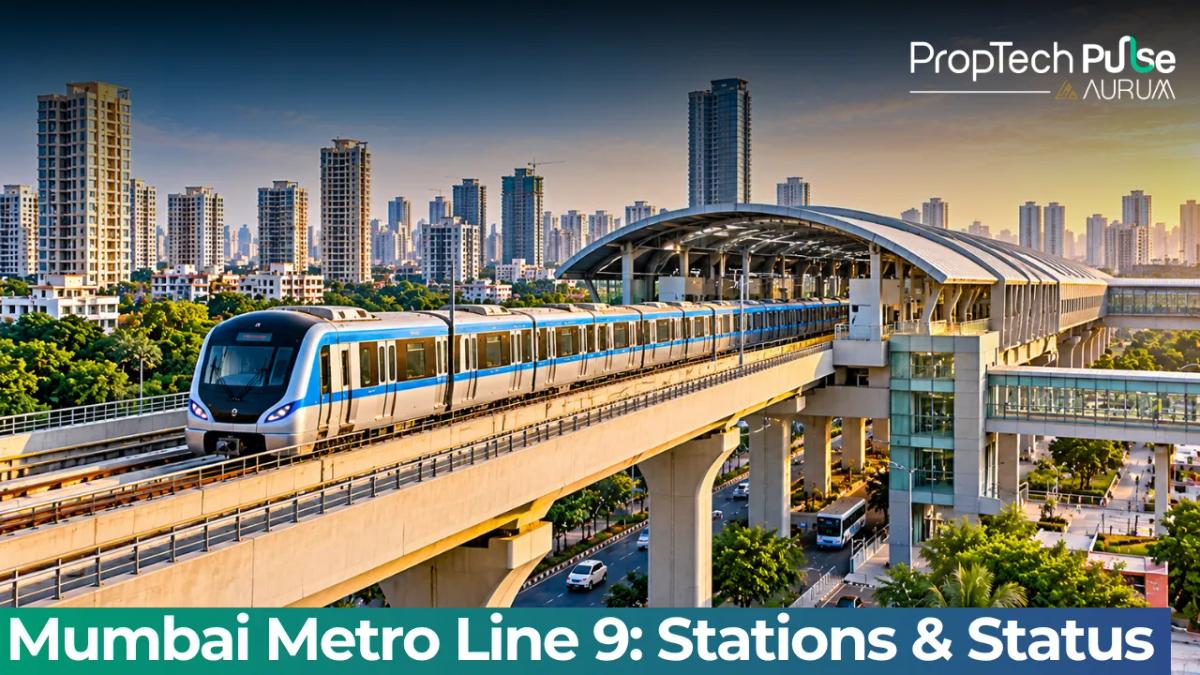
Residents of Dahisar, Mira Road and Bhayandar finally have a consistent daily commute option thanks to Mumbai Metro Line 9. The corridor opened on April 8, 2026, cutting hours of unpredictable road traffic into a fixed twenty-five minute transit window. The initial five-point-six-kilometre stretch connects four key nodes along the Western Express Highway corridor, linking directly to the wider city network at Dahisar East.
What Is Mumbai Metro Line 9?
Quick answer
Mumbai Metro Line 9 launched operations on April 8, 2026. The fully above-ground five-point-six-kilometre corridor connects Dahisar East to Kashigaon. Passengers can transfer to Line 7 at Dahisar East for a continuous journey to Andheri and south Mumbai. Operating hours run from 5:50 AM to 11:00 PM, with trains arriving every six to ten minutes depending on the time slot.
The project, executed by the Maharashtra Metro Rail Corporation, marks a major shift in how suburban residents move through the upper Western suburbs.
Before this corridor opened, anyone heading south from Mira Road relied entirely on the Western Express Highway, which routinely grinds to a halt during morning and evening rush hours. The new raised alignment bypasses surface bottlenecks completely, offering a weather-proof alternative for thousands of daily workers.
Mumbai Metro 9 Stations and Route Map
The initial operational segment carries exactly four stations along the eastern portion of the corridor.
You will find the westernmost terminal at Kashigaon, serving dense residential pockets and acting as a feeder node for travelers coming from Mira Road. Moving eastward, the line stops at Miragaon and Pandurangwadi before reaching the key interchange point at Dahisar East.
Direct transfers to Mumbai Metro Line 7 happen right inside the Dahisar East station complex. Once you cross the platform boundary and step onto Line 7, you can ride all the way to Gundavali and the Andheri interchange hub without changing trains again.
This physical connection eliminates the hassle of exiting the metro system and re-entering a different ticketing zone.
Mumbai Metro 9 Timings and Frequency
Service begins at 5:50 AM, giving early-shift employees enough buffer to reach corporate parks in Andheri or Powai before standard office hours. Trains operate continuously until 11:00 PM. During peak morning and evening windows, headways tighten to roughly six minutes. Midday and late-evening slots run slightly longer intervals between eight and ten minutes.
Commuter tip: Weekday afternoon slots rarely exceed four minutes of wait time. If your workplace allows flexible timing, shifting your departure to between 2 PM and 4 PM guarantees the shortest possible platform dwell periods.
Operators schedule around two hundred and seventy-six dedicated services on standard weekdays. The rolling stock consists of compact four-car rakes designed specifically for high-capacity short-distance hauling rather than long-haul travel.
Metro 9 Status: Phase 2 Progress
Phase 2 represents the western push from Kashigaon deeper into the Bhayandar belt. This additional four-point-three-kilometre stretch targets Sai Baba Nagar and terminates at Subhash Chandra Bose Maidan. Civil construction and track laying have reached an advanced stage across the entire remaining alignment, with structural closures completed on virtually all planned viaduct pillars.
| Phase | Route | Stations | Status |
|---|---|---|---|
| Phase 1 | Dahisar East to Kashigaon | 4 | Operational from April 2026 |
| Total Phase 2 alignment | Sai Baba Nagar to Subhash Chandra Bose Maidan (Track laying complete) | ||
Final commissioning remains subject to rigorous trial runs involving signalling systems, door alignments and emergency braking protocols. Officials typically require extensive non-revenue running data before declaring full passenger service readiness for a new segment.
Commute Math: Daheisar to Mira Bhayandar to Andheri
The true advantage of this route appears when you map the actual clock time lost on surface roads. Consider a typical journey starting near Kashigaon aimed at a commercial office in Andheri West during 8:30 AM traffic.
| Mode of transport | Average time required | Estimated cost per trip |
|---|---|---|
| Auto-rickshaw or cab | 75 to 90 minutes | ₹450 to ₹700 |
| Bus and local train transfer | 55 to 65 minutes | ₹85 to ₹110 |
| Metro Line 9 to Line 7 | 25 to 30 minutes | ₹50 to ₹60 |
Time savings compound significantly over a month. Deducting thirty extra minutes twice daily from a standard work week saves roughly four hours, which translates directly into more sleep, earlier meals or focused side-work. The rupee difference also favours the rail option once you factor in daily fuel surcharges or hourly auto-meter ticks.
Property Impact Around Key Stations
Transit upgrades always ripple through nearby property values, but the effect depends heavily on distance. Apartments within a walkable radius of Kashigaon and Pandurangwadi have already seen asking prices firm up. Builders launching fresh inventory close to these stops are positioning their projects as premium transit-facing developments, which drives up land rates in those immediate clusters.
Properties situated half a kilometre away benefit indirectly. Rental demand rises as commuters prefer living slightly quieter but still reachable locations. Investors tracking Mumbai Metro Line 9 progress know that early station caps drive initial price bumps, so buying older society flats here often yields better returns than chasing premium new launches.
Always factor in the last-mile connectivity before finalising a site visit. Many plots near the raised tracks are serviced by narrow municipal roads that struggle with evening congestion. A location might promise five minutes to the metro gate, but actually requires a ten-minute crawl through local traffic before you even reach the entrance ramp.
Agents note that listings tagged as Mumbai Metro Line 9 ready are commanding better viewing numbers across the board. Sellers use the operational timetable in brochures to justify premiums, especially for units facing east toward the Dombivli direction. Buyers should negotiate hard on properties that merely advertise proximity rather than genuine walkability.
Early Ridership and Ground Reality
Ridership figures collected immediately after launch show steady movement from Day 1. The corridor attracted thousands of daily users within its first week, confirming strong latent demand from an area previously starved of rapid transit options. Platforms remain orderly, with designated queues forming quickly despite heavy footfall during peak boarding windows.
Fare structures sit comfortably below traditional cab fares while matching standard suburban rail pricing. For families relocating closer to the Kashigaon and Miragaon stops, the reduction in transport overhead often outweighs minor premium apartment rents in the immediate vicinity. Buyers should always verify project RERA registration status before committing funds to any new development, regardless of proximity to transit hubs. verify project RERA registration status.
If you own property further back from the active stations, monitoring how infrastructure expansions influence residential price appreciation provides useful context. You can track these shifts by comparing recent transaction records in the locality over the last eighteen months. Local brokers usually hold the granular data needed to spot early momentum.
This kind of localized analysis separates informed decisions from hype-driven speculation. The infrastructure is solid, but capital gains take time to materialise. Patience pays off when you buy near the actual gate rather than settling for a random listing in the same postal pin code.
Timing Your Property Search Near Line 9
Real estate markets usually price in anticipated infrastructure projects months or even years before construction breaks ground. Since Mumbai Metro Line 9 is already running trains, the speculative hype cycle surrounding the eastern terminus has passed. Properties closest to Kashigaon and Dahisar East have likely absorbed their baseline uplift.
Watch Phase 2 instead. Valuation shifts will likely hit Bhayandar-eastern patches near the proposed Subhash Chandra Bose Maidan and Sai Baba Nagar stops within twelve to eighteen months. Planning to buy further out? checking current rates and trends for Mira-Bhayandar shows baseline pricing against newer inventory. Broader dynamics also matter. Reviewing a detailed look at property investment in Mumbai offers benchmarks against older hotspots like Thane and Navi Mumbai.
Frequently asked questions
When did Mumbai Metro Line 9 open to the public?
Mumbai Metro Line 9, also referred to as Line 9B, officially opened to the general public on April 8, 2026, following its inauguration by senior officials the previous day. The initial rollout covers the fully elevated five-point-six-kilometre stretch running from Dahisar East to Kashigaon, bringing immediate relief to daily commuters dealing with the heavily congested Western Express Highway corridor.
How many stations are there in Mumbai Metro Line 9?
The currently operational Phase 1 of the corridor consists of exactly four elevated stations starting from Dahisar East, followed by Pandurangwadi, Miragaon, and terminating at Kashigaon. These stops were strategically positioned to capture maximum catchment traffic within established residential hubs. The subsequent Phase 2 extension will add another four stations pushing further west toward Bhayandar.
Does Metro Line 9 connect directly to Andheri?
No single-seat journey takes you straight to Andheri on Line 9, but the transfer process is smooth and faster than road commutes. Travelers board Line 9 at Kashigaon, reach Dahisar East, and switch directly onto Line 7. This combined route delivers passengers straight to the Gundavali junction and Andheri stations in roughly twenty-five minutes during normal daytime hours.
What is the current status of Mumbai Metro Line 9 Phase 2?
Construction on Phase 2 has reached an advanced stage, wrapping nearly all civil and track-laying work along the remaining forty-three-hundred-metre alignment towards Subhash Chandra Bose Maidan in Bhayandar. The Maharashtra Metro Rail Corporation has finished most structural tasks. Now the system must undergo extended trial runs and signal certification before the final eastern terminus opens to regular passenger traffic.
How far is Kashigaon metro station from Mira Road railway station?
Kashigaon serves as the practical terminal stop for residents living further east, sitting approximately one point four kilometres away from the existing Mira Road local railway station. The distance requires a short feeder bus ride, an auto-rickshaw trip, or a brisk fifteen-minute walk along the newly widened municipal roads leading directly to the metro entrance ramp.
Sources
- Maharashtra Metro Rail Development Authority (MMRDA): Project timelines, launch dates, station lists, and operational parameters (accessed October 2026)
Enjoyed this blog article? Visit PropTech Pulse for more interesting blogs.





Ask Pulse Ai anything about real estate

Unlock the Latest in Real Estate
News, Infographics, Blogs & More! Delivered to your inbox.

