New Launch - India Real Estate Report 2026.

Services
Knowledge Hub
Resources
Tools

Ask Pulse Ai
©PropTech Pulse 2025, All rights reserved.


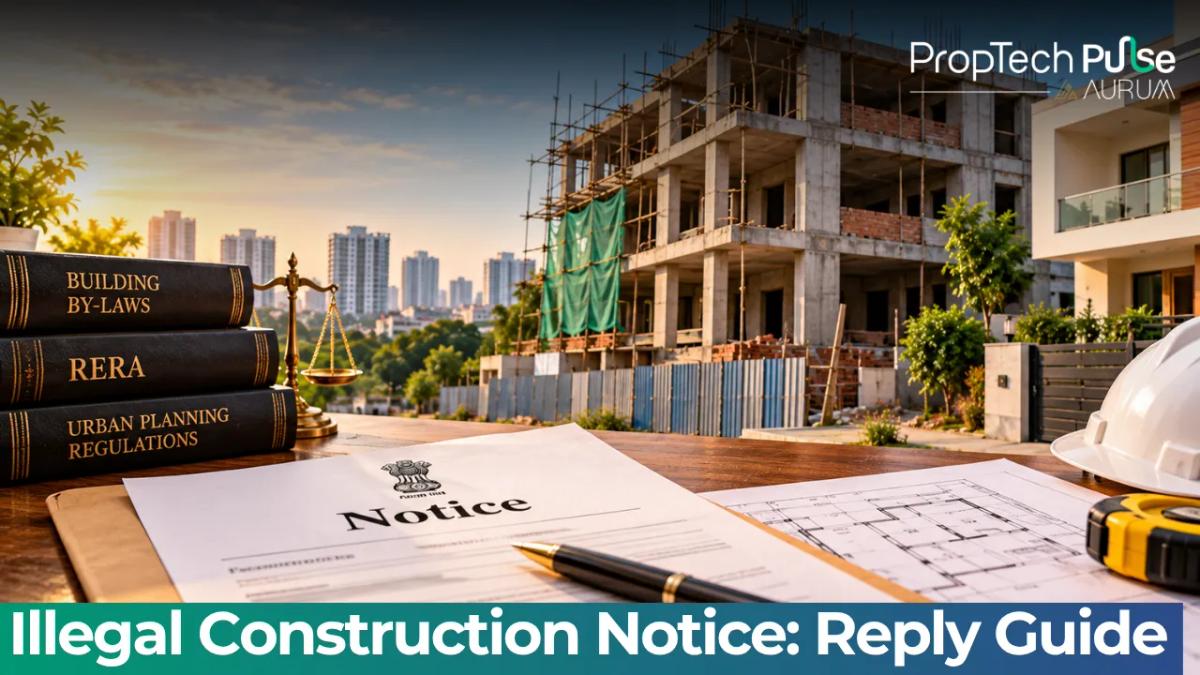
Property owners often notice extra floors added past the roof, walls crossing boundary lines, or shops appearing in residential buildings without permission. A notice for illegal construction serves as the official warning when authorities spot these breaches. Knowing which department handles your case saves weeks of back-and-forth.
What Is a Notice for Illegal Construction?
Quick answer
A notice for illegal construction is an official directive from municipal authorities requiring the owner to stop violating approved building plans. These breaches include adding unapproved floors, encroaching on public land, or altering structural layouts beyond sanctioned limits.
Municipal corporations and town planning departments issue these notices when field inspections reveal discrepancies between the approved sanctioned plan and actual work on site. Common triggers involve height restrictions exceeded in zones governed by low-density rules, partitions erected on terraces that were marked as open space, and basement car parks built without engineering sign-off.
The legal basis stems from state-level municipal acts rather than a single national law. Maharashtra relies on the Maharashtra Regional and Town Planning Act alongside the Mumbai Corporation Act, while Karnataka follows the Karnataka Municipal Corporations Act. Every local body maintains its own set of bye-laws detailing permissible setbacks, floor area ratios, and usage categories.
How to File a Complaint Against Illegal Construction
Filing a formal complaint against illegal construction requires targeting the correct authority. Wrong routing delays inspection dates and gives builders time to hide evidence behind scaffolding. Knowing exactly who holds jurisdiction for your locality prevents wasted effort.
Which Authority to Contact?
Mismatched filings stall progress. Use this decision matrix to route your report accurately based on the type of violation you are observing.
| Violation Type | Primary Authority | Secondary / Escalation Body |
|---|---|---|
| Height deviation, extra floors, terrace additions | Municipal Corporation / Taluka Panchayat | Town Planning Department |
| Land encroachment on government or common plots | Revenue Department / Land Development Officer | Civil Police Station |
| Structural damage affecting adjacent properties | Civil Engineering Wing of Municipality | Architectural Survey Team |
| Occupancy without completion certificate | Municipal Building Control Branch | RERA State Tribunal (for projects) |
For society flats or gated communities, the managing committee also receives complaints initially. However, societies lack demolition powers. They forward verified reports to the municipal ward office for enforcement action. Developers working on registered projects fall under legal steps when a developer violates rules if they bypass approved plans.
Steps to Lodge the Complaint
Start with digital reporting channels if available in your city. Several metropolitan bodies run dedicated grievance portals where you upload photographs and geotagged location data. Offline reports via WhatsApp or hand-delivered letters to ward offices capture the overhanging slab or extending wall with a concise caption.
If digital routes fail after two weeks, file a physical complaint letter addressed to the Chief Engineer or Assistant Municipal Commissioner at your divisional office. Keep two copies and have the receiving clerk stamp the duplicate with the date and incoming number. Follow up with a phone call referencing that incoming number four days later.
Illegal Construction Complaint Format
You can adapt the following text block for email submissions or printed letters. Fill the bracketed fields with your specific details before sending.
To: [Name of Municipal Commissioner / Ward Officer], [Municipal Corporation Name], [City Address]
Date: [DD Month YYYY]
Subject: Formal complaint against illegal construction at [Complete Property Address / Plot Number]
Dear Sir/Madam,
I am writing to report an ongoing unauthorised construction activity at the aforementioned address. Upon inspection, the structure clearly deviates from the sanctioned building plan in the following ways:
- [Describe deviation 1: e.g., additional third floor constructed beyond permitted height]
- [Describe deviation 2: e.g., solid wall built on common terrace/open space]
I request a mandatory site inspection by the building control department to verify these discrepancies. Please treat this communication as a formal request for enforcement action under the relevant municipal bye-laws. Enclosed are photographic proofs highlighting the violations.
Thank you for your attention to this matter.
Yours faithfully,
[Your Full Name]
[Your Contact Number]
[Your Address / Relation to the affected property]
If You Receive an Unauthorized Construction Notice
Receiving a formal directive on your own property differs sharply from lodging one. An unauthorized construction notice demands immediate professional review before responding blindly. The clock starts ticking the day the notice lands in your mailbox or gets affixed to the main gate.
Understanding the Notice
Every legitimate municipal notice lists specific clauses violated under state legislation. Check three elements immediately: the clause number cited, the exact nature of the breach mentioned, and the compliance window offered. Most standard windows run between five to ten working days depending on municipal bye-laws.
Ignore vague threats of heavy fines. The municipality attaches actual penalty slabs calculated per square foot of excess built-up area or a percentage of the total construction cost. Some jurisdictions allow owners to regularise minor mistakes by paying a surcharge, while structural alterations require full removal.
Documents to Submit With Your Reply
Your written response must include supporting papers. Submitting incomplete paperwork invites extended deadlines and second show-cause notices. Use this checklist to prepare your file before visiting the municipal office.
| Role | Documents Required |
|---|---|
| Complainant | Scaled photos of the violation, proof of ownership or lease, signed affidavit stating personal knowledge |
| Notice Recipient (Owner/Builder) | Original sanctioned plan copy, latest building completion status report, valid NOCs from fire or structural engineers |
| Notice Recipient (Owner/Builder) | Written reply citing relevant bye-law exceptions, payment receipts for previous non-compliance fees if applicable |
Keep original files safely. Municipal officers only accept attested photocopies unless specifically asked for the originals during face-to-face verification. Getting copies done within the compliance window avoids panic rushes at local print shops.
Timelines & Next Steps
The timeline moves from issuance to inspection once your reply reaches the designated officer. Inspections typically occur within three weeks. Survey officers verify floor counts and setback lines on-site, triggering a demolition or fine order within thirty days if breaches confirm.
Avoid self-help demolitions. Residents sometimes tear down protruding portions themselves fearing escalation. Doing so creates fresh criminal trespass liabilities and destroys crucial evidence needed for appeals. Always wait for the authoritative order before taking physical action.
Illegal Construction by Neighbour: Specific Actions
Dealing with illegal construction by neighbour involves balancing firm action with neighbourhood relations. Start indoors. Many violations begin inside the flat and spill outward as heavy furniture blocks balconies or private yards expand illegally onto shared corridors.
Illegal expansion often blocks airflow or daylight to adjacent windows. Local bye-laws strictly prohibit structures that cause this obstruction. Photographs taken at different times of day prove whether sunlight entry has been restricted beyond acceptable thresholds.
Courts routinely dismiss neighbour disputes that lack visual proof of tangible loss. Document everything carefully.
Call the police only if obstruction crosses into criminal trespass. A private citizen cannot order demolition or force contractors to halt work. Only trained municipal teams with demolition machinery and legal backing can break concrete safely and legally. Report repeat offenders to verifying building permissions before purchasing resources to understand standard enforcement patterns in your city.
Consequences of Non-Compliance
Penalties escalate quickly if you ignore the directive. Municipalities attach charges calculated on the excess area multiplied by current rates. Enforcers then secure the site and dismantle the unauthorised portion on-site. You bear the full cost.
Long-standing violations trigger asset attachment, freezing transactions until dues clear. Banks subsequently refuse fresh loans on tagged titles. Resale deals collapse during title verification, destroying exit options. Regularisation simply costs less than tribunal battles.
Next Steps Before You Act
Verify your position carefully and collect photographic evidence before filing. Read every word of the notice before drafting your reply. Consult a property dispute lawyer if the violation touches structural elements. Informed action prevents costly legal traps.
Frequently asked questions
How to complain about illegal construction by neighbour?
Direct approach: Contact your local municipal corporation's building control branch directly. Most metro cities offer online grievance portals where you can upload geotagged photos and plot details. Alternatively, dial the civic helpline or visit the nearest ward office. Keep copies of all submissions and request an acknowledgment receipt to track future follow-ups efficiently.
What is the format of a legal notice for illegal construction?
Standard formats demand clear identification of both parties, exact property addresses, and specific clause references from municipal bye-laws. They require detailed descriptions of the structural deviation alongside photographic proofs. A firm request for site inspection completes the draft. Professional legal firms adjust these templates based on regional act requirements to ensure maximum procedural validity.
How long does one have to reply to an unauthorized construction notice?
Timeframe focus: Compliance windows generally span between five to ten working days from the date of physical receipt or public display of the directive. This tight period forces owners to either pay pending regularization fees or submit documented counter-statements proving compliance with approved drawings. Missed deadlines accelerate penalty calculations automatically.
Can a police officer demolish illegal construction?
Jurisdiction clarity: Private citizens and local police officers lack statutory demolition powers. Their role stops at recording complaints, preventing violence, or registering criminal trespass cases when workers refuse to vacate. Only authorized municipal engineers holding written directives from senior commissioners can deploy heavy machinery to physically dismantle prohibited structures safely.
What happens if I ignore a notice for illegal construction?
Escalation path: Ignoring formal directives triggers progressive penalties tied to excess floor area calculations. Structural violations invite forced removal at the owner's expense. Severe defaults result in revenue court attachments freezing property sales and blocking fresh bank financing until full compliance is restored permanently through official tribunals.
Sources
- Uttar Pradesh RERA: General framework on building plan deviations and project compliance timelines (accessed October 2026)
- Government of India, Ministry of Law and Justice: Reference for constitutional remedies and writ petition applicability regarding municipal enforcement actions (accessed October 2026)
Enjoyed this blog article? Visit PropTech Pulse for more interesting blogs.





Ask Pulse Ai anything about real estate

Unlock the Latest in Real Estate
News, Infographics, Blogs & More! Delivered to your inbox.