New Launch - India Real Estate Report 2026.

Services
Knowledge Hub
Resources
Tools

Ask Pulse Ai
©PropTech Pulse 2025, All rights reserved.


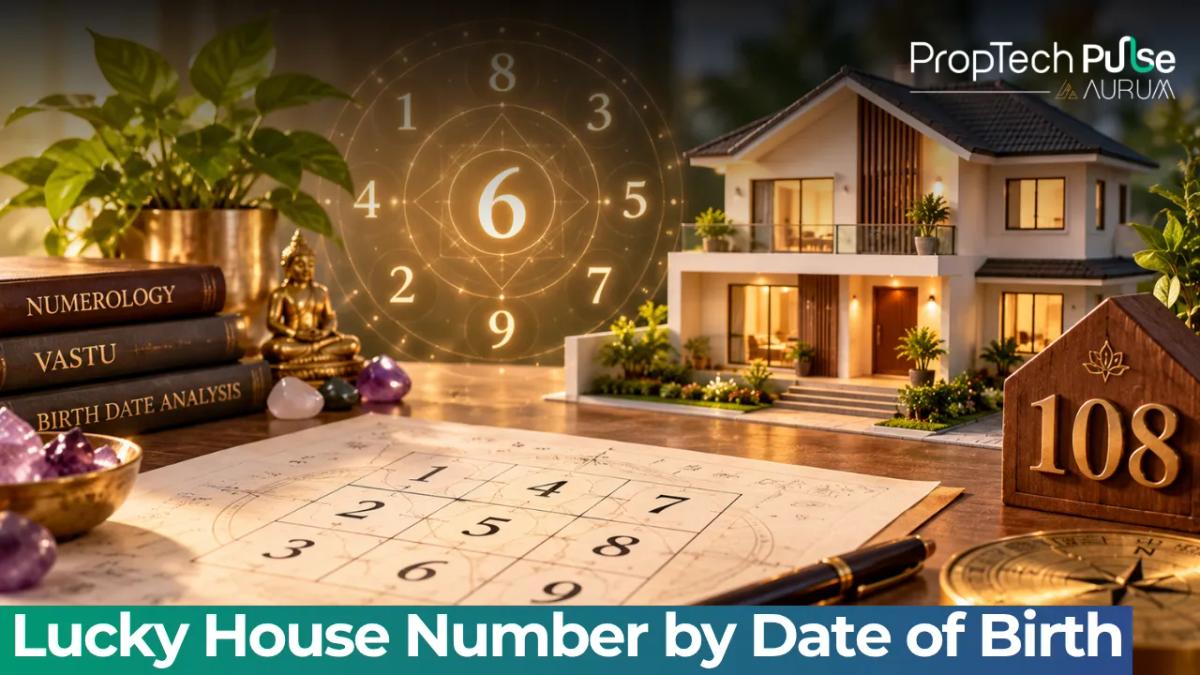
You spend months finding the right address. Then you freeze because the door plate reads “4” or “13”. In Ank Jyotish, the traditional Indian system of house numbers, nothing is inherently unlucky. Every digit pulls a distinct planetary energy into your space. The trick isn't avoiding certain doors. It comes down to matching the number to your own date of birth. You also need a strategy when two adults in one household carry completely different lucky numbers. This guide breaks down exactly how to calculate your lucky house number numerology. Next, we decode what key digits actually mean and how to handle flat letters or wing codes without guessing.
How to Calculate Your Lucky House Number Numerology
Quick answer
To find your lucky house number, reduce the door or gate number to a single digit. Add the digits together first. Match that result with your Mulank—the day of the month you were born. If the house number supports your birth number, the residence brings harmony. If it clashes, the environment demands patience. Numbers are neutral; the match determines the outcome.
It starts with Ank Jyotish. This system reduces every modern Indian address to a single base digit between 1 and 9. Once you have that digit, you compare it against your Mulank. Do this directly from your date of birth. An aligned house number amplifies stability and comfort. Practising house number numerology correctly removes guesswork. A clashing number introduces friction, but usually teaches the residents valuable lessons about discipline. Most generic guides tell you to run away from specific doors. That advice falls apart for joint families or couples moving into a new flat. Understanding lucky house number numerology requires looking at the full picture, not just one digit.
Extracting the true digit sum
Take a flat marked 402. Add the active digits: 4 + 0 + 2 = 6. The base number is 6.
If your gate reads 123, add 1 + 2 + 3 = 6. The base number is 6.
What happens when the sum exceeds a single digit? Reduce it again. Take 356. Add 3 + 5 + 6 = 14. That reduces to 1 + 4 = 5. The base number is 5.
Every modern apartment complex follows this reduction method. Strip leading zeroes or trailing spaces. The math stays identical.
Matching against your own date of birth
Your Mulank is the calendar day you were born. Born on the 15th? Your Mulank is 1 + 5 = 6.
If your birthday lands on the 2nd, your Mulank is simply 2.
What if your birthday is the 24th? Add 2 + 4 = 6. Compare that reduced birth digit to your base house digit. If your flat reduces to 6, the energies sync. If your flat reduces to 8, Saturn meets Venus. Both planets respect material security. This pairing builds steady, predictable growth.
Next, map your reduced house number to the ruling graha (planet). The vibration of that planet must either harmonise with your Mulank or actively support it.
| Reduced Digit | Ruling Graha | Primary Influence |
|---|---|---|
| 1 | Sun (Surya) | Authority, reputation, leadership |
| 2 | Moon (Chandra) | Emotions, hospitality, fluidity |
| 3 | Jupiter (Guru) | Learning, expansion, frequent guests |
| 4 | Rahu | Shifts, unconventional paths, technology |
| 5 | Mars (Mangal) | Action, courage, independence |
| 6 | Venus (Shukra) | Comfort, aesthetics, homely comfort |
| 7 | Ketu | Spirituality, solitude, scholarly focus |
| 8 | Saturn (Shani) | Patience, discipline, long-lasting results |
| 9 | Mercury (Budh) | Cleverness, communication, adaptability |
Meaning of Key House Numbers in Ank Jyotish
Certain base numbers appear constantly across India's housing stock. Knowing what they actually do prevents unnecessary panic when you view properties.
House Number 3: The Gathering Spot
Three falls under Jupiter's governance. Jupiter brings growth, wisdom, and warmth. Houses ruled by 3 attract visitors naturally. The kitchen tends to stay warm. Family gatherings happen frequently. For large households or young couples raising children early, a 3-house encourages social expansion and learning.
House Number 7: Quiet Reflection and Spirituality
Seven sits beneath Ketu's influence. Ketu strips away noise and distraction. A seven-house does not discourage social life. It simply asks for boundaries. Residents often find themselves drawn to books, meditation, or spiritual practice. Students, authors, and professionals working behind screens tend to thrive in 7-houses. The atmosphere feels lighter and more detached after sunset.
House No 8: Discipline, Responsibility, and Longevity
Eight carries Saturn's weight. Saturn builds foundations that last decades rather than seasons. An eight-house rewards steady effort and delays quick gratification. Families living in an eight-house might see slower initial progress. Their assets tend to hold value longer, though. People who prefer predictable routines and structured living feel safest under this vibration.
What Matters More in Flat No Numerology?
Modern builders hand out complex address formats. These confuse the basic reduction method. Here is how to separate signal from noise.
Ignore wing letters and tower designations completely. Drop the B if your plot reads 12-B. Ignore the letter C if the block is labelled Tower C. Letters trace back to Western Chaldean spelling systems. They do not belong to Indian house selection. Add the street digits instead.
Building numbers rarely impact individuals. The gate code or main entry door carries the residential energy. Treat the community building name as administrative data. Skip it unless your plot sits alone with no street number.
Once you know your number fits your energy, move to structural checks. Aligning your sofa, bed, and kitchen directions using Vastu Shastra basics for home orientation complements the numerical alignment perfectly.
Always verify the legal standing of the complex before committing to a floor or wing. A clean title matters far more than a perfect digit. Read our property legal verification guide to ensure the paperwork matches your expectations.
What About Conflicting Dates of Birth?
Joint families face genuine hurdles when multiple members enter the same space. One spouse may carry a Sun-based Mulank. Another carries a Moon-based Mulank. The parents lean towards Mars. The children pull Mercury and Jupiter. The house cannot satisfy everyone equally. Ank Jyotish resolves this conflict with two standard protocols. Applying lucky house number numerology to blended families requires picking a mediator.
Use the Owner and Youngest Child rule. The primary financial decision-maker sets the baseline energy. The youngest child sets the future trajectory of the house. If both numbers gravitate toward a similar base digit, choose that address. Ignore the grandparents' preferences if necessary.
Pick a neutral number for mixed households. Digits 1, 5, and 9 operate as universal peacemakers. They blend smoothly with almost every other birth number. Friction between co-residents drops significantly. Accept that some residences require compromise. No single address cures incompatible lifestyles.
Are There Really "Unlucky" Numbers Like 4 or 13?
Numerous guides warn buyers away from four and thirteen. That warning relies on misinterpreting what those numbers represent. In Ank Jyotish, thirteen collapses to 1 + 3 = 4. Both fall under Rahu.
Rahu is not a curse. Rahu governs sudden shifts, unconventional thinking, and rapid technological adoption. Stepping into a four-house triggers unexpected career breaks. Business pivots follow quickly. The environment pushes you out of routine. This looks chaotic from the outside. It fuels growth on the inside.
The same correction applies to eight. Patience compounds into generational wealth. Fear drives bad decisions. Check that the builder has handed over the property legally. Verify what is occupancy certificate status before transferring funds.
Before You Sign the Agreement
Do not skip the final checks just because a door number aligns with your birth date. Favourable lucky house number numerology creates a supportive background rhythm. It does not fix cracked beams. It ignores missing completion certificates or unclear water rights. Match the house number to your Mulank. Confirm the document trail. Make the choice. Close the deal if the maths supports you and the legal side holds up.
Frequently asked questions
Which house number is best according to numerology?
There is no single best number for every buyer. The highest-rated house digit is the one that reduces to match your birth date (Mulank). If your Mulank is 5, a 5-house boosts your natural momentum. If your birth date reduces to 2, a 2-house brings emotional stability. Always prioritise the personal math over generic popularity lists.
How to find your lucky house number by date of birth?
Start by calculating your Mulank, which is the day of the month you were born. Reduce that to a single digit by adding the numbers together. Then reduce the address door plate or main gate to a single digit. Compare both results. When the house digit supports or harmonises with your personal digit, you have found your ideal address.
What does house number 8 mean in numerology?
Eight carries the vibration of Saturn, which values patience, structure, and long-term effort. Unlike Western interpretations that label eight as difficult, Ank Jyotish sees it as a builder's number. Houses governed by 8 reward consistent routine and delay instant gratification. Families in an eight-house often see slower initial adjustments but gain lasting asset stability.
Is house number 4 bad for living?
Four is governed by Rahu, which drives unconventional shifts and rapid change. Rather than causing problems, a four-house challenges residents to break rigid habits. If your birth number responds favourably to Rahu, stepping into a four can trigger unexpected career jumps or business pivots. The environment pushes you forward, which looks messy to outsiders but fuels growth internally.
Why is house number 7 considered good?
Seven sits under Ketu's influence, which filters out urban noise and encourages focus. A seven-house naturally promotes studying, meditation, and deep conversations. It does not isolate residents; it simply asks them to set healthy boundaries between social time and private time. Writers, students, and senior citizens often prefer the calm atmosphere.
Sources
- National Housing Bank (NHB): Overview of national housing policy and market indices (accessed October 2026)
Enjoyed this blog article? Visit PropTech Pulse for more interesting blogs.





Ask Pulse Ai anything about real estate

Unlock the Latest in Real Estate
News, Infographics, Blogs & More! Delivered to your inbox.