New Launch - India Real Estate Report 2026.

Services
Knowledge Hub
Resources
Tools

Ask Pulse Ai
©PropTech Pulse 2025, All rights reserved.


Relocating to a metro for college or a junior job means your first month is spent hunting for rooms, negotiating deposits, and figuring out whether the kitchen water actually boils.
Somewhere along the way, you will see "PG available" next to "hostel beds open" and assume they mean the same thing. They do not. Understanding the difference between pg and hostel arrangements is crucial.
One confuses you with hidden charges while the other locks you into rigid schedules. Confusing a pay-as-you-go room with an institutional dormitory can cost thousands every month.
You do not need a thirty-page spreadsheet to pick accommodation. You just need to know which option matches your income stability, your tolerance for shared schedules, and what happens when the landlord decides to raise charges mid-year.
This guide breaks down the actual monthly outgo. We also explain the legal safeguards under recent tenancy reforms and the structural details that matter.
Quick Answer: PG vs Hostel in 2026
Quick answer
A PG (Paying Guest) offers flexible, furnished rooms with optional meals under a simple rental agreement, while a hostel provides dormitory-style sleeping quarters managed by strict institutional rules and fixed mess schedules. Hostels suit students bound by college requirements; PGs work better for working professionals and independent graduates who want predictable costs and fewer curfew restrictions.
Understanding the Basics: What Does PG Full Form Mean?
In casual usage, people search for the pg hostel full form because they encounter both terms on listing apps and campus notice boards. Both abbreviations stand for Paying Guest and Hostel respectively, but nobody uses "pg full form in hostel" as a technical classification.
A Paying Guest is simply a resident who pays for a furnished room. You often share common areas like the kitchen, living room, or dining hall. It is a commercial lodging arrangement disguised as a homestay. The term has nothing to do with academic hostels.
An academic hostel is a residential facility attached to a college, university, or coaching institute. It operates under institutional bylaws. The administration requires a registration certificate and enforces rolling bells, visitor logs, and mandatory attendance at fixed mess timings.
Private landlords running PGs do not fall under those statutes. They operate on standard residential tenancy norms, which recently gained clarity under central tenancy model legislation.
When booking a room, never assume a "premium hostel" listed on property sites is an educational institution. Many private operators slap the word hostel on their listings to attract students who expect lower nightly rates.
You end up paying PG prices for a bunk bed with zero academic oversight. Always ask for the operator's trade license and confirm whether the building carries fire safety clearance for lodgings.
Key Differences at a Glance
The core divide between the two lies in governance. One runs on market forces; the other runs on syllabus calendars and administration orders.
| Parameter | Private PG | University or Coaching Hostel |
|---|---|---|
| Primary Purpose | Commercial lodging for students and bachelors | Academic residence for enrolled students and staff |
| Governance | Property owner or registered management company | College administration or alumni trust |
| Rent Structure | Monthly recurring bill, sometimes weekly or fortnightly | Mandatory inclusion in the annual fee or fixed monthly slab |
| Mess Charges | Optional add-on or bundled fixed price | Mandatory inclusion in the flat rate or fixed monthly slab |
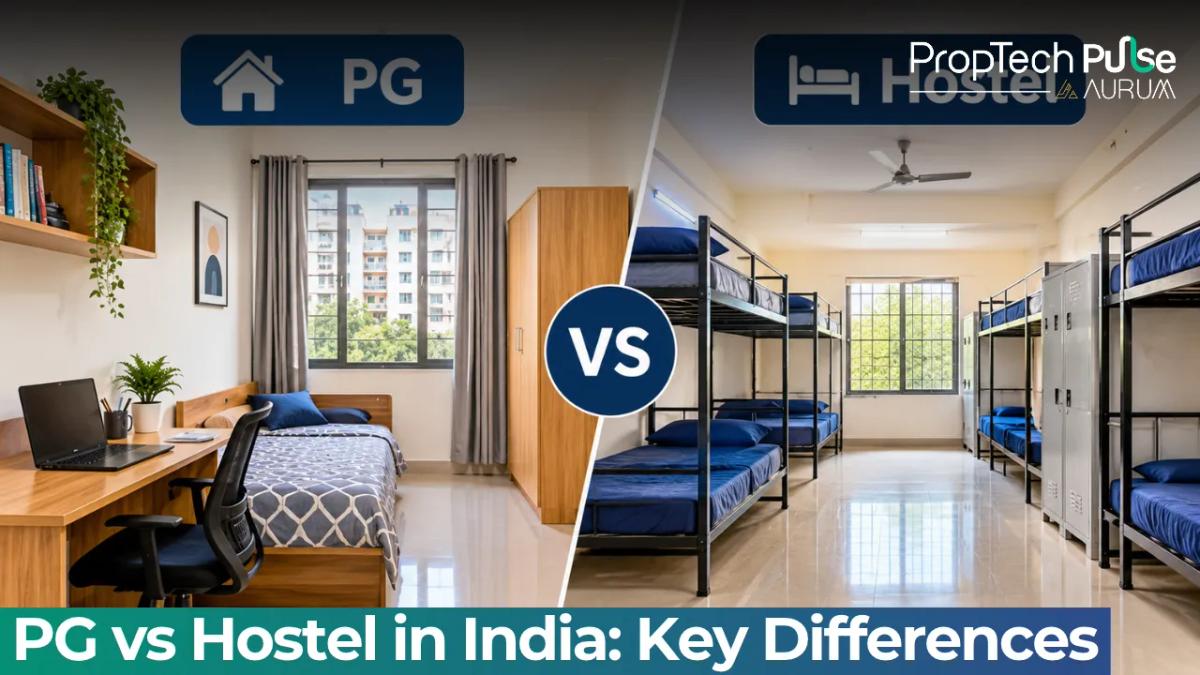
| Room Type | Single, double, triple, or four-sharing cabins | Dormitory-style bunk beds with limited personal storage |
| Curfew Policy | Minimal or absent; late returns depend on neighbourly cordiality | Strict lock-up times enforced by the warden; absence triggers penalty points |
| Security Deposit | Standard cap applies under newer rental reforms (usually two months' rent) | Often waived, or restricted to one month due to institutional policy |
| Maintenance Scope | Covers minor plumbing and lighting repairs via landlord's handyman | Covered in the flat fee or handled centrally by the college engineering department |
If you are reviewing a draft lease to understand what the landlord can legally deduct, check our guide on rental laws and standard clause structures.
Cost Breakdown: Where Your Money Actually Goes
Listing prices rarely match final payments. Hostels advertise a single daily rate that looks cheap, but hidden slabs for extra fans, geysers, and late-night laundry push the bill higher.
Private PGs quote an inclusive monthly figure, yet some operators pass rising energy costs straight onto residents through surcharge clauses.
Consider a standard scenario in a tier-one city for a bachelor sharing a three-room apartment.
A budget PG asks for ₹10,000 per head, including basic WiFi and two meals a day. Electricity runs through a single domestic meter paid by the owner, so you do not see spikes during summer AC hours.
If you move in for eight months, the total comes to roughly ₹80,000. There are zero surprise attachments.
Now take the hostel alternative. Suppose the base bed costs ₹3,000 per month. Mess fees add another ₹2,500. Internet connectivity, usually outsourced to a local provider inside the dorm block, costs ₹500.
If you run a fan or charge a laptop overnight, the maintenance committee may impose an additional ₹400 for power pooling. That brings the monthly outgo to ₹6,400.
On paper, it looks cheaper. But hostels rarely allow you to skip mess days when you travel back home for two weeks.
You still pay ₹2,500 regardless of whether you sit there or not. Over a semester, the locked-in meal charges alone exceed what you would spend cooking quietly in a shared PG kitchen.
In reality, private landlords increasingly bundle utilities to protect themselves against tariff hikes. Check whether the quoted rent covers the electricity sub-meter or leaves it open-ended. Some operators charge per unit above a baseline allowance.
This practice quietly shifts commercial grid pricing onto residential accounts. For students tracking cash flow, locking into a fixed all-inclusive PG prevents unpredictable top-ups. Just ensure the rent agreement spells out the utility cap clearly.
Before handing over the advance, compare total monthly exposure rather than staring at the headline number. Read the small print on deposit refund timelines so you are not left waiting months after moving out. Our explainer on security deposit rules breaks down what a landlord must return and how long the holding period typically runs.
Privacy, Rules, and Daily Lifestyle
Hostels thrive on uniformity. Every student eats at the same hour, lights go off at midnight during exam season, and guests are barred or heavily restricted.
That structure works well when you need rigid discipline, but it wears thin once your routine drifts away from classroom hours. Coaches, night-shift workers, or freelancers quickly find institutional curfews suffocating.
Private PGs function as micro-communities. You share a living space with strangers chosen mostly by affordability rather than academic batch. Dinner happens whenever everyone finishes work or classes.
WiFi bandwidth gets contested when two people join Zoom calls while someone else streams a movie. Noise levels vary wildly depending on which wing houses medical aspirants versus IT professionals.
The trade-off is autonomy versus peace. In a hostel, you get guaranteed quiet study blocks and regulated food quality, but you lose control over basic daily rhythms.
In a PG, you set your own schedule and can bring friends over without logging names at a desk, yet you must negotiate cleaning rotas and kitchen hygiene with housemates.
Expect occasional friction. Set boundaries early about visitors, fridge space, and bathroom timings, ideally before signing the token letter.
Safety Standards and Legal Protections Under the Model Tenancy Act
Tenant protection remains the biggest blind spot for first-time relocators. Private PGs lack the institutional safety nets that colleges provide, such as on-call nurses, police liaison officers, and emergency response drills.
Security relies entirely on the operator's infrastructure and your own vigilance.
For women seeking secure lodging, the demand for structured environments has pushed operators to adopt hostel-like features within PG premises.
Chains like sri sai pg for ladies, for instance, cater to female students and young professionals by installing biometric entry systems, round-the-clock CCTV, and restricting male visitors outside designated family hours.
Such branding helps candidates screen properties quickly on search platforms without visiting multiple locations blindly.
Legally, private accommodations fall under state-level rental frameworks. Most states have adopted or mirrored the Model Tenancy Act, 2021.
This act caps security deposits at two months' rent for residential lets and mandates written agreements for stays longer than five years.
While many short-term PG leases still bypass formal paperwork, the new guidelines force owners to disclose property titles, fix exit procedures, and register the contract digitally with the district rental authority.
You gain faster dispute resolution and reduced risk of arbitrary lock-outs.
Institutional hostels, meanwhile, operate under different compliance loops. University residences must clear fire NOCs from local civil defence and maintain minimum square footage per bed as stipulated by accreditation bodies.
Verify the building's occupancy permit before settling. Older college wings retrofitted with temporary partitions often lack proper egress routes, which matters more than fancy furniture when emergencies strike.
If you are weighing long-term housing stability against short-term rentals, look at broader market shifts. The shift toward managed accommodations has changed how urban youth approach relocation. See what is driving rental and coliving demand in india to understand why structured housing models are scaling faster than traditional independent flats.
When to Choose a Hostel vs a PG
Pick the hostel if your institution mandates on-campus residence, your course demands strict study hours, or your household prefers a controlled environment with vetted peers.
Hostels also work if you need immediate mess facilities and do not want to manage grocery runs or kitchen appliances.
Choose the PG if you want predictable monthly billing without locked-in meal slabs, prefer flexible entry and exit times, or require a quiet base that does not shut down at a prescribed bell.
Working grads, freelance creators, and postgraduate researchers consistently score PGs higher because the setup scales with erratic workloads without triggering wardens' penalties.
Run the checklist yourself. Match the monthly all-in cost against your stipend or salary, confirm the deposit retention policy in writing, and visit the kitchen and washrooms during evening hours to judge noise and maintenance responsiveness.
If the landlord hesitates to share the building's fire certificate or refuses to clarify utility capping, walk away.
When evaluating the difference between pg and hostel options, remember that transparency beats cheap headlines. The cheapest listing usually hides the steepest compromises.
Frequently asked questions
Is a PG better than a hostel for working professionals?
Yes, because working adults rarely fit into fixed mess timings or midnight curfews. PGs offer flexible schedules, optional kitchen access, and straightforward rent agreements that accommodate irregular work hours. Hostels enforce academic routines designed for students, which creates unnecessary friction for salaried residents trying to balance jobs and commutes.
What is the full form of PG and hostel?
PG stands for Paying Guest, referring to a resident who pays rent for a furnished room and often shares common spaces. Hostel refers to institutional dormitories managed by colleges or training centres that provide beds, meals, and strict supervision under university bylaws. Neither abbreviation relates to the other structurally.
How much is a typical PG rent in metro cities in 2026?
Shared rooms in tier-one metros generally range from ₹8,000 to ₹15,000 per month depending on location and room configuration. Premium solo rooms with dedicated study setups or upgraded interiors can cross ₹20,000. Always verify whether the quoted amount bundles electricity, WiFi, and meals to avoid unexpected surcharges.
Are PG accommodations safe for women?
Safety varies significantly by operator. Reputable chains deploy biometric locks, continuous CCTV monitoring, and strict visitor logs. Look for properties that explicitly comply with local municipal licensing for lodging and display fire NOCs visibly. Avoid unregistered layouts operating without clear owner disclosure or documented security protocols.
Do I need a rent agreement for a PG?
Technically yes, especially under the Model Tenancy Act. Written contracts protect tenants against arbitrary eviction and define deposit refund windows. While many short-term PG arrangements rely on verbal tokens, requesting a signed copy ensures you can approach rental authorities for dispute resolution if the landlord withholds dues.
Sources
- Ministry of Housing and Urban Affairs (mohua.gov.in): Overview of the Model Tenancy Act, 2021 framework and residential tenancy definitions (accessed November 2026)
Enjoyed this blog article? Visit PropTech Pulse for more interesting blogs.





Ask Pulse Ai anything about real estate

Unlock the Latest in Real Estate
News, Infographics, Blogs & More! Delivered to your inbox.

