New Launch - India Real Estate Report 2026.

Services
Knowledge Hub
Resources
Tools

Ask Pulse Ai
©PropTech Pulse 2025, All rights reserved.


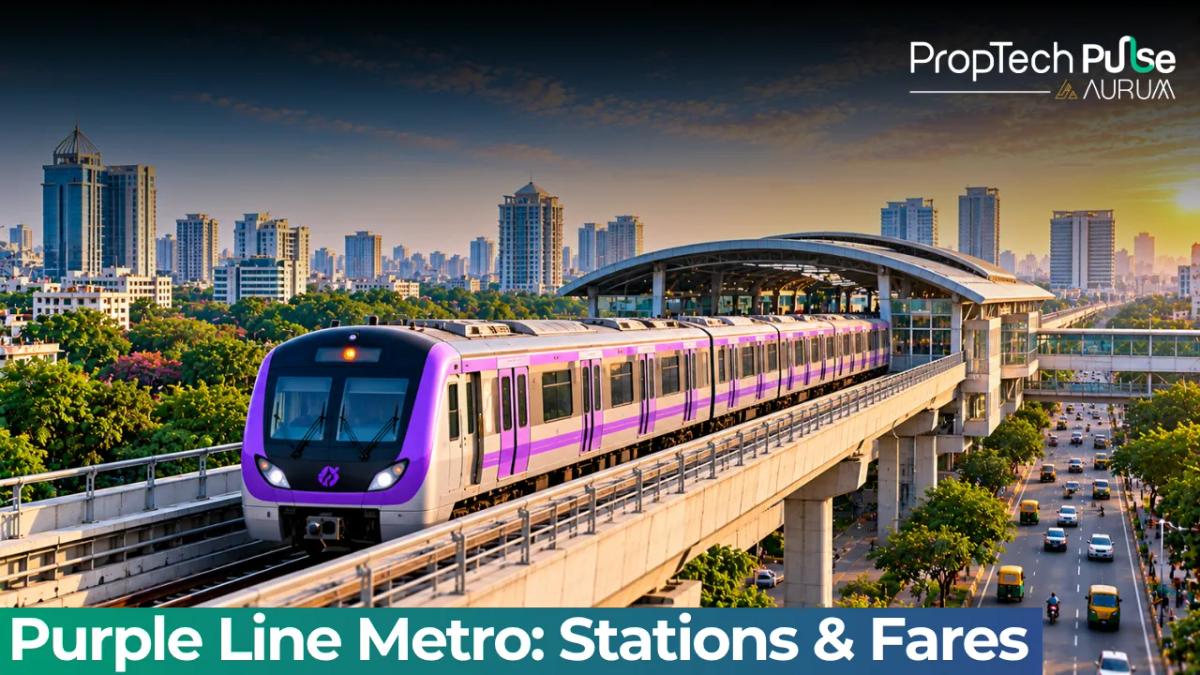
If you work in Indiranagar or start your shift near MG Road, traffic crawls on HAL Airport Road or Hosur Road usually force you to map out alternate routes. The purple line metro Bangalore route connects Kadugodi in Whitefield all the way to Challaghatta, turning fragmented east-west trips into a single commute. Daily cross-town travel no longer requires switching systems.
The entire stretch opened in October 2023. Trains arrive every five minutes during peak hours. For renters and homebuyers, the timeline matters just as much as the map. Below is the exact route breakdown, station list and fare breakdown.
Metro Purple Line Bangalore: Phase-Wise Breakdown
Quick answer
The metro purple line bangalore runs 43.49 kilometres from Kadugodi (Whitefield) to Challaghatta (Kengeri). It features 37 stations across two phases, operating daily from 5 AM to 11 PM. The full stretch connects major tech corridors and city centres, with interchanges available at KR Puram, MG Road and Majestic. Standard single-journey fares range from ₹10 to ₹50, while smart cards offer a consistent 5% discount.
The corridor splits into two technical phases handed over sequentially. Phase One covers 25.27 kilometres and launched in March 2022, linking KR Puram directly to the city core at Majestic.
Phase Two added another 17.86 kilometres, completing the east-west spine by opening the Whitefield and Kengeri branches in October 2023.
This sequence changed how developers price assets along the track. Phase One deliveries concentrated heavily around Vijayanagar and Shivajinagar. Once Phase Two closed the loop, rental demand spiked inside Whitefield and Krishnarajapura because the last-mile congestion tax disappeared.
Properties situated within a kilometre of new above-ground stops capture premium visibility. Teams evaluating supply along the corridor often check commuter-friendly properties near Ramamurthy Nagar to benchmark baseline absorption rates before committing capital.
Treat the line as a single entity when plotting relocation decisions. The western terminus at Challaghatta pushes into Bannerghatta Road's commercial belt, while the eastern end taps Kadugodi's IT expansion zones.
A unified signalling standard runs across both segments, meaning commuters never lose time waiting for platform alignments.
All 37 Purple Line Metro Stations (Layout & Location)
Understanding station layouts prevents wasted trips. Some stops sit entirely below ground to preserve narrow colonial-era streets in the city centre. Others run on raised tracks past Baiyyappanahalli to clear residential clusters.
Your nearest stop location dictates your parking strategy and evening return commute.
| Cluster | Key Stops Included | Primary Layout Type |
|---|---|---|
| Eastern Tech Corridor | Kadugodi, Devanahalli Hoskote Main Rd, Whitefield, ITPL, Chikkabanavar, Baiyyappanahalli | Above-ground structures |
| KR Puram Junction Node | KR Puram, Hegganahalli, Byrasandra, Banashankari | Mixed elevated and at-grade approaches |
| Central Heritage Zone | Vijayanagar, Jalahalli, Vijayanagar, City Circle, Majestic, Shivajinagar, MG Road (via transfer) | Underground cut-and-cover tunnels |
| Northern Connector | Hegde Nagar, Hebbala, Thirumenahalli | Above-ground structures |
| Western Residential Belt | Jnanabharathi, Kuvempu University, R.V. College, Cheluvarajaiah Swamy Block, Sahakara Nagar, Peenya Industrial Area, Peenya, Rajajinagar, Mahalakshmi Layout, Domlur, Silk Board, JP Nagar, Yeshwantpur, Kalyan Nagar, Nagawara, Bellahalli, Sarjapur Road, Whitefield, Kadugodi | Above-ground and At-Grade transitions |
Each of the thirty-seven stops carries designated numbering and colour-coded wayfinding.
Ground-level exits at above-ground stations feature wide staircases alongside escalators.
Lift access remains limited during peak boardings.
If you carry heavy luggage or move goods for a small business, plan your arrival window between 7 PM and 8 PM when platform crowding eases.
Property developers pushing new inventory along this axis frequently highlight proximity to these nodes.
Always verify the exact walking radius rather than relying on brochure claims. A comprehensive view of top builders in Bangalore provides transparency on which developers actually deliver within a ten-minute walk versus a fifteen-minute bus feeder ride.
Station Tip: Avoid the first train departure at 5 AM if you need parking. Reserved slots fill instantly at Baiyyappanahalli and Majestic. Use public feeders or autos from nearby cabs for a smoother morning exit.
Interchange Points and Cross-Line Connectivity
The metro purple line bangalore intersects three critical trunk lines. You do not need separate tokens to switch tracks at these junctions. Account for physical movement time instead.
Majestic, technically Nadaprabhu Kempegowda, handles the deepest transfers.
You arrive on the Purple Line underground concourse and navigate ramps down to the Green Line platforms. Expect eight to ten minutes of active walking during standard weekdays.
The signage is colour-coded. Duplicate naming conventions occasionally confuse first-time visitors, so keep your phone battery charged for offline maps if the corridor lighting dims.
MG Road offers a tighter connection. The Pink Line platforms sit nearly parallel to Purple Line access gates.
Transit users typically spend four to five minutes crossing over or down. Commercial workers rely on this specific link for lunch breaks and late shifts, pushing crowd density beyond average capacity between 1 PM and 2 PM.
KR Puram functions as the Blue Line handshake point. Because the platforms sit side-by-side at an at-grade station, transferring usually takes three minutes on foot.
Bus termini cluster immediately outside. Smooth transitions await commuters coming from electronic city and outer ring road fringes.
When planning investments, evaluate properties near understanding rental yields in Bengaluru micro-markets to compare how interchange proximity correlates with long-term appreciation versus pure transit-oriented density.
Purple Line Timings, Train Frequencies and Travel Duration
Daily operations follow a strict calendar split. Monday through Saturday trains depart the first terminal at 5:00 AM and terminate service at 11:00 PM. On Sundays and gazetted holidays, morning services start later at 7:00 AM and conclude at 10:40 PM.
Evening return trips from Challaghatta and Whitefield align closely with corporate release times. The purple line metro Bangalore schedule compresses waiting times significantly during standard weekday windows.
| Parameter | Weekday (Mon–Sat) | Weekend / Holiday (Sun) |
|---|---|---|
| First Train Departure | 5:00 AM | 7:00 AM |
| Last Train Departure | 11:00 PM | 10:40 PM |
| Standard Headway | 5 to 6 minutes | 7 to 8 minutes |
| Peak Hour Compression (Majestic to MG Road) | 3 to 3.5 minutes | N/A |
| Total End-to-End Journey Time | Approximately 80 to 90 minutes | |
Traffic signal reductions and road widening projects in surrounding corridors have slightly accelerated average station dwell times.
Catch the 5:15 AM departure if you depend on early morning shifts at ITPL. It guarantees seating until Baiyyappanahalli.
Trains fill rapidly after 5:30 AM. Standing room becomes the norm through Hebbala.
Exact Fares, Smart Cards and Ticket Calculations
Ticket pricing follows a distance-slab model managed by the rail operator.
Single journey tokens start at ₹10 for short hops within a single cluster. They cap around ₹50 for standard inner-corridor rides. A full stretch ride from Kadugodi to Challaghatta lands between ₹57 and ₹90 depending on precise entry and exit gates.
Smart Card holders receive a straight five percent discount applied automatically at validation.
You load cash digitally or at vending kiosks. Tap in, and the system deducts the discounted rate.
Group tickets operate differently. Tracking the purple line metro Bangalore fare structure reveals how distance directly impacts monthly overhead.
Schools, corporate bulk passes and institutional clients utilise this tier extensively.
Mathematical clarity helps you forecast monthly overhead.
Assume a resident commuting between Whitefield and Indiranagar. Their one-way trip covers roughly 18 kilometres, costing approximately ₹45 on a base token.
A daily round trip equals ₹90. Over twenty-two working days, that totals ₹1,980.
With a Smart Card, the same commute drops to ₹1,881. The monthly saving reaches ₹99.
Multiply that equation across a household of four professionals, or combine it with carpool fuel and maintenance expenses. You get a compelling financial case.
Practical Commuting Tips for Residents and Buyers
Location selection requires more than staring at a transit map.
You must factor in noise profiles, emergency access and the reality of monsoon drainage.
Raised sections generate mechanical hums from train motors, especially during night services between 11 PM and midnight when sound insulation contracts slightly.
Underground stations eliminate ambient street noise. Humidity build-up does affect elevator mechanics during heavy rains.
| Feature | Above-ground Stops (East) | Underground Stations (Central) |
|---|---|---|
| Parking Availability | Limited reserved bays; fills early | Zero surface parking at core terminals |
| Feeder Bus Integration | Strong BMTC coverage outside Whitefield/Challaghatta | Congested curb zones near Majestic/SMVD |
| Evening Safety | Well-lit pedestrian ramps and CCTV monitoring | Dependent on streetlights above ground-level exits |
| Rent Growth Trajectory | Steady 6 to 8 percent annual uplift | Premium spikes near interchange nodes |
Riders using the purple line metro Bangalore consistently report faster evening returns during monsoon months when major roads flood.
Waterlogging remains a recurring vulnerability for surface exits in older neighbourhoods.
Verify municipal maintenance records for stormwater drains adjacent to your chosen building.
Properties marketed as transit-oriented often promise accessibility. Physical barriers like broken pavement, stray animals or unregulated hawkers can extend walk times beyond acceptable limits.
Inspect the route personally during afternoon hours before signing lease agreements.
Buyer Rule: Prioritise buildings within 800 metres of the station entrance. Anything further demands a scooter or auto dependency that erodes the time-saving advantage of rail transit.
When to Rely on the Purple Line for Your Move
Daily commutes shrink by forty to sixty minutes if your office lies south of Koramangala or east of Old Madras Road without direct highway ties.
Renters benefit immediately from predictable costs.
Homebuyers gain long-term liquidity because institutional interest keeps asset values buoyant near verified node footprints.
Compare your current transit costs against the rail fares. Step outside during rush hour to validate the station exit environment.
That combination tells you whether the promise holds up in practice.
Frequently asked questions
Is the Purple Line metro fully operational now?
Yes. Both Phase One and Phase Two of the corridor opened completely in October 2023. Trains run continuously from Kadugodi to Challaghatta without any suspension blocks or temporary halts. Daily ridership reflects full network integration.
How many stations are there in the Purple Line metro Bangalore?
The route contains exactly 37 stations. Phase One delivered 23 stops spanning KR Puram to Majestic. Phase Two added 14 additional terminals extending outward to Whitefield and Kengeri. All stops carry official numbering.
Where does the Purple Line metro intersect with other lines?
Three major transfers exist. You connect to the Green Line at Majestic, switch to the Pink Line at MG Road and merge with the Blue Line at KR Puram. Each junction uses dedicated pathways designed for crowd management during rush windows.
What are the working hours of the Purple Line metro?
Services run from 5 AM to 11 PM on regular weekdays and Saturdays. Sunday and holiday timetables shift to a narrower 7 AM to 10:40 PM window. Headways tighten to roughly three and a half minutes at the busiest central hubs.
What is the exact fare for the Purple Line metro Bangalore?
Short-distance tokens begin at ₹10. Most intra-city rides cost between ₹30 and ₹50. A full journey stretching the entire length charges ₹57 to ₹90 depending on exact gate combinations. Smart Card users automatically receive a five percent reduction on printed tickets.
Sources
- Bangalore Metro Rail Corporation Limited (BMRCL) Official Portal: Operational schedules, fare slabs and smart card discount policies (accessed October 2026)
Enjoyed this blog article? Visit PropTech Pulse for more interesting blogs.




Ask Pulse Ai anything about real estate

Unlock the Latest in Real Estate
News, Infographics, Blogs & More! Delivered to your inbox.

