New Launch - India Real Estate Report 2026.

Services
Knowledge Hub
Resources
Tools

Ask Pulse Ai
©PropTech Pulse 2025, All rights reserved.


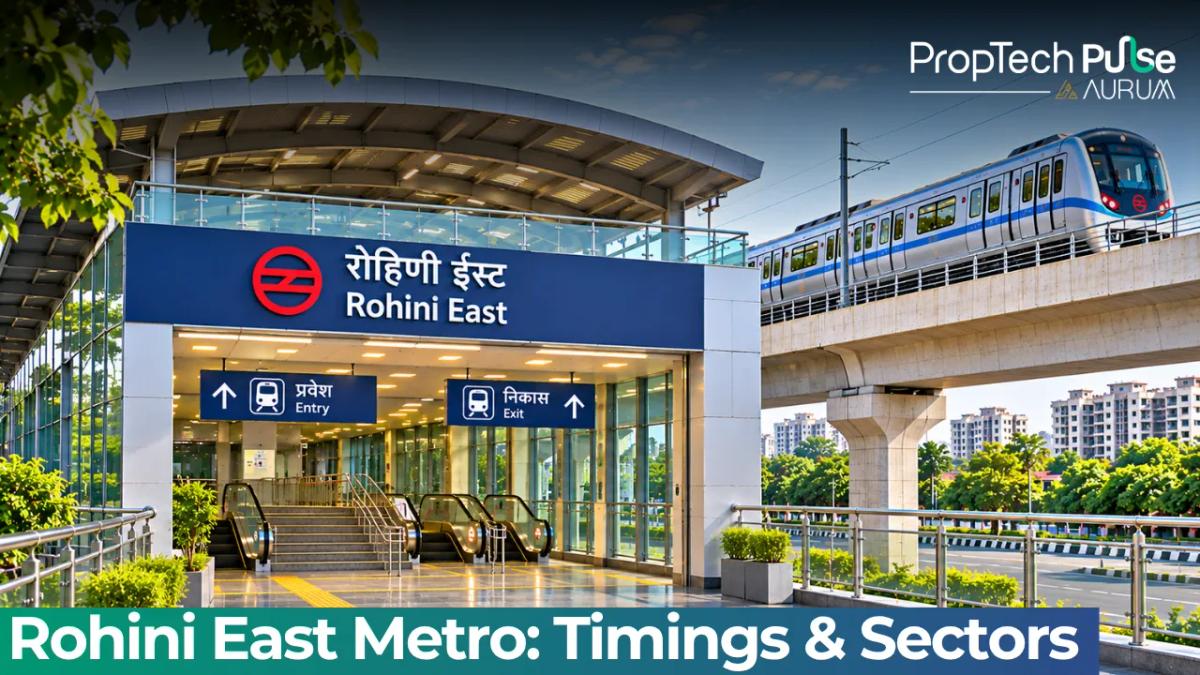
Flats near Bhagwan Mahaveer Marg trade heavily on walkability scores! Rohini East dictates access for a dozen sectors choked by narrow internal roads.
Master the gate layout before visiting any builder or owner. The right exit saves forty minutes daily versus waiting for route buses.
This guide cuts through generic map listings. We show verified DMRC train splits by direction. Every gate exit maps directly to specific sector numbers.
You also get a clear breakdown of why per-square-foot rates spike between Sector 8 and its neighbours.
Commuters working in Central Delhi need the interchange math more than glossy brochures. Knowing which gate leads into Society B or C saves hours of wasted site visits.
Where Is Rohini East Metro Station? Location & Layout
Quick answer
Rohini East metro station serves Sectors 1 to 3, 6 to 9, and 13 to 14 in North Delhi. It sits on the track running above Bhagwan Mahaveer Marg. The station provides three public exits that feed into distinct sector grids, making gate choice the single biggest factor for your daily commute.
The station tracks run parallel to the main arterial road. The concrete deck keeps commuters above street-level crowds, though zebra crossings pack up fast during rush hour.
Living near Sector 8 or 9 puts the platform right at the western boundary. You save forty minutes daily versus waiting for route buses.
We have already mapped how location shifts value across the city in other pockets. Reading through how does proximity to a metro station affect apartment pricing explains exactly why two buildings five hundred metres apart trade at wildly different numbers.
First & Last Train Timings at Rohini East
DMRC timetables shift slightly depending on maintenance schedules, but the baseline split holds true year-round. The key difference for Rohini East is directional timing asymmetry during peak adjustments.
Trains bound towards Rithala generally depart earlier than those heading towards Shaheed Sthal or Pitam Pura because of terminal turnaround requirements at the northern end.
| Direction | Train type | Approximate time |
|---|---|---|
| Towards Rithala (West) | First train | 05:30 |
| Towards Rithala (West) | Last train | 23:00 |
| Towards Shaheed Sthal / Pitam Pura (East) | First train | 05:40 |
| Towards Shaheed Sthal / Pitam Pura (East) | Last train | 23:15 |
| Weekend offset | -40 mins | Covers both directions |
Towards Rithala (Westbound)
This direction carries most of the early office crowd. Trains originate at Rithala before moving south. Arriving between 05:30 and 06:00 usually guarantees a seat, especially if you catch the second train of the hour. Weekend services start ten minutes later.
Towards Shaheed Sthal & Pitam Pura (Eastbound)
The eastbound run feeds into Dwarka and eventually branches out. The gap between trains stretches slightly longer here because some rakes continue past Shaheed Sthal towards Botanical Garden or Dharamshala.
Miss the 05:40 departure and expect a twelve-minute wait rather than the standard five to six minutes typical of mid-corridor stops.
Station Exits & Walking Distances to Nearby Sectors
Navigating this station physically separates a smooth routine from a stressful one.
The floor spans the width of Bhagwan Mahaveer Marg, forcing pedestrians into specific gates that drop you at opposite ends of the local grid. Mapping yourself to the wrong gate adds fifteen minutes to your walk every single day.
| Gate | Serves these sectors/landmarks | Walking time |
|---|---|---|
| Gate 1 | Sectors 1, 2, 3, 6, 7, 8 | 5 to 10 minutes via Bhagwan Mahaveer Marg |
| Gate 2 | Fire Station, Sectors 9, 10, 13, 14, Rajpur Village | 8 to 15 minutes along Jai Mangal Kothari Road |
| Gate 3 | Divyang Friendly & Staff only | Ground level access, limited public exit |
| Accessibility coverage | Full grid reach | Depends on sector density |
Gate 1 opens onto the main boulevard where Society A, B, or C buildings line the footpath. Cross the median strip via Gate 2 and follow the service lane toward the fire station, funneling traffic toward Sectors 13 and 14. Keep a close eye on overhead signs for construction crew moves.
Commuter tip Avoid Gate 1 after 18:30 during monsoon season. The drainage dip outside the stairwell pools water quickly. Slips and falls delay entry for nearly twenty minutes.
Connecting to the Wider Network
Rohini East functions as a feeder station rather than an interchange hub. You transfer trains once you reach the next major node.
Most people living in Sectors 7 to 9 reach the nearest interchange in under twenty minutes.
Heading west, Netaji Subhash Place appears after two stops, connecting directly to the Pink Line.
One more step brings Inderlok, crossing the Green Line for North Campus and Karol Bagh commuters. Head east and Kashmere Gate waits eight stops away, merging Yellow and Violet lines toward Shahdara and the airports.
Residents targeting Gate 1 gain a seven-minute walk max. Those choosing Sector 14 must use Gate 2. Accept the extra steps and you secure wider road frontage for cars.
Market rates & property values
Prices here do not move in lockstep.
The spread between the lowest and highest trading rates in immediate walking distance regularly exceeds fifty percent. Structural inventory and basic road geometry drive these gaps.
Sector 8 commands the top tier, hosting massive DDA housing clusters alongside luxury floors built over wide avenues.
Emergency vehicles turn around easily here, a clearance rarely found in older North Delhi pockets. Ready floors average ₹19,831 per sq ft while infrastructure maturity caps future appreciation spikes.
Trading sits similarly high in Sector 14, hovering near ₹19,285 per sq ft for independent owner-built homes.
Lower down the scale, Sectors 13 and 9 trade between ₹16,600 and ₹17,100 per sq ft, offering cleaner construction but narrower streets that slightly dampen resale liquidity.
| Sector | Price range (₹ per sq ft) | Proximity rationale |
|---|---|---|
| Sector 8 | 18,500 to 20,500 | DDA housing, wide avenues, ready floors |
| Sector 14 | 18,800 to 19,800 | Independent houses, premium cash transactions |
| Sector 9 | 16,500 to 17,500 | Clean construction, slightly narrower roads |
| Sector 13 | 16,000 to 17,200 | Resale dominant, moderate foot traffic |
| Area Average | 17,450 per sq ft | Reflects mix of DDA stock and private builds |
If you want precise valuations in this pocket, check current market trends in adjacent zones like rates and trends new delhi sector 34 rohini and rates and trends new delhi sector 14 rohini before signing any offer sheets. Never rely purely on broker quotes. Circle rates remain the absolute floor for registration tax bases.
Buyers should always verify land values against government registry data to avoid paying stamp duty on inflated paperwork. Current Delhi rates publish openly and update quarterly.
Phase 4 Extension Impact
DMRC maintains several extension plans, with two standing out for this neighbourhood.
The Red Line pushes northwest from Rithala to Nathupur, reinforcing corridor passenger flow even though the northern anchor sits far out. Frequency increases and headways shrink accordingly.
A second project links Inderlok to Indraprastha, connecting the Green Line to the historic core and bypassing Kashmere Gate bottlenecks.
Young professionals shifting from central hubs are renewing investor interest in both corridors. Hold your ground on pricing when agents pitch extensions; completion timelines routinely stretch by eighteen months.
Where to Buy Near Rohini East
Your choice boils down to road width versus construction age. Prioritise Sector 8 or 14 for modern lifts where parking actually fits scooters.
Walk farther via Gate 2 for higher comfort ratings, or pick Sectors 1, 2, or 3 only when budgets hit ₹15,000 per sq ft. Always budget for wiring upgrades and tank filters upfront, then stick to the first block behind Gate 1 for pure commute speed.
Frequently asked questions
Which line is Rohini East metro station on?
Rohini East metro station sits on the Red Line, which is officially designated as Line 1 of the Delhi Metro network. The station functions as an elevated structure running parallel to Bhagwan Mahaveer Marg in Sector 18 of Rohini. It connects the northern terminal at Rithala directly to major commercial districts in south Delhi, including Majlis Park and Botanical Garden.
What is the first and last train time from Rohini East?
Trains departing towards Rithala begin their daily run around 05:30 am on weekdays, with the final service leaving shortly before midnight. The eastbound services heading towards Shaheed Sthal and Pitam Pura typically start ten minutes later at 05:40 am. Weekend schedules shift forward by approximately forty minutes, with earlier closing times for both directions.
How far is Rohini East metro station from Sector 8?
Sector 8 sits within a five to ten minute walking distance from Gate 1, located directly off Bhagwan Mahaveer Marg. Most residential complexes in the first and second societies fall squarely inside the easy walking radius. Vehicles take barely two minutes to reach the main bus stand, though street traffic can delay movement during evening rush hours.
Which line connects to Rohini East metro station?
The Red Line forms the primary corridor passing through this station. Commuters switching to the Pink Line transfer after two stops west at Netaji Subhash Place. Those needing the Green Line reach the Inderlok interchange four stations away in the same western direction. Kashmere Gate serves as the eastern connection point for the Yellow and Violet lines after eight stops.
Sources
- Delhi Metro Rail Corporation: Daily timetable and operating hours for Red Line (accessed October 2026)
Enjoyed this blog article? Visit PropTech Pulse for more interesting blogs.



Ask Pulse Ai anything about real estate

Unlock the Latest in Real Estate
News, Infographics, Blogs & More! Delivered to your inbox.

