New Launch - India Real Estate Report 2026.

Services
Knowledge Hub
Resources
Tools

Ask Pulse Ai
©PropTech Pulse 2025, All rights reserved.


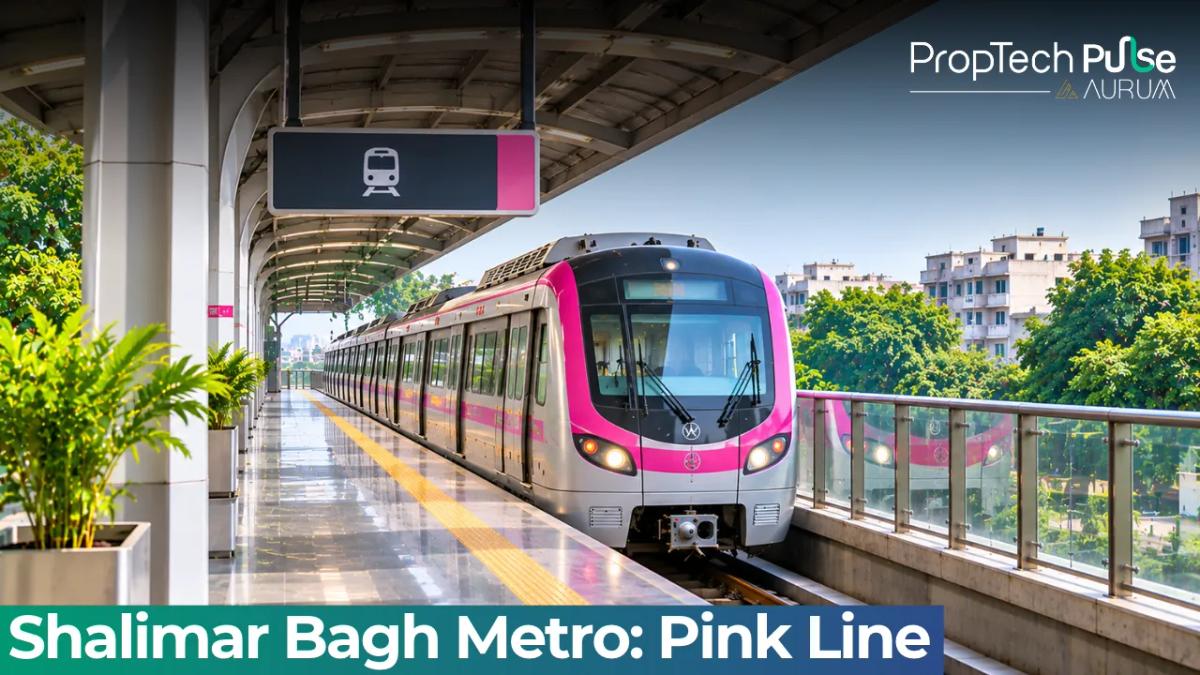
If you are navigating north-west Delhi, the Shalimar Bagh metro station is your direct link to the busy Wazirpur Industrial Area and Computer Market.
Located on the deep-underground section of the Pink Line (Line 7), this station serves daily commuters heading toward Azadpur, Rajouri Garden, or Shaheed Sthal.
The station layout trips up many passengers because of its circular service pattern.
Knowing which platform catches you to Azadpur versus Netaji Subhash Place saves time and avoids backtracking across the concourse. Below is a verified, commuter-focused breakdown of the gates, timings, and route logic for late 2026.
Quick Facts & Station Code
Quick answer
Shalimar Bagh metro station sits on the Pink Line (Line 7) operated by Delhi Metro Rail Corporation. Opened in March 2018, it features a deep-underground design with five exit gates mapping directly to residential blocks and the Wazirpur business district. Daily commutes run from 06:06 to 00:32 depending on direction, with peak frequencies under six minutes.
Here is the core station data:
| Feature | Details |
|---|---|
| Operator & Line | DMRC | Pink Line (Line 7) |
| Opening date | 14 March 2018 |
| Address | Block AG, Poorbi Shalimar Bagh, Delhi – 110088 |
| Structure type | Deep underground (approx. 16m depth) |
| Total platforms | 2 island platforms |
| Total exit gates | 5 gated entrances |
Which Line Is Shalimar Bagh Metro? Understanding the Pink Loop
The Shalimar Bagh metro belongs to the Pink Line, Delhi’s longest operational corridor stretching from Majlis Park to Shaheed Sthal.
Because the line passes through the central cluster of transfer stations near Kashmere Gate, the tracks form a partial circle around the city centre.
Platform 1 vs Platform 2: Which Way Does the Train Go?
The circular service pattern trips up most first-time riders. Instead of simple straight-outbound trains, the Pink Line runs two distinct loops from this station. The tracks physically split after leaving the platform, curving in opposite directions before looping back around the central nodes.
- Platform 1 (+ Loop): Trains travel clockwise. You head toward Azadpur, Kishanganj, and eventually loop back to Janakpuri West.
- Platform 2 (- Loop): Trains travel anti-clockwise. You head toward Netaji Subhash Place, Dwarka Sector 21, and loop back to Rajouri Garden.
That setup requires extra attention when scanning destination LED boards before stepping onto the tracks. Standing on the wrong side of the yellow safety strip wastes valuable minutes.
Commute tip Always check the destination board on the train or ask the assistant before boarding. If you mistakenly take the wrong loop at Shalimar Bagh, you can still switch platforms inside the station, but you will add roughly fifteen minutes to your commute.
A key transit hub like this directly influences resale values and rental demand. If you evaluate an investment nearby, understanding how transport cuts commute friction explains premium pricing on adjacent streets. See our guide on how proximity to a metro station affects apartment pricing to benchmark the premium you should expect.
Shalimar Bagh Delhi Nearest Metro: Location & Address
When people search for the Wazirpur nearest metro station, Shalimar Bagh is consistently the correct answer.
Officially, the address reads Block AG, Poorbi Shalimar Bagh, New Delhi – 110088. The entire structure sits below grade, meaning there is no ground-level entrance.
You descend via stairs, escalators, and lifts into the concourse level before accessing the platforms.
This depth was chosen to avoid disrupting the dense commercial footfall above, though it adds a vertical trek for those carrying luggage or bulky equipment.
All 5 Gates at Shalimar Bagh Metro: Landmark Mapping
Misusing the wrong gate means crossing traffic-heavy roads like the Outer Ring Road or walking past half a kilometre of closed shutter markets. Use this mapping to pick the right exit immediately upon surfacing.
| Gate Number | Direct Access / Landmarks |
|---|---|
| Gate 1 | KV School AG Block, residential society entrances |
| Gate 2 | AG Block main market, local banking hubs |
| Gate 3 | Ashok Vihar Phase IV boundary, Wazirpur Fire Station |
| Gate 4 | Wazirpur Computer Market, EPFO regional office |
| Gate 5 | DTC Bus Stand approach, lesser-used commercial lanes |
Gates 4 and 5 give professionals the shortest path to the computer market. Searching the new delhi shalimar bagh pin code while house hunting? Note this practical detail: deliveries and tenant move-ins align much better once you know which gate faces the active construction zone.
First and Last Train Timings from Shalimar Bagh
Delhi Metro generally opens between 05:30 and 06:00 across lines, but exact departure times from Shalimar Bagh vary by direction. Below are the confirmed window timings.
| Direction | First Train | Last Train |
|---|---|---|
| Towards Azadpur | 06:46 | 00:32 |
| Towards Netaji Subhash Place | 06:06 | 23:06 |
Train Frequency & Peak vs Off-Peak Intervals
Frequencies tighten drastically during rush hours. On weekdays, trains arrive every 5 minutes 10 seconds to 5 minutes 43 seconds between 08:00 to 10:00 AM and 05:30 to 08:30 PM. Weekend service stretches to roughly 8-minute intervals.
Off-peak daytime hours hold steady around 6 to 7 minutes. Checking the DMRC app before stepping out lets you time your arrival perfectly.
Fares, Ticket Counters & Payment Options
As an underground interchange node, fares scale with distance rather than staying flat.
A standard single-journey card costs between ₹20 and ₹50 for short hops within North Delhi. The fare scales significantly higher if you travel south toward HUDA City Centre or Botanical Garden.
Season cards and corporate passes bypass the ticket counter entirely at automated readers. Smart card kiosks, automated vending machines, and the manual counter all accept UPI, debit cards, and cash.
The smart card remains the most economical option for weekly commuters.
It offers discounted reload rates compared to single-use tokens. Keep a spare recharge handy, because machine queues swell instantly during peak morning rushes.
Interchange Points & DTC Bus Stand Connection
Shalimar Bagh hosts no direct physical interchange. It links into the wider network via delhi sarai rohilla nearest metro station guide timings for cross-town transfers further north.
The major transfer hub remains Kashmere Gate, requiring a change to the Violet or Yellow Line for east-west cross-city travel. Immediately outside Gate 5 sits the dedicated DTC bus stand.
Buses originating here connect Shalimar Bagh directly to Rohini sector plazas, Pitampura, and Ashok Vihar.
The walk to the bus bay takes about three minutes, making it highly practical for last-mile coverage without calling out-of-state cab services.
Station Facilities: Lifts, Escalators & Accessibility
Because of the 16-metre depth, vertical mobility defines your experience here. Three high-capacity lifts and seven dual-direction escalators are spread across the gates and platforms.
The station holds full Divyang-friendly certification. Wheelchair ramps line the stairwells leading to lift bays, and braille tiles track along the main concourse walkways to assist visually impaired passengers.
Mobile charging stations are available on the mezzanine floor. Both paid and unpaid toilet blocks maintain daily sanitation rosters.
Final Check Before You Board or Buy
If you rely on this station daily, download the DMRC Trip Planner app and save your home-to-work route to account for weekend frequency drops. For investors scouting the area, always pair the transit data with current micro-market prices. Compare current valuations against historical highs by reviewing rates and trends new delhi shalimar bagh.
Cross-reference the new delhi shalimar bagh pin code listings to verify your target building falls inside the immediate walking radius. Staying outside that ring means longer walks.
Frequently asked questions
Which line is Shalimar Bagh metro station?
Shalimar Bagh lies on the Pink Line, officially designated as Line 7 of the Delhi Metro network. Operated by the Delhi Metro Rail Corporation, this stretch handles heavy weekday passenger volumes connecting north-west suburbs to the central business clusters.
What is the last train timing from Shalimar Bagh?
The final departure depends strictly on your direction. Head north toward Azadpur and the clock shows 00:32 as the cut-off. If you board southward toward Netaji Subhash Place and onward, the shuttles stop running at 23:06. Always verify the day of travel beforehand.
How many gates are there at Shalimar Bagh metro?
There are five separate gated entrances spread across the station perimeter. They manage foot traffic flows toward Ashok Vihar, Wazirpur Computer Market, and local residential complexes. Each gate funnels passengers onto the concourse level before dropping them down to the underground platforms.
Which metro station is closest to Wazirpur industrial area?
Shalimar Bagh serves as the primary railhead for the industrial belt. While other corridors touch the outskirts of the zone, this station places you within a ten-minute walk of the heavy machinery workshops and trade offices. No alternative Delhi Metro stop offers a shorter path.
Is Shalimar Bagh metro station underground?
Yes, the station is fully buried approximately sixteen metres below street level. This deep-cut design avoids cutting through the dense commercial roads above. Passengers must descend via stairs, escalators, or elevators to reach the tracks, making vertical movement a core part of using the station daily.
Sources
- Delhi Metro Rail Corporation (delhimetrorail.com): Official station directory, line identification, facility counts, and timetables (accessed November 2026)
- Delhi Metro Rail Corporation (delhimetrorail.com): Published fare charts and smart card discount structures (accessed November 2026)
Enjoyed this blog article? Visit PropTech Pulse for more interesting blogs.





Ask Pulse Ai anything about real estate

Unlock the Latest in Real Estate
News, Infographics, Blogs & More! Delivered to your inbox.

