New Launch - India Real Estate Report 2026.

Services
Knowledge Hub
Resources
Tools

Ask Pulse Ai
©PropTech Pulse 2025, All rights reserved.


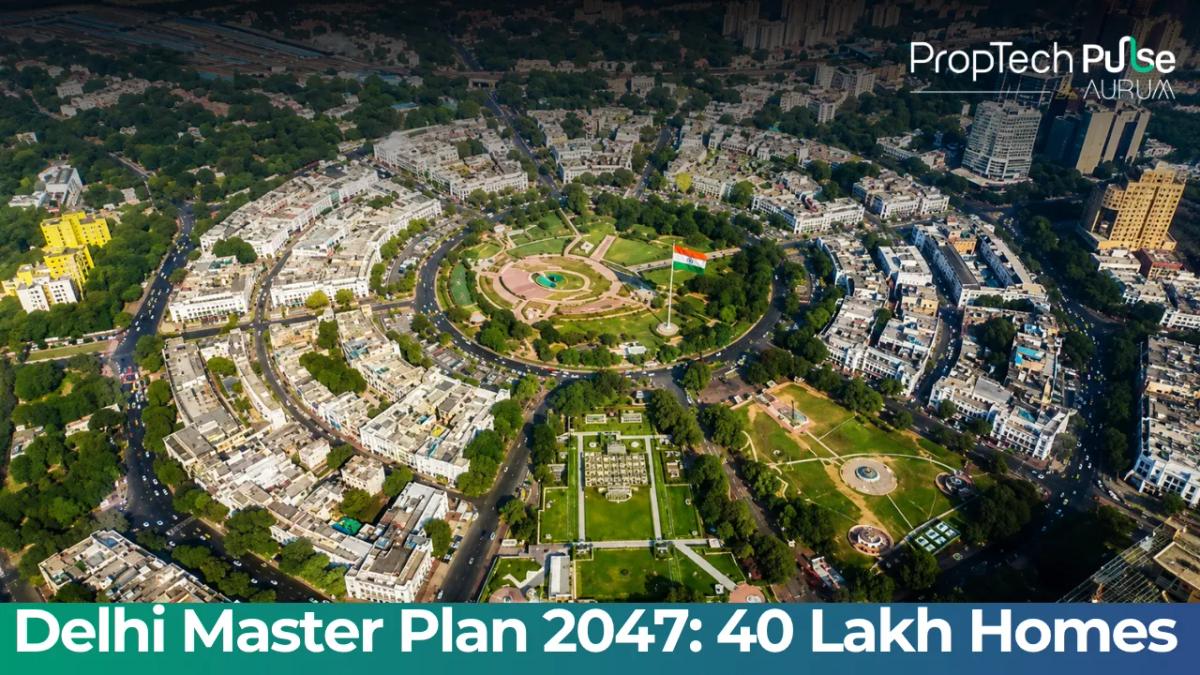
Union Housing and Urban Affairs Minister Manohar Lal Khattar unveiled the Delhi Master Plan 2047 on August 20.
The plan targets 30 to 40 lakh new housing units over the next two decades. The focus is on affordable housing, to accommodate the city's growing population.
Delhi's population has risen sharply over the decades. It grew from 94 lakh in 1991 to 1.38 crore in 2001, and 2.12 crore in 2021.
It now stands at around 2.4 crore. The plan expects the population to reach 3.2 crore by 2047, an increase of 80 lakh people.
The city's total land area remains fixed at 1,483 square kilometres, adding pressure on planners.
The plan aims to meet housing demand through redevelopment, densification of existing neighbourhoods, transit-oriented development and land pooling in new areas.
Metro expansion and transit-oriented development
Khattar said Delhi's metro network will expand to 695 km by 2047. Six new Regional Rapid Transit System (RRTS) corridors will also be developed.
Under the plan's transit-oriented development (TOD) norms, high-density mixed-use development is planned within 500 metres on either side of metro corridors. A similar 500-metre radius applies around RRTS, railway and high-speed rail stations.
The plan also proposes:
- Multimodal transit hubs at Anand Vihar, Sarai Kale Khan and Kashmiri Gate
- A unified parking management system
- Relaxed Floor Area Ratio (FAR) for various categories near transit corridors
Building norms relaxed, height caps lifted
Building height norms have been removed across most of Delhi. Exceptions include the Lutyens' Bungalow Zone, Civil Lines, Connaught Place, the Yamuna floodplain and Ridge, Land Pooling Areas, Low Density Areas, and zones restricted by heritage authorities.
For plotted residential housing outside these zones, the plan sets a maximum height of 15 metres without stilt parking, and 17.5 metres with it.
Commercial activity will be allowed on ground floors along 30-metre-wide roads. The plan also opens the door to very tall buildings, classifying structures over 100 floors as "landmark developments."
A proposal for round-the-clock "24-hour city" zones is also included, alongside dedicated 24-hour Metro connectivity for those areas.
Chief Minister Rekha Gupta said the plan prioritises housing for all sections of society, including slum redevelopment through a public-private partnership model coordinated between the DDA and the Delhi government.
Also Read: DDA Approves Delhi Master Plan 2047 for Affordable Housing
What real estate experts say about the plan
Amit Goyal, Managing Director of India Sotheby's International Realty, said the notified plan gives the industry long-awaited certainty.
He called transit-oriented development the plan's real value driver, saying roughly 40 lakh additional dwelling units matches the scale of supply the capital needs.
He noted that the draft's Green Development Area policy, covering around 69 villages, does not appear in the final notified plan.
Parveen Jain, president of NAREDCO, called the plan a positive, development-oriented step for the city's real estate sector.
Harsh Vardhan Bansal, president of NAREDCO Delhi, said its focus on planned development and flexible mixed-use rules could create a more conducive environment for developers to invest in the city.
Enjoyed this update? Visit PropTech Pulse for more real estate news, investment insights and property market trends.


