New Launch - India Real Estate Report 2026.

Services
Knowledge Hub
Resources
Tools

Ask Pulse Ai
©PropTech Pulse 2025, All rights reserved.


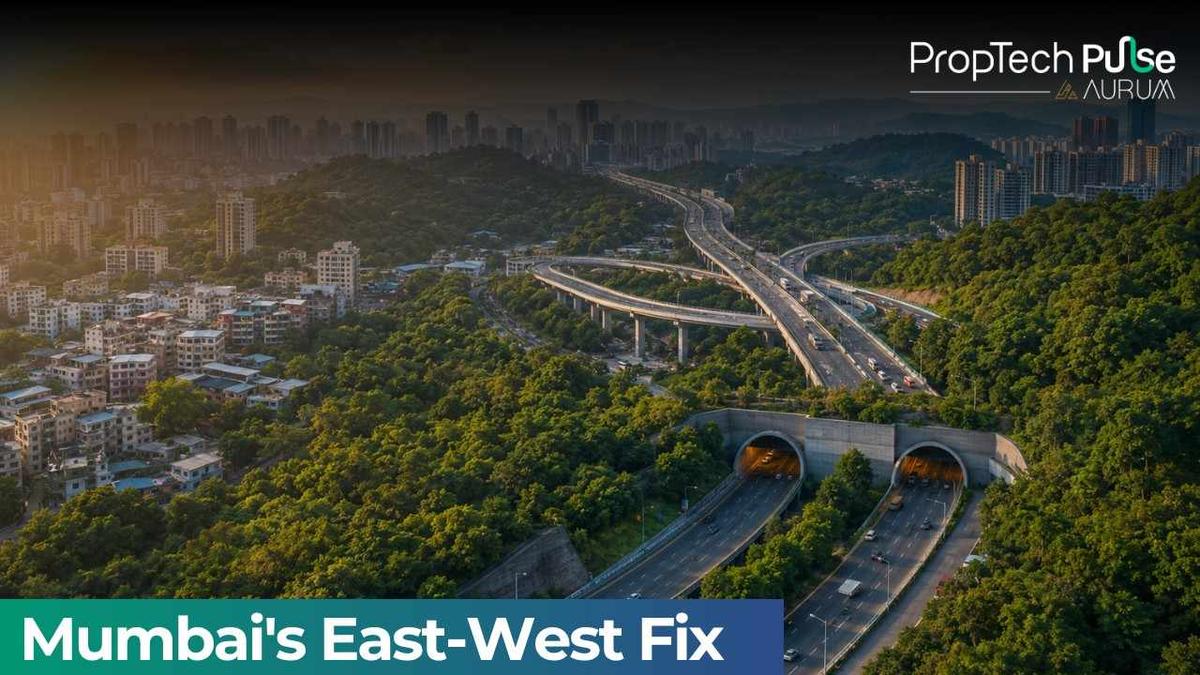
Seventy-five minutes. That's how long it currently takes to get from Goregaon to Mulund, crawling through JVLR traffic or looping around Ghodbunder Road. A new corridor is about to cut that to 25 minutes, and the price signals along its route are already moving before a single tunnel has opened.
What the GMLR actually is
The Goregaon-Mulund Link Road is Mumbai's fourth east-west corridor, after Ghodbunder Road, JVLR and SCLR. It's not just a road. The project spans 12.2 km and includes flyovers, a 6.3 km twin tunnel bored under Sanjay Gandhi National Park, and integration points with the Metro 2A network.
Total project cost sits at Rs 14,000 crore, with the tunnels alone accounting for Rs 6,548 crore. The foundation stone was laid in July 2024, and BMC is executing the project across four phases. Once complete, the commute between Goregaon and Mulund drops from 75 minutes to roughly 25, a reduction that isn't incremental. It's structural.
Where the project actually stands
The first flyover, a 1.3 km stretch from Dindoshi Court to Ratnagiri Hotel junction, is on track to open by the end of May 2026. Tunnel boring machines are being lowered into launching shafts at Goregaon, with boring expected to begin in the first half of 2026. The Mulund flyover package, including a 120-metre cable-stayed structure, is scheduled for June 2027.
Full operational status for the entire corridor, tunnels included, is targeted for 2029. That's a five-year build from foundation stone to completion, which is roughly in line with comparable large-scale Mumbai infrastructure projects, neither unusually fast nor a red flag for delay.
Project Snapshot
|
12.2 km Total corridor length |
Rs 14,000 Cr Total project cost |
2029 Full corridor operational |
Goregaon to Mulund: Before vs After
|
Current 75 min |
After GMLR 25 min |
GMLR Timeline
|
July 2024 |
May 2026 |
|
June 2027 |
October 2028 |
|
2029 |
|
Property Price Signals
|
Rs 32,000/sq ft |
8 to 15% |
|
15 to 25% |
60 to 65% |
The tunnel is the part that actually matters
Building under a national park isn't simple. The 6.3 km twin tunnel runs at depths between 20 and 160 metres, and the Centre has already approved forest land diversion, clearing what's typically the hardest regulatory hurdle for a project like this. The design includes zero surface-level ventilation outlets, meaning no disturbance to the forest canopy above.
Flyovers opening in 2026 provide immediate local traffic relief. But the tunnel is what unlocks genuine east-west connectivity, and it's the tunnel completion that analysts are pointing to as the real trigger for the projected price movement.
What the numbers say about property impact
Goregaon West currently averages around Rs 32,000 per sq ft, with micro-markets like Bangur Nagar running Rs 34,000 to 42,000 depending on the project. Year-on-year appreciation has been running at 5 to 11%.
Real estate analysts project 8 to 15% price appreciation across GMLR-connected zones over the next two to three years. The logic tracks a pattern Mumbai has seen before. Properties within 2 km of the SCLR and JVLR access points appreciated 15 to 25% within three years of completion, outperforming the broader market by 8 to 12 percentage points. If GMLR follows a similar curve, and there's no obvious reason it wouldn't given the scale involved, the corridor becomes one of the more concrete infrastructure-to-price stories in Mumbai's current development cycle.
The bigger shift underneath one road project
Mumbai's eastern suburbs currently price at 60 to 65% of equivalent western suburb rates. That gap exists largely because east-west movement has been a genuine bottleneck for decades, not because eastern locations lack demand. GMLR doesn't just help the west. It creates a rebalancing effect, unlocking a pool of buyers who work on the eastern side but have always preferred the social infrastructure of the west, and who've stayed away purely because of the commute.
That's the part worth watching past the flyover openings and press releases. Mumbai's north has been growing along its rail corridors for a century. GMLR is the first project actually built to break the east-west divide rather than work around it, and if it delivers on that promise, the ripple effects extend well past the immediate corridor into how the entire northern suburbs relate to each other.
Enjoyed this update? Visit PropTech Pulse for more real estate news and market insights.


