New Launch - India Real Estate Report 2026.

Services
Knowledge Hub
Resources
Tools

Ask Pulse Ai
©PropTech Pulse 2025, All rights reserved.


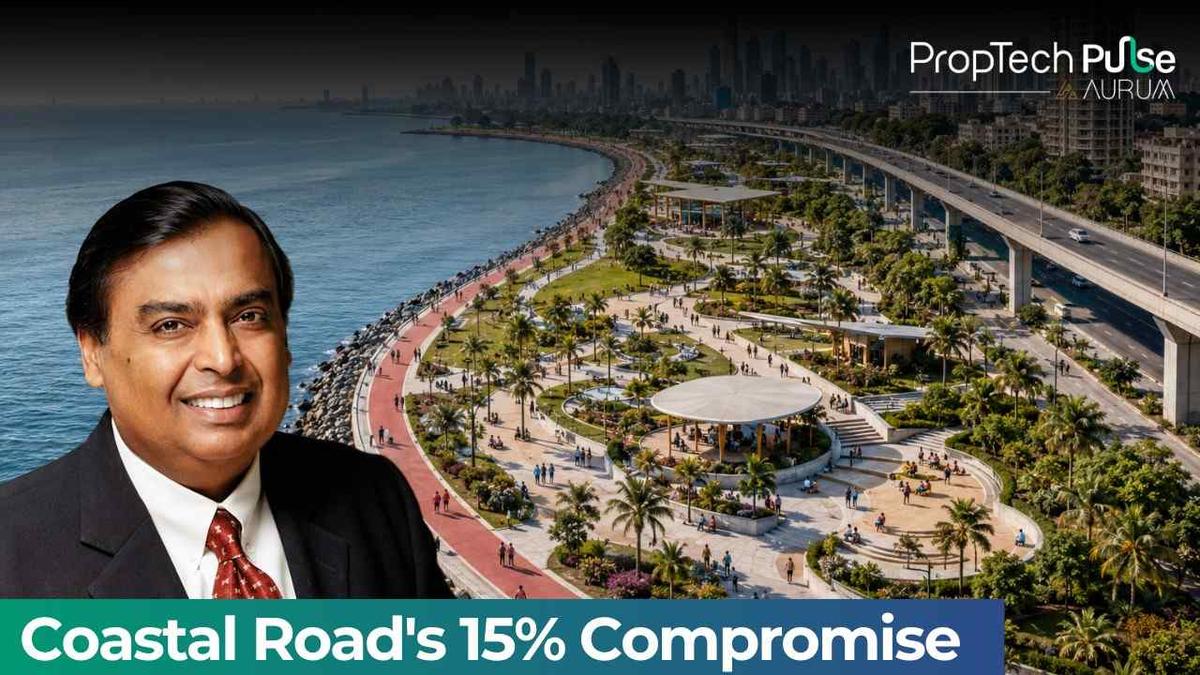
Four percentage points forced an entire redesign. Reliance Industries submitted a revised master plan for open spaces along Mumbai's Coastal Road to the BMC on July 17, cutting the share of ticketed, access-controlled recreational area from 19% down to 15%, the exact ceiling a Supreme Court directive had set the previous month.
What changed and why
The Supreme Court's clarification, issued in June, was unambiguous. A maximum of 15% of public open spaces along the Coastal Road could carry ticketed or access-controlled facilities. The remaining 85% had to stay freely accessible to the public. BMC officials flagged that Reliance's original submission exceeded that threshold, which forced the resubmission.
That's a meaningful design constraint, not a paperwork tweak. Four percentage points across a stretch running from Nepeansea Road to Worli translates into real square footage that had to move from commercial or premium-access use into fully public zones.
What's actually being built
The revised plan spans the entire reclaimed stretch and divides it into six zones: Nepeansea Road, Breach Candy, Mahalaxmi Temple, Haji Ali and Racecourse, Worli South, and Worli North. Planned features include an observation deck, a native tree museum, a scenic overlook toward Haji Ali Dargah, an event lawn at Worli, three cultural gathering spaces, two pet parks (one off-leash), and a food and beverage destination.
This isn't a narrow strip of green along a road. It's a full waterfront public realm project, and the mix of amenities suggests the plan is trying to serve very different user groups across a single long corridor: joggers near Worli, families near the temple zones, dog owners, tourists at the observation points.
The resistance nobody's fully resolved yet
Not everyone's satisfied with the revision. Managing committee members from over 30 housing societies in Breach Candy have formally objected to BMC over proposed access points into their neighbourhood. Their ask is straightforward: a wider green buffer between the public waterfront and residential blocks, and fewer entry points funnelling visitors directly past their buildings.
That tension is worth sitting with. A 15% ticketed cap addresses commercialisation, but it doesn't automatically solve the separate problem of foot traffic volume through residential access points. Those are two different objections, and satisfying one doesn't guarantee the other gets resolved.
Before vs After: Ticketed Area
|
Original Plan 19% Ticketed / access-controlled |
Revised Plan 15% Per Supreme Court cap |
Project Snapshot
|
Submitted by |
Governing body |
|
Stretch covered |
Resubmission date |
The Six Zones
| Nepeansea Road | Breach Candy | Mahalaxmi Temple |
| Haji Ali & Racecourse | Worli South | Worli North |
Planned Public Amenities
|
Observation deck & scenic overlook toward Haji Ali Dargah |
Native tree museum |
|
Event lawn & 3 cultural gathering spaces |
Two pet parks, including one off-leash zone |
|
Food and beverage destination |
|
Resident Opposition
|
30+ housing societies |
Their ask |
Why this matters beyond one stretch of coastline
Large-scale reclaimed public space in Indian cities almost always ends up contested between three competing pressures: commercial viability for whoever's funding development, genuine public access, and the residential communities living immediately adjacent. The Coastal Road project is now a live test case for how that gets adjudicated when a judicial directive, rather than a negotiated compromise, sets the terms.
BMC continues to scrutinise the revised submission, and final approval depends on resolving both the regulatory compliance question and the Breach Candy access dispute. Whichever way this settles, the precedent, a Supreme Court-mandated cap on privatised access within a public infrastructure project, is the part likely to get cited the next time a similarly ambitious waterfront or public space development runs into the same commercial-versus-public tension somewhere else in urban India.
Enjoyed this update? Visit PropTech Pulse for more real estate news and market insights.


