New Launch - India Real Estate Report 2026.

Services
Knowledge Hub
Resources
Tools

Ask Pulse Ai
Services
FOR BUYERS & RENTERS
FOR REAL ESTATE DEVELOPERS








Refer other Connectors &
Multiply IncomeRefer other Connectors
& Multiply Income
Refer KuberX & earn
commission on every
loan they get
disbursed.


Scan & Download
©PropTech Pulse 2025, All rights reserved.


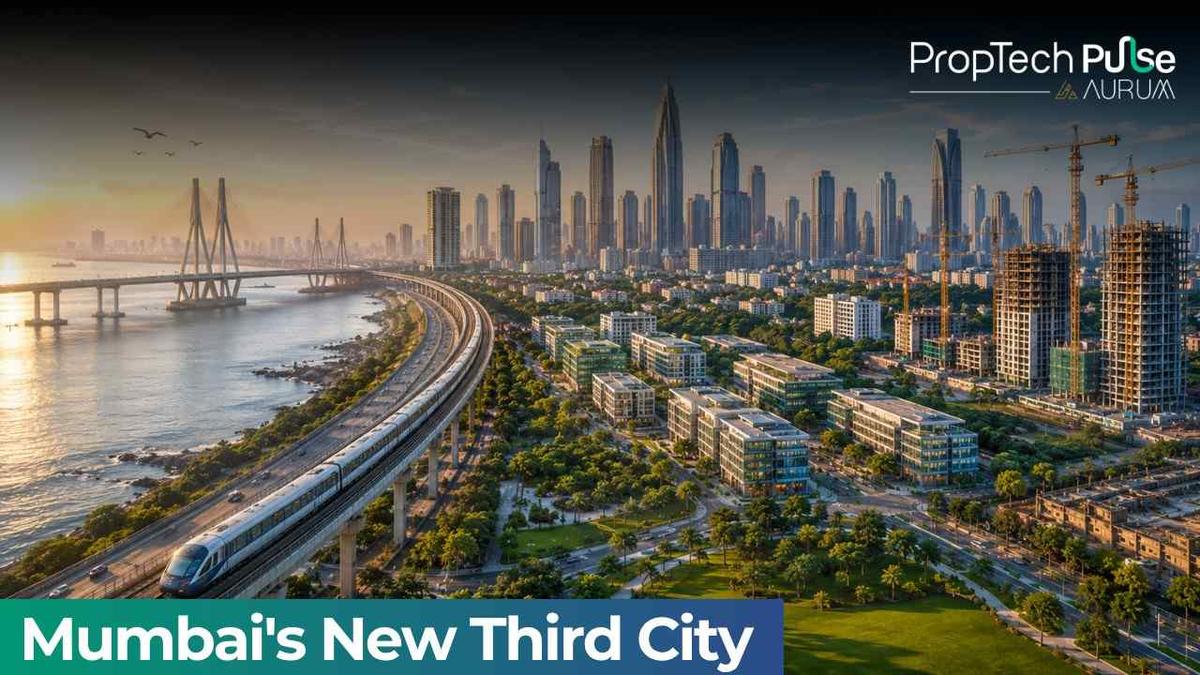
Fifty years after Mumbai's island city ran out of room and the state built Navi Mumbai from scratch across the creek, history is repeating itself at a far larger scale. A new metropolis called Mumbai 3.0 is now officially under construction, and 2026 is the year it stopped being a planning document and started becoming a physical place.
What Mumbai 3.0 actually is
Officially named the Karnala-Sai-Chirner New Town, the project was formally christened by the Mumbai Metropolitan Region Development Authority in October 2024. It spans roughly 323 square kilometres across 124 villages in the Uran, Pen, Panvel and Karjat talukas of Raigad district. Mumbai 1.0 was the original colonial-era island city. Mumbai 2.0 was Navi Mumbai, planned in the 1970s and 80s and now home to over 1.6 million people. Mumbai 3.0 is being built around a new gravitational centre, the Navi Mumbai International Airport, with the ambition of absorbing millions of residents as the region's population heads toward 28 million by 2030. CIDCO is the Special Planning Authority for the NAINA area, while MMRDA leads development for the broader zone.
The infrastructure making it credible
What separates Mumbai 3.0 from just another announced township is the infrastructure already built around it. The Atal Setu sea bridge, operational since early 2024, has cut a 90-minute commute to roughly 20 minutes. The airport itself opened on October 8, 2025, with commercial flights beginning that December, handling up to 20 million passengers annually and scaling toward 90 million over time. Navi Mumbai Metro Phase 1 has run for three years, with extensions planned toward the airport. And the Mumbai-Pune Expressway Missing Link, an eight-lane greenfield bypass, opened on May 1 after seven years of construction. MMRDA's total infrastructure outlay for the region is pegged at more than ₹48,000 crore, backed by an $11 billion commitment secured at Davos in January 2025, of which Blackstone alone earmarked $5 billion for hospitality, retail and warehousing in the zone.
A land model built to avoid India's usual land wars
One of the more unusual features here is how land is being acquired. Under CIDCO's Town Planning Schemes, landowners contribute 60% of their land toward development infrastructure and receive back at least 40% as serviced, legally clear plots. MMRDA calls it India's first participatory land acquisition model, and in April 2026 secured 216 acres through it. A separate policy move cut the NAINA betterment charge from 50% down to just 0.05%, a reduction of over 99%. That single change unlocked a ₹6,000 crore pipeline of CIDCO infrastructure tenders, part of a larger ₹14,300 crore programme and the first such pipeline the region had seen in over a decade.
What the numbers already show
Residential prices in micro-markets around Mumbai 3.0, including Panvel, Ulwe and Khopta, have appreciated 40 to 100% over the past four to five years. Plot values along the Panvel and JNPT-Uran Road corridor have grown at an estimated 10 to 12% annually, well above the region's longer-term average of 5 to 6%. Commercial and warehousing assets in the zone are reportedly yielding 8 to 10%, notably higher than established business districts in Navi Mumbai or the island city. MMRDA and NITI Aayog have set a target of roughly doubling the region's GDP from around $140 billion to $300 billion by 2030, with Mumbai 3.0 positioned as central to that goal.
By The Numbers
|
323 km² Area spanning 124 villages |
₹48,000 Cr MMRDA infrastructure outlay |
$11 Bn Investment secured at Davos 2025 |
|
20 Mn Airport passengers/year (scaling to 90 Mn) |
28 Mn Projected MMR population by 2030 |
$300 Bn Target MMR GDP by 2030 (from $140 Bn) |
Three Generations of Mumbai
|
Mumbai 1.0 The original colonial-era island city |
Mumbai 2.0 Navi Mumbai, planned in the 1970s-80s, now home to over 1.6 million people |
Mumbai 3.0 KSC New Town, built around the Navi Mumbai International Airport, under construction now |
Property Appreciation Around Mumbai 3.0
|
40 to 100% |
10 to 12% annually |
|
8 to 10% yields |
|
Risks To Watch
|
Timeline slippage |
Social infrastructure lag |
|
Early-stage planning |
Legal friction |
What could still go wrong
The Panvel-Karjat suburban rail corridor already missed its December 2025 deadline. Social infrastructure, schools, hospitals and retail currently lag behind the physical infrastructure being built. As of mid-2026, only six NAINA villages have formally sanctioned village development plans. And the land pooling model, while designed to reduce conflict, has still generated legal friction, including at least one Town Planning Scheme dispute requiring an arbitrator. Mumbai 3.0 is, in effect, a test of whether India can deliberately engineer a new city at speed rather than watching one grow organically. Whether that description holds will depend less on the vision and more on how consistently the remaining pieces, the metro extensions, the corridor, the rail link, actually get built on schedule.
Enjoyed this update? Visit PropTech Pulse for more real estate news and market insights.


