New Launch - India Real Estate Report 2026.

Services
Knowledge Hub
Resources
Tools

Ask Pulse Ai
©PropTech Pulse 2025, All rights reserved.


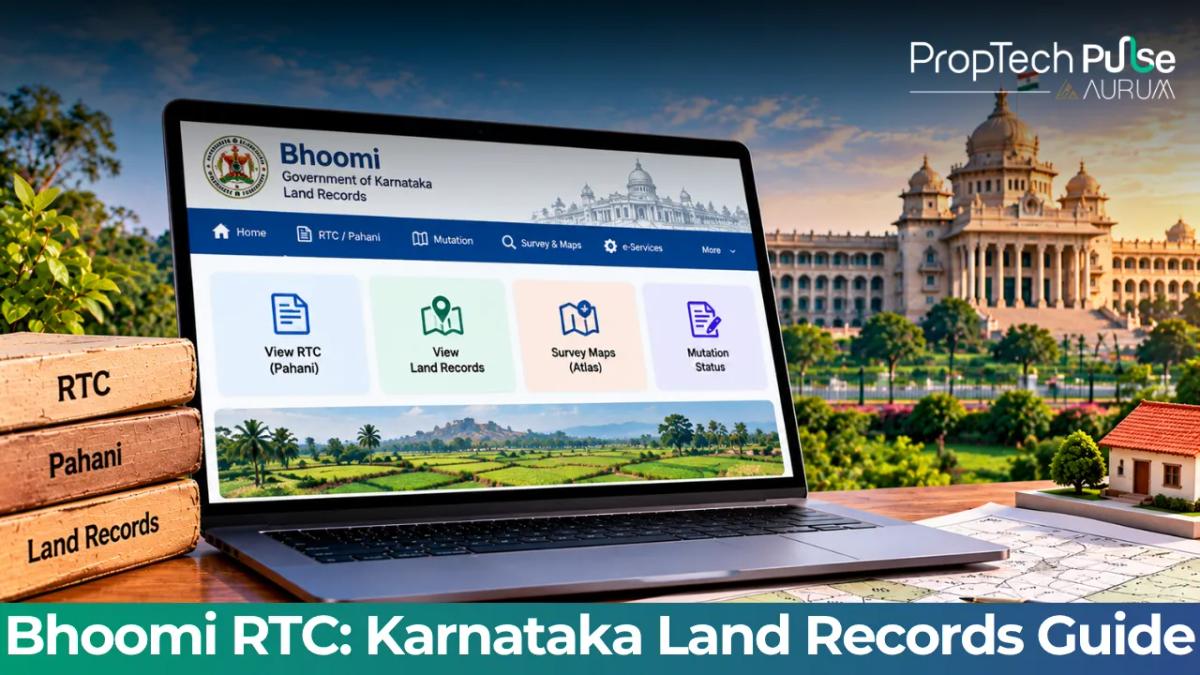
In Karnataka, checking a land title begins on the official portal. Most buyers stop typing as soon as they spot an owner's name. That mistake costs people millions. A basic screenshot hides hidden charges, attached loans, and pending mutations. Protect your advance by reading the liability column first. Cross-reference the survey number against the statewide site map. Learn exactly when a digital download counts as legal proof. Follow these steps before signing anything.
What is Bhoomi RTC (Pahani)?
Quick answer
Bhoomi RTC is the official land record proving ownership in Karnataka. You can view rtc online instantly to check the owner name and land type, but downloading a certified copy requires an OTP login and a small fee. Always cross-check liabilities and mutation status before paying any advance.
This record serves as the backbone of property ownership in the state. Buyers typically request bhoomi rtc to verify names and exact extents in acres or guntas. The database automatically flags soil categories such as dry ayacatha. Each entry determines whether a transaction proceeds or stalls.
A blank remarks field implies clear title until a separate mortgage search changes that assumption. "No Charge" means the parcel sits unpledged. An "Attachment" code reveals a frozen asset. "Charge" flags an active bank loan. Banks must issue formal clearance before transferring marked land.
First-time buyers often ignore everything beyond the opening columns. Skipping the liability section traps purchasers in agreements with pledged parcels. Spotting these markers prevents capital lock-ins. Request a fresh download whenever market prices shift or ownership transfers occur.
Bhoomi Online vs Digitally Signed Copy: Which One You Actually Need
The system offers two distinct outputs. Understanding the difference saves hours at the registrar's office and keeps your documentation compliant with banking standards.
Free Preview: Steps to view rtc online for verification
Open the district-level land records page, select your district, taluk, and village, then enter the four-digit survey number along with the Hissa number. The system generates the Pahani immediately behind a simple captcha challenge. This free version serves one purpose: preliminary verification. It confirms the owner's name and the basic land extent without costing anything.
Treat that preview as a quick fact check while standing on-site or reviewing a broker pitch. It lacks a government signature, meaning banks reject it for processing and courts ignore it during disputes. Use it to build confidence, never to close deals.
Certified i-RTC: Fee, EKYC login & when to download
To get a legally binding document, request the authenticated i-rtc. Mandatory Aadhaar OTP login secures the payment gateway and prevents unauthorised bulk printing. A small fee processes upon successful authentication. You need the certified pdf specifically when preparing a sale deed or submitting proof for a home loan. The embedded signature validates the file across state databases automatically.
| Feature | Free Preview | Certified i-RTC |
|---|---|---|
| Purpose | Initial verification | Legal transactions and loans |
| Digital Signature | None | Government encrypted signature |
| Cost | Zero | Nominal government fee |
| Accepted for Sale Deed | No | Yes |
| Login Requirement | Captcha only | Aadhaar OTP or DigiLocker |
| Best Use Case | Site visits and broker discussions | Bank approvals and deed registration |
Using the Bhoomi Portal Correctly
Drop address-based searches completely. Locality tags change frequently during municipal updates. Survey numbers stay fixed for decades. Select the correct district first, then scroll directly to the matching taluk. Enter the survey number manually to force the latest revision. This approach bypasses outdated cached files.
Verify the on-screen Hissa number against project brochures and broker notes. Agents sometimes quote legacy survey numbers dating back to undivided parent parcels. Unsubdivided entries show up as massive plots when the revenue database hasn't caught up. Physical layouts and digital gaps routinely spark title disputes. See our property legal verification guide for a deeper breakdown of supporting documents.
Jump straight to the remarks section once the document loads. Skip decorative watermarks and footer QR codes. Hunt for court cases, lien holders, or creditor notes. Blank remarks indicate unencumbered titles until legal counsel proves otherwise. Remember that the portal tracks raw land rights only. Structural mortgages never appear on agricultural matrices.
Pro tip: Never trust address-based queries on land portals. Localities get renamed frequently. Stick strictly to the four-digit survey number to retrieve accurate historical data without confusion.
Critical Cross-Checks: Mutation, 11E Sketches & Dishaank Limits
An on-screen owner name does not guarantee clear possession. The Mutation Register proves transfers entered the sub-divisional officer's ledger. State law mandates ninety-day updates. Rural workloads routinely push those deadlines to six or twelve months as officers manage heavy case loads.
Pending status creates friction but rarely voids ownership when sellers retain submission receipts and payment challans. Get those documents right away. Track progress using the acknowledgement number on the public dashboard. Extended waits usually signal bottlenecks that delay final registrations.
Verify boundary alignment for vacant plots using 11E sketches from state mapping tools. Physical markers deteriorate over decades due to floods or unauthorised creeping. The Dishaank app overlays satellite imagery onto village maps. Input ground coordinates to compare against plotted layouts. Push back hard if developers claim satellite data settles boundary arguments. Courts still demand tangible re-surveys.
Pull the SSLR record to confirm the survey block belongs to the claimed taluk. Fraudulent numbers occasionally surface in unregulated layouts aiming to trap unwary buyers into purchasing forest-adjacent zones or restricted corridors.
RTC vs Khata: Why Your Flat Gets Different Records Later
New buyers in Bengaluru often confuse these parallel systems. The rtc governs raw plots across the state. Khata operates strictly as a municipal tool managed by city corporations. Once you pay annual tax for a built structure, the local body updates your extract or issues an electronic Aasthi certificate.
This transition happens when developers secure Layout Approval Certificates for converted residential land. Before conversion, you hold a traditional record. After construction finishes and units hit the market, the society handles the tax ledger via khata transfer. Attempting a flat purchase using only archived records creates administrative mismatches.
Align both layers before releasing payments. Ensure you know how to verify Karnataka RERA registration and khata status for new complexes. Protect yourself from builders who sell titled land but delay municipal integration, leaving you unable to connect utilities later.
Verification Checklist Before Booking a Plot or New Project
Replace guesswork with a strict sequence. Fetch the latest Pahani directly from the portal. Match the listed owner against the agreement seller exactly. Scrutinize liabilities. Withdraw immediately if attachments surface until the seller clears them. Demand mutation receipts listing the seller as transferee. Verify the survey block via SSLR records. Walk the physical perimeter yourself. Check dimensions against digital maps. Require a Conversion Order proving non-agricultural zoning. Agricultural purchases violate state laws and invite demolition. This checklist takes twenty minutes online. It stops capital lock-ups. Booking payments trigger severe buyer-side penalties regardless of title defects. Gather evidence first. Handle finances later. Account for upfront cash needs alongside local stamp duty calculation before signing. Refresh your bhoomi rtc downloads daily during negotiations.
Decision Rule: Pay the Advance Only After Three Digits Clear
Hold all funds until the portal shows an unencumbered name, mutation receipts arrive in your inbox, and survey blocks match ground coordinates. Sellers pushing for digital skips should face indemnity clauses. Keep money in escrow until updates clear. Property markets accelerate quickly. Defective titles freeze for years. Verify now to dodge future litigation. Store your bhoomi rtc copies safely for lenders and legal teams.
Frequently asked questions
What exactly is a Bhoomi RTC?
A Record of Rights, Tenancy and Crops, commonly called a Pahani, is the official land record issued by the Karnataka revenue department. It confirms the owner’s name and exact plot size. The document also flags soil types like dry ayacatha, plus any bank loans or court attachments that block a sale.
How much does it cost to download a signed i-RTC?
The Karnataka government charges a nominal fee for generating a digitally authenticated copy. The exact amount processes through the state payment gateway during checkout. You need to log in with Aadhaar OTP authentication to complete the transaction and secure a legally valid PDF for loan applications or registration counters.
Is the free preview on Bhoomi sufficient for buying land?
The free view provides immediate confirmation of ownership and basic extents, making it excellent for preliminary checks. However, it lacks a digital signature, meaning banks and registrars will reject it for formal procedures. Always request the authenticated version once you proceed to deposit advances or draft agreements.
Can Dishaank app boundaries replace a physical survey?
Satellite overlays track visible changes and general parcel locations efficiently. Developers often rely on the app for rough measurements during early planning stages. The official disclaimer states maps remain for reference only and do not substitute for licensed chain surveys when establishing legal property lines for transactions.
What happens if the mutation shows pending status on Bhoomi?
Pending mutations indicate the revenue office has received your application but has not updated the master register yet. The legal process mandates resolution within ninety days, though field delays often extend the wait significantly. Retain the submission receipt and share it with the seller as proof that the transfer initiated correctly.
Sources
- Land Records Department, Government of Karnataka: Official portal access parameters and service definitions (accessed October 2026)
- Digital Certification Centre, Karnataka: Protocols for obtaining digitally authenticated i-RTCs and state payment procedures (accessed October 2026)
Enjoyed this blog article? Visit PropTech Pulse for more interesting blogs.





Ask Pulse Ai anything about real estate

Unlock the Latest in Real Estate
News, Infographics, Blogs & More! Delivered to your inbox.

