New Launch - India Real Estate Report 2026.

Services
Knowledge Hub
Resources
Tools

Ask Pulse Ai
©PropTech Pulse 2025, All rights reserved.


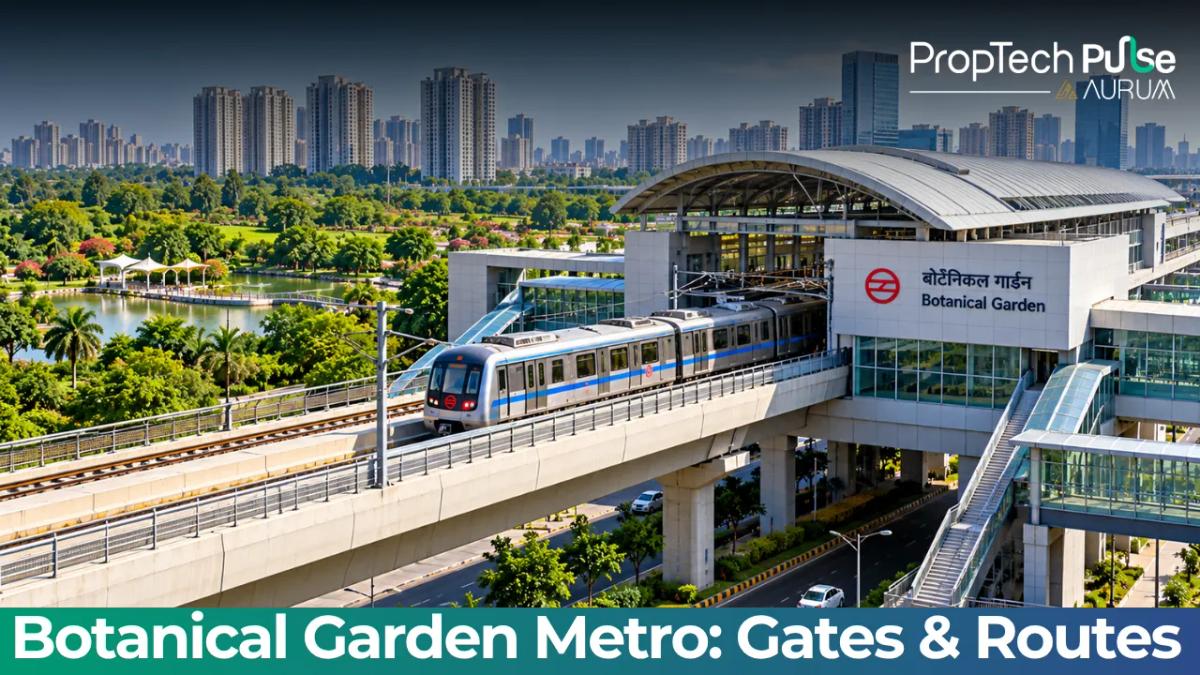
Crossing a busy interchange usually means fighting crowd flow instead of moving fast. This junction separates eastbound commuters from westbound traffic heading to the city center.
Knowing the correct exit matters most if you are timing a morning commute. It also protects your investment when buying property nearby. Misjudging the walk can waste ten minutes every single day.
Strategic Wayfinding: Botanical Garden Metro Gate No. Breakdown
Quick answer
The Botanical Garden metro station functions as the second busiest interchange hub in the network. Correct gate selection depends entirely on whether you are exiting toward office parks, boarding a multi-level car parking ramp, or catching regional buses toward Greater Noida. Knowing the exact drop-off points cuts waiting time during peak hours.
Built directly above the tracks, the concourse acts as a funnel between ground level and the island platforms. Pedestrian traffic splits sharply at the stairwells.
Pedestrian and Office Access (Gates 1, 2, 3 on Captain Vijayant Thapar Marg)
Gates 1 through 3 open onto Captain Vijayant Thapar Marg. They feed straight into the retail strip and offices in Sector 38. Skip the elevators if you need a quick turn. Head to the central foot overbridge stairs to hit the corporate parks or grab lunch from street vendors. Phase III business districts sit right there.
Multi-Level Car Parking Entry (Gate 4)
Gate 4 sits off the main road frontage. It feeds straight into the ramp for the multi-level parking facility. Drivers arriving before 8 am clear this lane fast. Midday returns queue briefly near the automated kiosks. Finding your car after work takes no time once you drop into the ramp.
| Gate Number | Best For | Ground Level Landing |
|---|---|---|
| Gates 1 to 3 | Office workers, retail shoppers, pedestrians | Captain Vijayant Thapar Marg walkways |
| Gate 4 | Vehicle owners dropping off or picking up passengers | Multi-level car parking ramp access |
| Total Zones | Four distinct exit corridors managing peak crowd dispersion | |
Understanding the Layout: Botanical Garden Blue Line and Magenta Line Routes
Transferring lines requires crossing the concourse level. The process adds three to five minutes compared to underground interchanges. Moving smoothly at the botanical garden metro station depends on reading floor arrows and ceiling banners early.
Eastbound and Westbound Platform Flow
Two side-by-side island platforms emerge from the upper concourse. Eastbound trains push passengers toward the outer ring. Westbound services cut straight through to Central Delhi, passing Rajouri Garden. Boarding the wrong carriage is easy to fix since trains switch directions rapidly. Listen for announcements and watch the destination boards above each door.
First and Last Train Timetables for Commuters
Terminal stations set the tempo for the entire branch. Trains originate on schedule regardless of passenger load, keeping frequency tight on rainy weekdays.
Morning departures align perfectly with corporate shifts. Since the magenta line terminates here, rolling stock turns back immediately. The blue line uses this node as a swing point southward.
| Line | Direction (Destination) | First Train | Last Train |
|---|---|---|---|
| Magenta Line | Towards Dwarka Sector-21 | 06:04 AM | 11:31 PM |
| Magenta Line | Towards Janak Puri West | 06:00 AM | 11:06 PM |
| Blue Line | Towards Noida Electronic City | 07:38 AM | 11:55 PM |
| Average Off-Peak Frequency | Every 8 to 10 minutes | ||
Peak hour warning During festival weeks and budget seasons, the 8:30 am to 9:30 am window floods faster than usual. Board the second coach where space exists, rather than pushing for the front doors near the escalators.
Connecting Beyond the Metro: Bus Stops, Parking, and Walkability
Acting as a direct anchor, the station connects to regional surface transport. This reduces reliance on private taxis for last-mile commutes while buses circle the complex.
DTC Routes and the Yamuna Sarthi Link to Greater Noida
Delhi Transport Corporation services run frequent circular routes between residential blocks and commercial centers. Regional operators fill the gaps with Yamuna Sarthi CNG buses headed to YEIDA. Stops sit just beyond the eastern boundary wall, hitting GBU, Dankaur, and Sector 22D. Travelers switching modes at the botanical garden metro station sync their transfers with late evening blue line arrival waves.
Parking Capacities and Ground-Level Amenities
Infrastructure spend focuses on vehicle storage and quick refreshments. The parking zone handles 950 vehicles, splitting 770 slots for bikes and 175 for cars. Monthly passes vanish fast near IT parks. Register at the booth early. The concourse hosts a PNB ATM, a PILO water kiosk, and the AVA dining zone. Grab a coffee at Chaayos without leaving the platform.
Why the Station's Transit Volume Matters for Nearby Real Estate
Interchange status changes how tenants value proximity. Tenants accept higher rents when daily travel shrinks. Landlords near the station see lower vacancies during academic cycles. Developers stack green certifications to justify premium rates. Investors weighing entry points near the botanical garden metro station must measure walkability against actual rental history.
Rental Demand Drivers Along the Corridor
Daily movement of professionals sustains co-living setups and short-term lets. Engineers, finance staff, and support roles cluster in Phase III and Sector 39 because they want to minimize commute friction.
Reliable rail access cuts monthly cab expenses, locking in stronger leases. Builders calculate absorption speeds using this steady footfall. The baseline holds firm even when broader pricing pauses occur.
The NMRC Extension Project and Long-Term Appreciation
Northern Metropolitan Region authorities allocated ₹5,245.95 crore for the Noida Metro Extension Project. The route stretches from the terminus to Sector 142, linking homes to jobs.
Upward mobility compresses land availability, pushing valuations higher within eighteen months of breaking ground. State regulatory portal approvals prevent exposure to unregistered launches. Monitor construction milestones alongside local occupancy certificates.
Before You Commit to a Floor Plan
Transit proximity dictates resale liquidity faster than amenity lists do. Choose buildings within six hundred meters of the exit ramps. Ignore units advertised as metro-facing when they sit half a kilometer away.
Map your own morning route for two weekdays before signing any paperwork. A site walk reveals drainage performance and noise levels that brochures always hide.
Frequently asked questions
Which gate leads to multi-level parking at Botanical Garden metro?
Gate 4 serves the multi-level car parking ramp. It sits away from the main road frontage, directing vehicle owners straight to the automated ticket kiosks and descent lanes under the concourse slab. Drivers entering before 8 am find this lane clear, but midday returns often queue briefly near the payment machines.
What are the first and last train timings at Botanical Garden metro station?
Morning services depart at 06:00 AM for Janak Puri West and 07:38 AM toward Noida Electronic City. Evening trains conclude around 11:31 PM and 11:55 PM respectively, adjusted seasonally by operations teams. Terminal origins keep frequency tight even when passenger loads dip during off-peak weekdays.
Is Botanical Garden metro station an interchange station?
Yes, it operates as an elevated interchange connecting two distinct networks. Passengers transferring between lines cross the central concourse level, adding roughly three minutes to journey times compared to underground stations. The dual-platform design separates eastbound flows from westbound commuters effectively.
How to reach Greater Noida from Botanical Garden metro?
Regional operators run Yamuna Sarthi CNG semi-low-floor buses stopping just beyond the eastern boundary wall. These routes feed directly into Greater Noida and YEIDA sectors, halting at GBU and Dankaur terminals. Travelers switching modes find the transfer timed closely with the late evening blue line arrival waves.
Sources
- Delhi Metro Rail Corporation: Station layout and interchange specifications (accessed October 2026)
- Uttar Pradesh Real Estate Regulatory Authority: Project compliance verification guidelines (accessed October 2026)
Enjoyed this blog article? Visit PropTech Pulse for more interesting blogs.

Ask Pulse Ai anything about real estate

Unlock the Latest in Real Estate
News, Infographics, Blogs & More! Delivered to your inbox.

