New Launch - India Real Estate Report 2026.

Services
Knowledge Hub
Resources
Tools

Ask Pulse Ai
©PropTech Pulse 2025, All rights reserved.


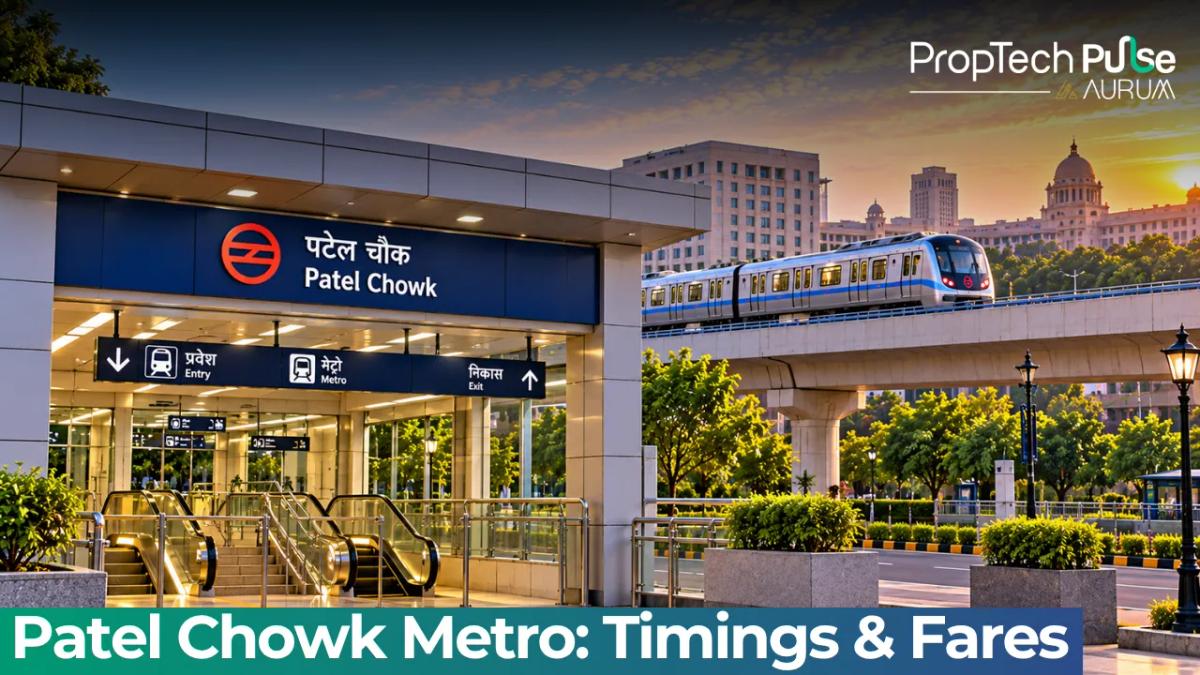
Finding your way through central Delhi metro corridors usually works reliably. Getting lost near Patel Chowk metro station when you have a medical appointment or need to reach Sansad Marg quickly breaks that pattern.
The station sits right at the intersection of government hubs, major hospitals, and tourist zones.
Crowd patterns shift drastically depending on the hour. This guide cuts through the noise with the exact exits you need, realistic parking notes, and current fare data for daily commuters and visitors.
Patel Chowk Metro Station at a Glance
Quick answer
Patel Chowk metro station (code PTC, station number Y-8) lies on the deep-level underground section of the Yellow Line. It connects Sansad Marg, RML Hospital, and Connaught Place through four distinct exit gates. Trains operate between roughly 05:25 AM and 11:55 PM, with smart cards offering a consistent discount over single-use tokens for daily travellers.
Built during Phase 1 of the Delhi Metro network, Patel Chowk opened on July 3, 2005. It became one of the earliest connectors in the central corridor. The station follows a deep-underground layout common to this stretch.
Crews dug roughly 20 meters below surface level to avoid historic infrastructure and heavy traffic flow above ground.
The station serves multiple passenger types simultaneously. Government employees commuting between housing societies and Sansad Marg mix with patients heading to Ram Manohar Lohia Hospital. Tourists also pass through on their way toward India Gate and Jantar Mantar.
Because the surface zone sees such varied footfall, knowing your designated gate before stepping out matters greatly. A five-minute walk turns into a twenty-minute loop if you pick the wrong exit.
Around 35,000 to 40,000 passengers move through the station daily. Crowds peak heavily between 8:30 AM and 10:00 AM. Another surge hits in the early evening rush. Planning your entry point matters just as much as planning your exit.
Station Code, Line & Structure
Patel Chowk falls squarely on the Yellow Line. Trains run from Samaypur Badli in north Delhi down to HUDA City Centre in Gurugram. On the physical track layout, the station carries the identifier PTC.
It holds position Y-8 in the line sequence. Platforms feature an island design. Both directions share the same wide underground concourse level. You choose the left or right staircase or lift for departure once you step onto the platform.
First & Last Train Timings at Patel Chowk Metro
The first morning departure towards Samaypur Badli arrives at the platform around 05:28 AM.
The southbound service heading to HUDA City Centre typically departs at approximately 05:52 AM from this same platform.
Evening services wrap up later. The last northbound train reaches Patel Chowk near 11:35 PM. The final southbound train arrives closer to 11:55 PM.
These times shift slightly on weekends and during operational maintenance windows.
Checking the live schedule board before your return journey is always wise. DMRC generally adjusts the timetable annually based on ridership data and seasonal demand.
Platform Directions & Route Map on the Yellow Line
This stop sits right in the middle of the city centre loop. Once you are on the correct side of the platform, the next stop dictates your direction clearly. Trains heading toward Rajiv Chowk physically move uphill.
Metro officials classify that route as southbound towards the Gurugram end. You will pass through Mandi House, Central Secretariat, and Udyog Bhavan. After that, the line drops into deeper sections near the airport corridor.
Trains towards Central Secretariat continue further south. This path connects directly to the Airports Express Line interchange. You will ride past Race Course, Barakhamba Road, and Janpath.
The route then reaches Rajiv Chowk shortly after.
The Yellow Line runs strictly linear at Patel Chowk metro station. There are no branch splits inside the building.
You simply follow the arrow signage pointing toward either the Samaypur Badli terminus or the HUDA City Centre terminus.
Which Exit Gate Leads Where?
There are four primary public exit gates spread across the northern and southern edges of the station complex. Selecting the wrong gate often means walking all the way back around the block. Here is exactly what each gate feeds into:
| Gate Location | Primary Destinations | Walking Time |
|---|---|---|
| Gate 1 (North side) | Sansad Marg, Lok Kalyan Bhawan, RML Hospital, Pradhan Mantri Office vicinity | 3 to 5 mins |
| Gate 2 (South-west side) | Jawaharlal Nehru Stadium, Connaught Place Outer Circle, Rajendra Place | 8 to 10 mins |
| Gate 3 (East side) | India Gate, Kartavya Path, Rashtrapati Bhawan approaches, National Gallery of Modern Art | 10 to 12 mins |
| Gate 4 (West side) | Pragati Maidan Exhibition Grounds, Pragati Vihar market, Delhi Circus | 7 to 9 mins |
The most common mistake happens to visitors heading to India Gate. They exit through Gate 2 because the signboard points broadly towards CP. They quickly realize they walked away from India Gate.
Always confirm the surface landmark facing your chosen staircase before pressing the turnstile.
If you are navigating a medical visit to RML Hospital or a government office near Parliament Street, treat Gate 1 as your dedicated exit.
Peak weekday mornings bring the heaviest concentrated crowd to this gate.
Commercial buyers eyeing rental yields near transit nodes notice something useful here. The immediate streets connected to Gates 2 and 3 host several mid-rise rental buildings and commercial offices.
Knowing exactly which gate feeds into which commercial strip lets you judge walkability scores properly. how proximity to a metro station affects apartment pricing explains the broader valuation mechanics behind this specific station's catchment area.
Updated Fare Matrix & Travel Costs
Fares on the Yellow Line depend on distance travelled. The matrix resets periodically as DMRC reviews cost structures. The gap between token and smart card prices remains consistent however.
Using a smart card gives you a straight percentage discount on almost every short-haul journey.
| Destination Station | Token Fare | Smart Card Fare |
|---|---|---|
| Rajiv Chowk (North) | ₹10 | ₹9 |
| Central Secretariat (South) | ₹10 | ₹9 |
| Mandi House (North) | ₹10 | ₹9 |
| Dhaula Kuan (South - Airport Line Interchange) | ₹20 | ₹18 |
| Anand Vihar Terminal (Full Line Span) | ₹50 | ₹45 |
| HUDA City Centre (Full Line Span) | ₹60 | ₹54 |
| Annual Smart Card Recharge Discount Example (500 km threshold reached) | Up to 15% off base rates | |
For daily commuters working near Sansad Marg or looping between Rajouri Garden and HUDA City Centre, the smart card pays for itself quickly.
Casual visitors also save money by skipping the token counters. Those counters get backed up heavily between 08:00 AM and 09:30 AM.
If you are travelling with a large group or small children, keep basic concession rules in mind.
Child tickets require physical age verification at the ticket window. Smart cards loaded with family profiles handle age discounts automatically. Load one card for the whole group whenever possible.
Nearby Landmarks, Hospitals & Commercial Hubs
Patel Chowk acts as a pivot point for some of the capital busiest zones. Distance estimates measure from the nearest gate to the destination doorstep. We calculated these under normal walking conditions without road crossing delays.
| Landmark / Destination | Type | Distance from Nearest Gate |
|---|---|---|
| Ram Manohar Lohia (RML) Hospital | Medical Facility | ~100 m (Gate 1) |
| Sansad Marg / Parliament Street | Government Zone | ~250 m (Gate 1) |
| Connaught Place Inner Circle | Shopping / Transit Hub | ~750 m (Gate 2) |
| India Gate & Kartavya Path | Tourist / Monument | ~1.5 km (Gate 3) |
| Jantar Mantar | Heritage Site | ~600 m (Gate 2) |
| Pragati Maidan Exhibition Complex | Event Space / Market | ~800 m (Gate 4) |
| National Gallery of Modern Art | Cultural Institution | ~500 m (Gate 3) |
The hospital connection at Gate 1 deserves special attention for patient visitors.
RML stands as one of the oldest teaching hospitals in the country. Emergency cases arrive around the clock daily. Knowing that the metro entrance feeds directly onto the approach road saves valuable time during urgent visits.
Station Amenities, Accessibility & Park-and-Ride Reality
Accessibility infrastructure at Patel Chowk matches the standard DMRC requirement for central corridor stations. Elevators connect all platform levels to the concourse floor.
Wheelchair users and passengers carrying heavy luggage navigate vertically without stairs. Escalators run continuously in both directions on the main staircases.
The station includes tactile guiding paths for visually impaired commuters. These paths run from the turnstile area directly toward the waiting queue on the platform.
Divyang-friendly washrooms equipped with grab rails and emergency call buttons sit on the concourse level near the ticket counter zone. Water dispensers and drinking fountains are also available at ground level.
Parking near Patel Chowk operates differently than in the residential suburbs. No structured park-and-ride facility attaches to the station.
Surrounding lanes feed into extremely tight street parking that shifts quickly. Attempting to drive a car here solely to catch a local train is usually inefficient. Only book a parking spot if you are visiting a nearby meeting rather than commuting long-distance.
Peak Hours Alert Between 08:30 AM and 10:00 AM, Gate 1 experiences continuous surges from government office workers. If you are heading toward Sansad Marg or a RML appointment, plan to arrive ten minutes outside this window if possible, or be prepared for queue management staff holding the turnstiles open manually to prevent platform congestion.
ATMs from major national banks sit immediately outside the concourse exit.
Food stalls and tea kiosks scatter around Gate 3 and the eastern plaza. Afternoon commuters rely on these spots for quick refreshments.
The surface transport integration relies heavily on Delhi Transport Corporation buses stopping along Janpath and Rajkot Road.
Stand clear of the curb markings while bus schedules align with arriving trains. Smooth transfers happen when you step aside. Coordination between the metro and surface fleet improves significantly during major events held at Pragati Maidan.
Temporary shuttle routes override fixed bus lines during those weeks.
Making the Most of Your Trip
Patel Chowk functions as a structural hinge in the Delhi Metro system.
Renters evaluating units near Connaught Place take note. Government employees relying on Sansad Marg access understand it too. The four-gate layout defines your real daily commute more than train frequency ever could.
Carry a reloadable smart card at all times. Pick the gate aligned with your final sidewalk destination instead of chasing the closest signboard.
Time your exit to avoid the absolute peak congestion windows. Patel Chowk metro station rewards prepared travelers every single day.
Frequently asked questions
What is the station code for Patel Chowk metro?
Patel Chowk station carries the code PTC and sits at position Y-8 on the Yellow Line. The Y prefix indicates it belongs to the original Phase 1 corridor constructed alongside lines like Blue and Red. Every station on the Delhi Metro network uses this dual coding system to identify line membership and sequential track order. When booking tickets or consulting route maps online, referencing Y-8 ensures you are pulling up the correct underground platform configuration.
How many gates are at Patel Chowk metro station and where do they go?
There are four public exit gates arranged across the northern and southern boundaries of the station. Gate 1 leads directly to Sansad Marg and RML Hospital. Gate 2 connects to Jawaharlal Nehru Stadium and Connaught Place Outer Circle. Gate 3 provides access toward India Gate, Kartavya Path, and the National Gallery of Modern Art. Gate 4 opens toward Pragati Maidan exhibition grounds and Delhi Circus. Choosing the right gate avoids crossing major intersections twice during your walk.
What are the first and last train timings at Patel Chowk?
Trains depart toward Samaypur Badli at approximately 05:28 AM, marking the start of the morning service window. The first southbound train to HUDA City Centre leaves around 05:52 AM. Evening services conclude with the final northbound train arriving near 11:35 PM and the last southbound service hitting the platform at 11:55 PM. Slight variations occur during holiday periods or scheduled engineering maintenance nights when trains run at reduced frequency until 10:45 PM.
Is Patel Chowk an interchange station?
No, Patel Chowk is not an interchange station. It serves exclusively as a Yellow Line node with two directional tracks sharing a single underground concourse. Passengers wishing to switch lines should head to Rajiv Chowk one stop to the north, which offers interchange options, or continue south to Central Secretariat to access the Airport Rapid Metro Line. Keeping this linear path in mind prevents unnecessary platform changes or confusing detours through wider transfer hubs.
How to reach Connaught Place / India Gate / RML Hospital from Patel Chowk metro?
For RML Hospital, exit immediately through Gate 1 and follow the direct pedestrian pathway running parallel to Sansad Marg; it takes roughly five minutes. To reach Connaught Place Inner Circle, take Gate 2 and walk south along Rajkot Road turning toward Janpath before looping east into the circular road; expect an eight to ten minute walk. India Gate requires exiting via Gate 3 and walking straight east along the widened Kartavya Path boulevard, which covers about fifteen hundred metres in comfortable daylight conditions.
Sources
- Delhi Metro Rail Corporation (DMRC) Station Directory: Station layout, platform details, and gate mapping (accessed October 2026)
- DMRC Official Timetable: First and last train departure and arrival records for Yellow Line terminals (accessed October 2026)
- DMRC Fare Matrix: Current token and smart card tariff slabs for short and long-haul routes (accessed October 2026)
- DMRC Delhi Metro Museum Guidelines: Entry protocols and visitor logistics (accessed October 2026)
Enjoyed this blog article? Visit PropTech Pulse for more interesting blogs.

Ask Pulse Ai anything about real estate

Unlock the Latest in Real Estate
News, Infographics, Blogs & More! Delivered to your inbox.

