New Launch - India Real Estate Report 2026.

Services
Knowledge Hub
Resources
Tools

Ask Pulse Ai
©PropTech Pulse 2025, All rights reserved.


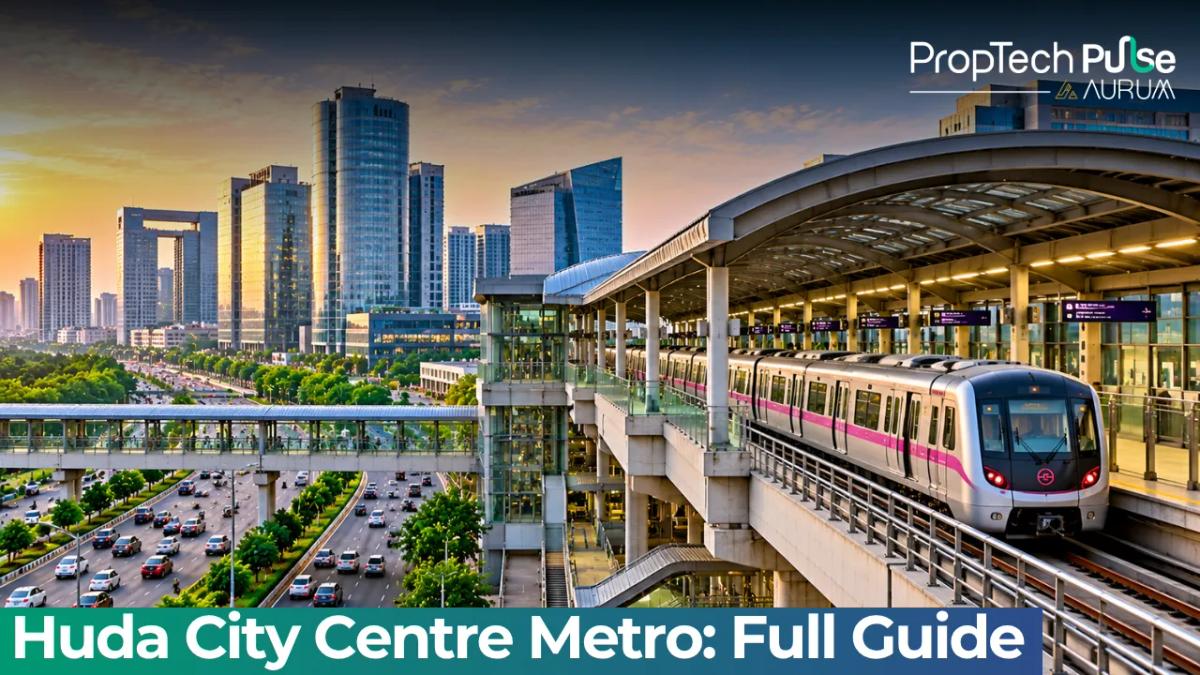
Commuting from Central Gurgaon means you need to know exactly which exit works best at the northern terminus of the Yellow Line.
Legacy search terms keep driving traffic toward Huda City Centre metro station, even though authorities renamed the hub to Millennium City Centre Gurugram back in July 2023. Picking the correct gate saves fifteen minutes during peak hours and stops confusion when catching connecting buses.
We map the exact platform layout, break down exit strategies for Gates 1 to 3, list current timings and fares, and outline connectivity for renters in Sectors 29, 43 and 44.
Updated Name: Millennium City Centre Metro Station
Quick answer
The former Huda City Centre metro station was renamed Millennium City Centre Gurugram in July 2023. It remains the northern terminus of the Delhi Metro's Yellow Line.
Administrative clarity matters for legal documents, rental agreements and business mail, so use the updated title.
The Haryana Mass Rapid Transport Corporation Limited changed the name to mirror the district's expanding corporate footprint. While old signage fades, digital maps now confirm the shift. Stick to the new title for all formal paperwork.
If you are searching for directions, ticket counters operate using both names interchangeably. You will find the station easily whether you type the legacy query or the modern title into a map application.
Legacy queries like Huda City Centre metro station still dominate local search traffic, but official operations follow the Millennium timeline.
Location & Connectivity
Positioned at the absolute northern end of the Yellow Line. Searches for the Huda metro station gurugram lead directly to the city's primary transit interface connecting to North and East Delhi. Trains originating here traverse major junctions including Rajiv Chowk, Shaheed Sthal (New Bus Adda), Rohini West and conclude at Samaypur Badli in Delhi.
The station sits close to the Gurugram-Mawana border. This positioning makes it a natural gateway for long-distance bus terminals nearby, integrating road travel with rail commutes.
The station acts as a critical feeder for commercial hubs spanning Gurugram's central belt. It funnels thousands of professionals into the capital daily.
Unlike intermediate stations where lines extend indefinitely, platforms here are engineered to allow train reversal. Intermediate stations hold trains moving forward.
Platforms here engineer train reversal specifically for terminating coaches. Understanding this mechanics is crucial for passengers boarding at this stop, particularly those unfamiliar with the network.
Gate-by-Gate Exit Strategy
Picking the wrong exit adds unnecessary distance, especially when carrying luggage or traveling with elderly family members. Finding your way through the Millennium City Centre metro complex requires awareness of its split layout.
The station features multiple entry and exit points spread across the perimeter. Each gate aligns with specific high-traffic landmarks and commercial zones.
| Gate Number | Primary Landmark | Best For | Walking Distance |
|---|---|---|---|
| Gate 1 | Max Super Speciality Hospital | Healthcare visits, Unitech Business Park employees | Approximately 5 minutes |
| Gate 2 | Gymkana Club, Sector-29 | Residents of Sectors 28 and 29, club members | Approximately 2 minutes |
| Gate 3 | Signature Towers, DLF Cyber City extension | IT and corporate park professionals | Approximately 1 minute |
| Total Gates Accessible | Three dedicated exits | N/A | N/A |
Gate 1 features a paved walkway leading straight to the medical complex. Visitors attending outpatient departments or emergency consultations benefit immensely from this shortest route.
They bypass heavier vehicular traffic found on the adjacent ring roads. Employees working in nearby technology parks also utilize this corridor regularly.
Passengers exiting through Gate 2 land almost directly onto the pavement servicing the residential stretches of Sector 29.
Families returning from school runs or evening errands at local markets prefer this path due to its proximity to neighborhood commercial strips. Cyclists frequently navigate this route given the flat terrain.
The modern skyline of Signature Towers dominates the approach to Gate 3. Tech workers exiting late from flexible shifts often queue here because it opens directly toward the glass-facade offices.
The pedestrian flyovers associated with this gate separate foot traffic completely from the busy highway running parallel to the station.
RSRTC and private operators stand outside Gate 2 and Gate 3 primarily. If you are transferring to a road journey bound for Jaipur or Chandigarh, checking your bus operator's designated boarding point upon arrival prevents wandering past the wrong vehicle.
Station Facilities: Timings, Fares, Parking & ATMs
Timing your trip avoids the worst weekday surges, which typically hit between 8:30 AM and 9:30 AM. Early shifts benefit from 5:45 AM departures, while late returns track schedules until the 12:49 AM cutoff. Plan your commute windows around these fixed departure times.
Fare structures rely on distance-based tiers rather than flat pricing. A single journey ticket taken from this station to the furthest northern endpoint, Samaypur Badli, commands a fee of ₹60. Children below six years of age ride free provided they do not occupy a separate seat. Students holding valid institutional passes enjoy heavily discounted rates across the network.
Rush hour survival tip: Carry your Delhi Metro card pre-loaded before hitting the turnstile. Keeping your mobile wallet handy allows instant top-ups if funds run dry mid-commute. Avoid the secondary pathways near Gate 2 after 9:00 AM; the narrow sidewalks create severe bottlenecks with commuters heading toward DLF Cyber City.
Daily commuters save significantly by swapping single cash tickets for automated passes. A Sector 43 resident booking a ₹120 round trip twice daily spends ₹2,640 over twenty-two workdays.
Standard monthly passes drop that figure to roughly ₹2,200. You cut costs immediately while skipping turnstile queues.
Cash handling anxiety disappears thanks to the banking infrastructure located inside the paid zone.
Major networks including HDFC Bank, State Bank of India, Yes Bank and IndusInd Bank maintain functional automated teller machines. You can access these without leaving the secure transit area.
Vehicles requiring storage have designated parking facilities within the perimeter. Two-wheelers occupy segregated racks that see heavy occupancy before 10:00 AM. Four-wheelers sit in a larger lot where paid slots start at nominal hourly rates.
The fee structure updates annually, but remains competitive relative to valet parking costs inside nearby malls.
Nearby Localities & Infrastructure
The transit hub anchors one of Gurugram's oldest residential markets. Real estate dynamics here differ vastly from emerging micro-markets driven purely by speculative demand.
Properties radiating outward from the station command premium pricing. Owners find consistent liquidity whenever they decide to sell or lease.
Sector 29 holds the highest concentration of independent homes. Families prioritizing space over vertical living often target the large duplexes here. Apartments closer to the station boundaries rent quickly to young corporate couples seeking reduced commute friction. Checking how proximity to a metro station affects apartment pricing reveals why transit-oriented assets consistently outperform peripheral locations during market downturns.
Bridging the gap between vintage charm and rapid redevelopment defines Sector 43. Older layouts face demolition pressure as developers assemble plots for modern township integrations. Investors tracking this shift should review Haryana RERA project registration details to verify builder legitimacy before allocating capital.
Educational infrastructure supports the demographic heavily. Institutions like NorthCap University and multiple branches of Shri Ram School sit within a three-kilometer radius.
This ensures steady academic year migration of students into short-term rentals. Parents frequently choose housing based on institutional proximity rather than luxury finishes alone.
Max Super Speciality dominates the local healthcare narrative.
Its proximity supplements Fortis and Medanta campuses located slightly further along the National Highway. Emergency access directly improves the livability score of every building within shouting distance.
Retail consumption thrives in the shadow of the station.
Open-air plazas offer dining options ranging from quick coffee joints to family entertainment centers. Weekend footfall transforms quiet lanes into buzzing precincts. This dynamic drives up small-business valuations considerably.
Gurugram Metro Route: complete station guide explores additional connectivity patterns serving the wider urban sprawl beyond Central districts. Rental yields fluctuate predictably across the network, with co-living models gaining traction among international students and junior consultants. Exploring co-living spaces in HUDA Sector 27 demonstrates how shared accommodations maximize rental returns near educational institutes.
Commuter Tips for Terminal Station
Boarding mechanics at terminal stations differ sharply from intermediate stops. Trains simply cannot cross this boundary, meaning every carriage must prepare to reverse direction.
LED indicators clear up any confusion about whether a coach heads south or shuts down overnight. Listen for onboard announcements confirming the run number.
Strict queuing discipline keeps rush-hour commutes stress-free. Step back from the edge and stand firmly behind the yellow tactile paving.
Crowds compress heavily near escalators, so guarding your personal space prevents injuries. Let elevator users board first, then take the stairs once the priority queue clears.
Mobile applications functioning offline prove invaluable here. Network congestion occasionally spikes inside crowded carriages. This disconnects data streams entirely. Downloading route maps and station diagrams in advance ensures navigation continues uninterrupted despite signal failures.
Commute Decision Rule
Pick properties within walking distance of Millennium City Centre Gurugram if your office sits in North or East Delhi. Prioritize daily transit reliability over chasing unproven price spikes in distant sectors.
Skip locations near Golf Course Road or DLF Phase 4 entirely. Commuting eastward defeats logical routing and drains your energy. The terminus stay wins.
Frequently asked questions
Is Huda City Centre metro station renamed?
Yes. In July 2023, the Haryana Mass Rapid Transport Corporation Limited (HMRTC) officially changed the name from Huda City Centre to Millennium City Centre Gurugram. While physical signage is being updated across the station, digital maps and legacy booking portals still frequently display the old name. Both names work interchangeably when locating the station, but official correspondence should use the new title.
What is the first and last train time from Huda metro station?
The first train towards Delhi (Samaypur Badli) departs approximately at 5:45 AM. The last scheduled train leaves around 12:49 AM. During peak working hours, trains arrive at a four-minute frequency to manage the heavy volume of commuters heading to Central Gurgaon and Delhi. Service intervals widen slightly late in the night.
Which gate is best for visiting Max Hospital?
Gate 1 provides the most direct route to Max Super Speciality Hospital. The hospital entrance sits roughly five minutes away from the main transit corridor. If you are traveling for a consultation or appointment, exiting through Gate 1 places you closest to the designated ambulance bay and patient drop-off zone.
Can I switch to a southbound train at Millennium City Centre?
No. Because Millennium City Centre serves as the northernmost terminus of the Yellow Line, there are no tracks extending further north. All trains arriving here terminate before continuing south toward Kashmere Gate or other lines. You must board any departing train at this station to reach the rest of the network.
Sources
- Delhi Metro Rail Corporation (DMRC): Station coordinates, Yellow Line operational routes, and single journey fare structures applicable to Northern Terminus (accessed October 2026).
- Haryana Mass Rapid Transport Corporation Limited (HMRTC): Official naming directives updating Huda City Centre to Millennium City Centre Gurugram and jurisdictional boundary definitions (accessed October 2026).
Enjoyed this blog article? Visit PropTech Pulse for more interesting blogs.

Ask Pulse Ai anything about real estate

Unlock the Latest in Real Estate
News, Infographics, Blogs & More! Delivered to your inbox.

