New Launch - India Real Estate Report 2026.

Services
Knowledge Hub
Resources
Tools

Ask Pulse Ai
©PropTech Pulse 2025, All rights reserved.


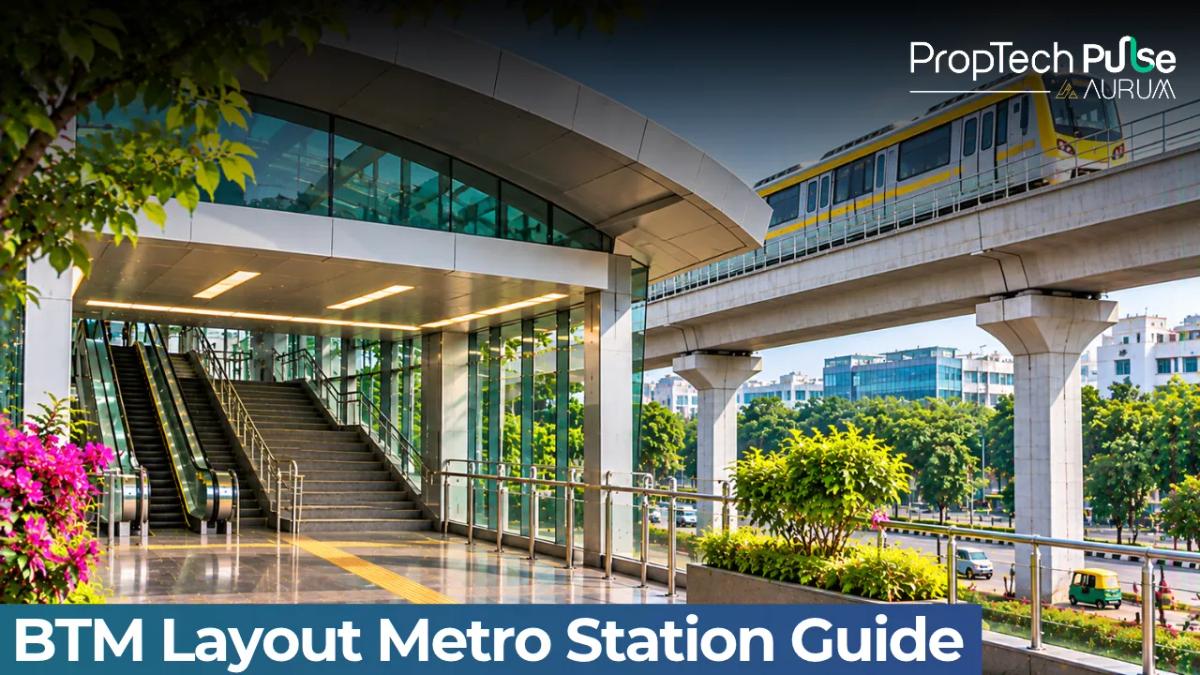
If you live or work between Silk Board and the city centre, the BTM Layout metro station is your fastest daily escape from road traffic.
Opened in August 2025, this stop on the Yellow Line sits on the Outer Ring Road at Marenahalli. It feeds commuters straight into Bengaluru’s core IT corridors and business districts.
For first-time riders checking fares or homeowners comparing societies along Fourth Main, this guide covers the exact schedules, fare math, interchanges and commute realities that matter right now.
Key Details & Location of BTM Layout Metro Station
Quick answer
The BTM Layout metro station is Stop 4 on the Yellow Line, opened in August 2025. First trains leave at 06:00 on weekdays and 07:00 on Sundays. A single-journey token to Majestic costs around ₹60, while smart card users pay roughly ₹54–₹60 depending on time. Expect a 30-minute ride to the city centre and a similar hop south to Electronic City.
The BTM Layout metro station handles heavy commuter volume between the Old Madras Road corridor and the sprawling residential pockets along the Outer Ring Road.
This location feeds thousands toward the tech parks clustered around Electronics City, Hebbagodi and beyond. The last mile, however, usually requires a short bus or auto ride.
Residents already settled in BTM Layout Bengaluru have seen afternoon rush-hour gridlock ease from the Fourth Main and Sixth Main areas. Newer housing stock also lines up nearby, anchoring zones like Abbaappa Layout in BTM and BDA Layout in BTM Stage 4, where walkability to the gates is quickly becoming a primary deciding factor.
Platform Split: Where to wait for your direction
Most Yellow Line stations use a two-platform setup split strictly by direction.
Heading north into the city? Catch the train on Platform 1 bound for RV Road.
Southbound travelers waiting for the final stretch to Silk Board board Platform 2 toward Delta Electronics Bommasandra. The platform-to-street escalators connect directly to the Marenahalli flyover exit, saving you from cutting through local markets when running late.
Working Schedule: First & Last Trains at BTM Metro Station
Train frequencies tighten during peak morning and evening hours, but the first and last departures shift depending on the day.
BMRCL adjusts the Monday schedule to accommodate the sudden spike after the weekend break. The station launches the first train earlier than usual.
This Monday anomaly matters more than you would expect if you rely on the station daily.
| Day | First Train Departs BTM Layout | Last Train Departs Terminal |
|---|---|---|
| Monday | 05:05 | 23:55 |
| Tuesday to Saturday | 06:00 | 23:55 |
| Sunday | 07:00 | 23:55 |
Commuters relying on the very last train back to Bommasandra or SRG Road should aim to reach the station by 23:25 to avoid missing the slot entirely.
Trains typically run every seven to eight minutes during office hours. They stretch out closer to midnight.
Fares & Journey Planner to Major Hubs
The btm metro network spans a long stretch, meaning travel distance dictates ticket price more than complex zone categories.
Most daily commutes from BTM Layout fall into the mid-range fare brackets once you cross past Central Silk Board and enter the older downtown tunnels.
A standard single-journey token from BTM Layout to central points lands between ₹50 and ₹60.
Smart card holders save money consistently, though peak-hour surcharges eat up some of that discount if you swipe during the heaviest crowds.
| Destination Hub | Stops from BTM Layout | Token Fare | Smart Card Fare (Approx.) | Travel Time |
|---|---|---|---|---|
| Majestic | 10 | ₹60 | ₹54–₹58 | ~30 mins |
| MG Road | 8 | ₹50 | ₹45–₹48 | ~22 mins |
| Silk Board | 3 | ₹30 | ₹27–₹28 | ~10 mins |
| Rajajinagar | 14 | ₹70 | ₹63–₹66 | ~40 mins |
The smart card offers a ten per cent off-peak discount and five per cent during rush hours, paid upfront when you top up at the vending machine.
For salaried professionals making a round trip daily, buying monthly smart card passes often brings the effective cost down to under ₹3,000, depending on current BMRCL pass structures.
Interchanges & Future Lines: Pink & Blue Line Connections
Right now, BTM Layout functions as a direct-line station.
You cannot transfer to another metro track without exiting and re-entering at the next stop, usually Central Silk Board or Shivajinagar if going the other way.
The surrounding map is shifting fast due to Phase 3 expansions.
The biggest immediate upgrade is the planned Pink Line interchange at Jayadeva Hospital, located just half a kilometer away from the existing Yellow Line footpath exits.
Once completed, residents living near the metro will have direct access to the northern industrial belts without touching the congested city centre corridors.
The construction timeline remains fluid, but BMRCL has allocated the footprint alongside the hospital's main entrance.
South of the station, the upcoming Blue Line extension pushes the network closer to Sarjapur and Hosur Road fringes.
Between the Pink Line link at Jayadeva Hospital and the Blue Line creeping south, the area gets a dual-corridor benefit that existing property posts routinely overlook.
Why BTM Layout Metro Station Matters for Buyers & Commuters
A metro station rarely fixes a broken locality, but it reliably caps extreme commute times and raises rental floors.
Properties within walking distance of BTM Layout see faster leasing cycles because software employees value predictable door-to-door transfers over the chaos of parking searches outside major IT parks.
That said, proximity translates differently to capital growth versus rental yield.
High-yield rentals cluster close to college hostels and corporate parks.
Appreciation happens when infrastructure upgrades hit, like the new Pink Line gates or better last-mile feeder bus routes tied to the Outer Ring Road flyovers.
Readers evaluating whether a specific project deserves the premium often look at broader market rules.
See our breakdown of how metro access affects apartment prices before paying extra for front-row gates near the station.
Before You Buy Near BTM Layout Metro
If you are treating this as a permanent home, test the last-mile route yourself before booking.
Walk from the building entrance to the turnstile at 6:30 PM.
Note how many signal delays block the auto rickshaw stand, and check if the society allows bike parking near the gate if you plan to switch modes halfway.
Metro access works best as one leg of a longer commute chain.
Pair it with sensible neighbourhood checks on drainage, water table levels and local council approval before committing funds.
Frequently asked questions
What are the first and last trains at BTM Layout metro?
Monday gets a head start with the first train leaving at 05:05 to beat the weekday surge. Daily services shift slightly later to 06:00, while Sunday opens much later at 07:00. Weekends and weekdays both finish strong, with the final train hitting Bommasandra at 23:55. Plan to clear the gates by 23:25 to avoid missing the slot.
How much is the metro fare from BTM Layout to MG Road?
A standard ticket to MG Road runs about fifty rupees if you buy a one-way token at the counter. Daily travelers usually hold a loaded smart card, which brings the cost down to forty-eight rupees during evening rush and slightly higher off-peak. The journey takes just over twenty minutes once you board the RV Road-bound carriage.
Can I change lines at BTM Layout metro?
Not directly. BTM Layout currently operates as a single-track stop on the Yellow Line, meaning you must alight and walk to the opposite platform to reverse direction. However, a dedicated Pink Line interchange gate is approved for Jayadeva Hospital, located barely half a kilometer south, which will eventually solve the connection problem for residents living along the Outer Ring Road.
Which stations are next to BTM Layout?
The immediate neighbours on either side are Central Silk Board to the north and Hennur Bande to the south on the Yellow Line sequence. If you expand outward, Shivajinagar marks the next major transfer point heading toward the Green Line. Keep in mind that physical distance on the tracks does not always match linear geography due to the underground tunnels feeding into the city centre.
Enjoyed this blog article? Visit PropTech Pulse for more interesting blogs.


Ask Pulse Ai anything about real estate

Unlock the Latest in Real Estate
News, Infographics, Blogs & More! Delivered to your inbox.

