New Launch - India Real Estate Report 2026.

Services
Knowledge Hub
Resources
Tools

Ask Pulse Ai
©PropTech Pulse 2025, All rights reserved.


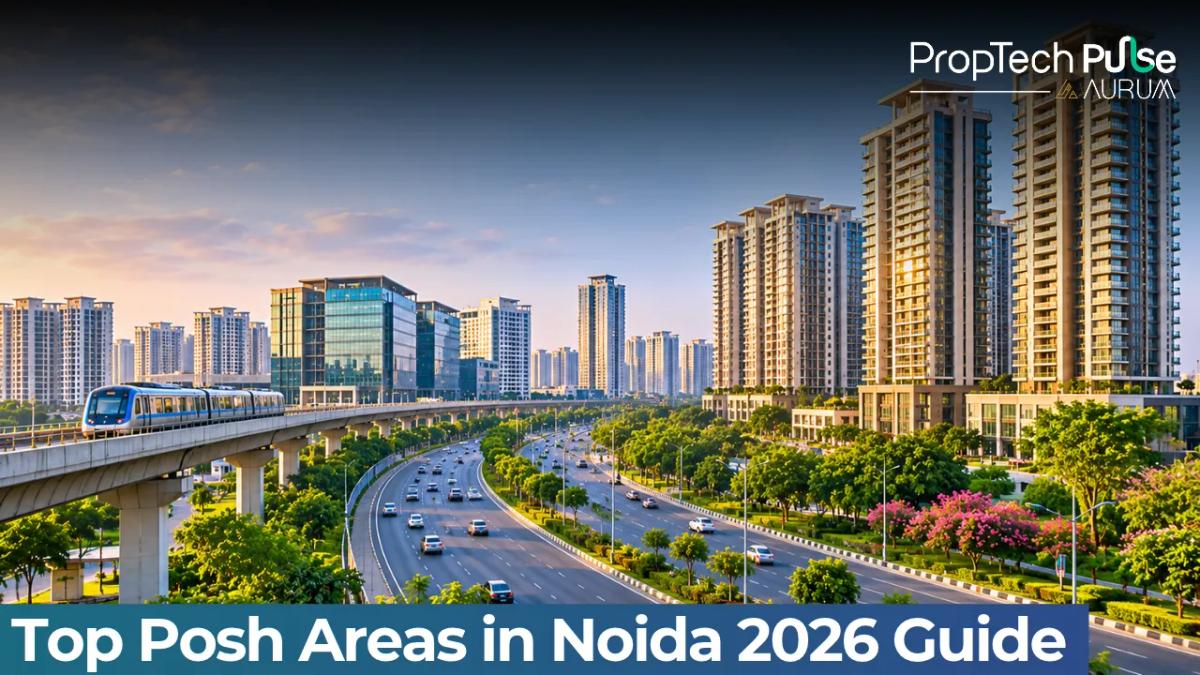
In Noida, being a posh area in noida means strict urban planning dictates your lifestyle. It isn't just about price per square foot. It relies on low floor-space ratio (FAR) limits, secure gated infrastructure, and wide roads that physically separate these zones from the rest of the city.
Buyers searching for a posh area in noida want two distinct things: sprawling independent houses in legacy bungalow belts, or modern vertical living with resort-style amenities.
This guide cuts through standard listing copy. We map the actual luxury zones using the Noida Authority’s master plan rules.
We also break down what structurally defines each posh area in noida and explain how the impending Jewar Airport launch reshapes long-term capital appreciation.
What Actually Makes a Locality "Posh" in Noida?
Quick answer
A posh area in noida is defined by strict master-plan zoning rather than just market price. The Noida Authority enforces low Floor Space Ratio (FAR) limits, mandates minimum road widths, and preserves green buffers in premium sectors like 15A, 44, 94, and 150. These municipal rules prevent haphazard high-rise encroachment, ensuring the wide streets, low density, and high privacy that justify premium valuations.
When people talk about noida neighborhoods reaching a certain income bracket, they aren't just referring to builders charging extra for sea-view facades. They are talking about a physical blueprint dictated by municipal policy.
The Noida Authority reserves its premium plots for strictly regulated development.
The main driver is Floor Space Ratio. Commercial sectors push FAR limits to their maximum to generate revenue. Top-tier residential sectors cap FAR significantly lower. That math directly controls building height and population density.
Lower density yields wider internal roads, larger setbacks, and fewer shared walls. This structural premium commands higher prices.
Beyond zoning, established posh localities carry mature infrastructure that takes years to replicate. Think of underground cabling, dedicated stormwater drains, and paved sidewalks that survive the monsoon season.
Developers can add marble lobbies and infinity pools. But they cannot buy the peace of mind that comes with decades-old civic planning.
Noida’s Legacy Luxury Zones
Noida started in 1993. Its first wave of affluent families settled where the land was widest and the original master plan prioritized low-rise construction. These areas hold value because inventory is fixed.
When a 60-foot-wide independent house changes hands, it rarely hits the broader market twice in a decade.
Sector 44 & 15A: The Original Trophy Addresses
Sector 44 sits at the geographical heart of early Noida. It was designed exclusively for large independent homes. The result is tree-lined streets and massive plot sizes that simply do not exist in newer phases.
Proximity to the lively Sector 18 shopping district keeps daily errands short. The area maintains a quiet residential aura after 8 PM. Families prefer this pocket because the surrounding community has existed for decades.
Schools, clinics, and premium supermarkets are all within walking distance.
Adjacent Sector 15A offers similar independence-focused architecture. It leans slightly more towards newer constructions on older plots. The combination of established social circles and central geography makes these two sectors the traditional benchmark for wealth in the region.
Investors looking at the investment potential of noida real estate often flag these sectors for their rental stability among senior corporate expats who prioritize space over vertical amenities.
Sector 47 & 50: Established Family Enclaves
Just east of the core trophy addresses, Sectors 47 and 50 blend independent housing with well-regulated low-rise apartment complexes. These neighborhoods attract parents relocating from Delhi.
They sit close to several reputed international schools and major medical centers in Sector 39.
The pace here is deliberate. You will not find the chaotic traffic of mixed-use commercial blocks. Wide boulevards lined with mango and Neem trees define the aesthetic. Property values remain resilient precisely because the supply of land is exhausted.
Noida’s New-Age High-Rise and Golf-Course Luxury
As Noida's initial land bank filled, development shifted toward controlled vertical expansion. Builders applied for higher FAR approvals in specific pockets.
They created a completely different type of luxury centered on modern amenities, concierge services, and smart-home integrations.
Sector 150: The Low-Density Green Standard
If you want modern architecture without the feeling of living in a concrete jungle, Sector 150 is the current gold standard. The master plan allocated massive open spaces and parks within this sector.
The design forces buildings to step back from the street. This creates a layout where towers are separated by substantial green verges rather than brick walls. Traffic calming measures keep vehicular speed low.
Young families choose it for elevator access and clubhouse gyms, refusing crowded playgrounds or blocked views.
A practical way to understand this premium is through the math of space. In a standard 2,000 sq ft apartment footprint, a FAR difference between 2.0 and 1.5 drastically changes the building height.
It translates to roughly 20% more open space distributed among the residents.
When you calculate the per-sqm cost, you pay for that unbuildable footprint. Luxury buyers in Noida pay a 12% to 15% premium per square foot. They accept this to avoid shared walls and compromised ventilation.
Sector 128 & 137: Golf-View and Corporate Convenience
Closer to the Noida-Greater Noida Expressway, these sectors capture professionals working in nearby IT and BPO hubs. Several high-rise developments boast direct views of the Indian Golf Course.
The course acts as a permanent green buffer against pollution and noise.
The trade-off is slightly higher population density compared to Sector 150. Superior retail integration on the ground floors compensates. Restaurants, pharmacies, and boutique stores operate on-site. You leave your society less frequently.
Sector 94: Sky-Living at the Border
Positioned right at the edge of Noida heading toward Greater Noida, Sector 94 bridges two worlds. It functions as a gateway locality. Developers prize the prime frontage along wide arterial roads.
Projects here lean heavily into resort-style programming, featuring pool decks, sky lounges, and extensive fitness tracks.
Commuters favor this address. It offers rapid access to the DND Flyway expansions while remaining connected to the latest transit infrastructure. Understanding which noida sectors have the best metro connectivity confirms that future Blue Line expansions will thread through this corridor, cementing its status as a high-value transit-oriented development zone.
Expanding Premium Boundaries Beyond Noida City Limits
Premium boundaries rarely stay static. As Noida’s prime sectors become prohibitively expensive or entirely sold out, capital flows across municipal borders. The immediate beneficiary is the stretch along the Yamuna Expressway heading south, specifically around Zero Point.
This intersection marks the end of the existing Greater Noida municipal authority jurisdiction and the beginning of Yeida-controlled territory.
Buyers seeking ultra-premium villas, independent floors, and luxury townships are turning to zero point greater noida. It offers vast tracts of land that Noida no longer possesses.
The sheer scale of these new township projects mimics the best layouts found in Gurugram’s DLF phase extensions.
Specialized teams of real estate agents in greater noida have developed deep expertise in navigating Yeida’s allotment rules. They smooth the path for investors used to the stricter grid of Noida.
You get more physical asset for your money here. You trade municipal maturity for significantly larger square footage.
How Jewar Airport and Infrastructure Are Reshaping Prices
The single largest catalyst for Noida’s next decade is the Noida International Airport at Jewar. Currently under advanced completion by the Airports Authority of India, the operational timeline points toward late 2026.
An international hub improves connectivity. It rewrites the attractiveness map for entire districts.
Sectors that previously felt peripheral are experiencing accelerated appreciation. This includes 94 and parts of Phase II. They sit on the optimal approach paths and highway connections leading to the new terminal.
The psychological shift for buyers is tangible. Owning property near an international airport fundamentally alters exit strategies and long-term holding periods. Investors evaluating the pari chowk metro station guide to jewar airport access see clear evidence that upcoming interchange links will funnel massive commuter traffic through eastern Noida.
Luxury developers are already pricing in this infrastructure premium. Projects promising direct expressway access now command 15% to 20% premiums over comparable units located further north.
Modeling a five-year hold requires accounting for initial airport hype and speculative spikes.
Properties within a 10-kilometer radius of a proposed airport typically see a 25% price bump during the pre-construction phase. Markets stabilize once operations begin.
Noida benefits from a stronger baseline demand curve. Dips are shallow. Recovery is fast.
Quick Comparison: Which Noida Luxury Sector Fits You?
| Sector | Vibe | Best For | Indicative Price Tag |
|---|---|---|---|
| 44 & 15A | Legacy, expansive, highly private | Families prioritizing independent houses and central location | Premium Independent Houses |
| 47 & 50 | Established, balanced residential mix | Parents requiring proximity to top-tier schools and hospitals | Mid-to-High Range |
| 150 | Modern, low-density, park-centric | Young families seeking wide setbacks and resort-style societies | High-End Vertical |
| 128 & 137 | Golf-facing, corporate-adjacent | Professionals wanting retail convenience and minimal commute friction | Premium Vertical |
| 94 | Gateway, transit-focused, amenity-heavy | Investors targeting capital appreciation near the Jewar corridor | High Growth Potential |
Note that the figures above represent general bracket positioning rather than specific rupee-per-square-foot averages. Rates fluctuate weekly based on tower height, facing direction, and ongoing builder discounts.
Due Diligence Before Buying Luxury Real Estate in Noida
Luxury status does not automatically guarantee a clean title or smooth possession. The complexity of Noida’s master plan means that individual plots sometimes carry unique encumbrances, restricted transferability clauses, or overlapping land-use permissions.
Always cross-reference the approved master plan for your specific sector before signing an agreement.
Verifying the project on the state regulator's portal is non-negotiable. A thorough walkthrough of how to verify UP RERA registered projects reveals whether the builder actually holds the necessary occupancy certificates. It also shows if their promised amenities match what is legally approved.
Finally, consult the latest data from the ACRU portal to ensure you are not paying a speculative premium detached from official circle rates. Secure your purchase. Walk away from unclear titles immediately. The most expensive home is rarely the safest investment.
Frequently asked questions
Which is the most expensive posh sector in Noida right now?
Sectors 44 and 15A consistently command the highest per-square-foot rates due to their scarcity of large independent houses and central location near Sector 18. Modern vertical towers in Sectors 150 and 94 command high rates. True trophy assets in the legacy zones, however, trade at a steep markup due to permanently fixed land supply. Demand stays fiercely competitive even as the broader market cools.
What makes Noida neighborhoods different from Greater Noida?
Noida operates under a rigid, centralized municipal master plan enforced strictly by the Noida Authority, dictating exact road widths, FAR limits, and green zones. Greater Noida, managed by YEIDA, focuses on massive township developments, industrial integration, and flexible plotting rules. Essentially, Noida offers mature, highly regulated civic infrastructure and dense connectivity, while Greater Noida provides vast undeveloped land and newer, sprawling township models further from Delhi.
Is Zero Point Greater Noida considered a posh residential zone?
Zero Point serves as the prestigious gateway at the exact boundary between the Noida-Mathura Road and the Yamuna Expressway. It is rapidly becoming a premium destination for ultra-high-net-worth individuals seeking large villa plots and luxury townships. Because Yeida allows for expansive, low-density developments here, it attracts buyers who want Gurugram-scale spaciousness but desire the logistical advantages of being adjacent to Noida's established infrastructure grid.
Which posh areas in Noida have the best connectivity to Delhi?
For direct highway access to Central and West Delhi, Sectors 94, 128, and 137 provide the fastest commutes via the Noida-Greater Noida Expressway and the DND Flyway interchanges. Within the city limits, the northern sectors like 44 and 15A are geographically closest to the DND entry points, drastically reducing morning traffic friction. Recent Blue Line metro expansions are also integrating Sector 94, offering a traffic-free alternative for commuters heading toward the southern corridors.
How does the Jewar Airport affect property prices in Noida?
The Noida International Airport at Jewar fundamentally reweights the region's appreciation curves, acting as a powerful magnet for capital. Properties positioned along the approach flight paths and expressway corridors—particularly in Phase II, Sector 94, and eastern Greater Noida—are commanding significant premiums. Buyers modeling a five-year hold should anticipate initial speculative volatility, but the long-term structural uplift for well-located luxury inventory is historically proven and exceptionally strong.
Sources
- UP RERA: Project verification guidelines and registration rules (accessed November 2026)
- Delhi Metro Rail Corporation: Blue Line route mapping and station interchange details affecting Noida connectivity (accessed November 2026)
Enjoyed this blog article? Visit PropTech Pulse for more interesting blogs.

Ask Pulse Ai anything about real estate

Unlock the Latest in Real Estate
News, Infographics, Blogs & More! Delivered to your inbox.

