New Launch - India Real Estate Report 2026.

Services
Knowledge Hub
Resources
Tools

Ask Pulse Ai
©PropTech Pulse 2025, All rights reserved.


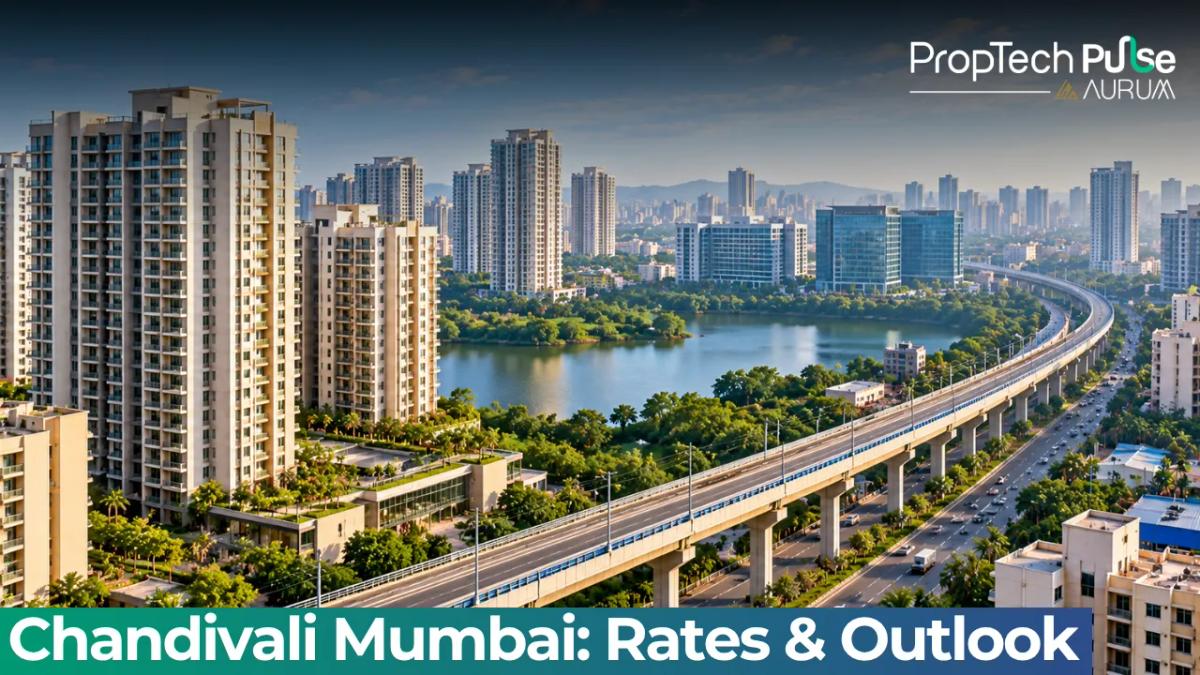
Avoid chasing branded premiums. Instead, target the adjacent catchment that feeds the same employment hubs. Chandivali functions as the arbitrage zone for developers and families targeting SEEPZ, Powai CBD, and BKC. You get the same commuter geography, younger inventory, and tighter capex on day one.
Where is Chandivali Mumbai? Boundaries and core connectivity
Quick answer
Chandivali sits on the eastern edge of the SV Road-VJF-Rajiv Gandhi Phirozshah Mehta Marg corridor, sandwiched between Powai lake to the south and the JVPDUK/JVLR commercial spine to the north. It delivers direct rail access at Saki Naka, highway exits for WEH and EWH within two kilometres, and a twenty-minute drive to SEEPZ and Andheri MIDC.
BKC is expanding westward. Living inside Chandivali puts you inside the same commuting gravity well as those centres. It strips away the heritage society premiums that dominate Powai proper.
JVLR, Highway Access and Railway Links
The Junction of Ville Parle and Deonar cuts straight through the neighbourhood. Traffic flows shift constantly, but the geometry is simple. Heading west takes you to Saki Naka and the Western Express Highway ramp in ten minutes.Heading east pushes you toward Deonar flyover and the Eastern Express Highway exit. Saki Naka railway station sits roughly twelve hundred metres from the main residential belt. Commuters walk, cycle, or take local e-rickshaws to reach the line connecting to Dadar, Kurla, and Thane.
Auto stands proliferate along Raheja Vihar and Nahar Marg. This reduces dependency on the local train during peak shifts. Investors tracking locality details across the Chandivali and Powai stretch usually find that proximity to JVLR carries less noise penalty than people assume. Side streets branch quickly off the arterial road. Most housing blocks sit on quieter grids.
Neighbourhood ecosystems and daily commute realities
Daily life in Chandivali hinges on micro-infrastructure reliability rather than luxury branding. Water supply remains stable due to mandatory borewells and rooftop storage mandated by MahaRERA for all post-2015 towers.Power fluctuations are rare, though most societies rely on DG sets covering only common areas and elevators. Interior wiring checks should always precede purchase, especially in inherited flats where previous owners upgraded kitchens or installed heavy air conditioning units without load calculations. Medical access is genuinely strong. Lilavati Hospital, Sishir Multi-Specialty Hospital, and Fortis Hiranandani sit within a five-kilometre radius. Emergency response times rarely exceed twelve minutes from the heart of Raheja Vihar.
Schools cluster around the Saki Naka and Hiranandani Gardens periphery. St Mary Convent High School, Glenfield School, and Vibgyor High are reachable via the internal road network. Parents prefer the shorter bus routes because municipal school buses face heavy JVLR congestion during drop-off hours.
Commercial ecosystems operate on convenience tiers. Daily groceries come from neighbourhood mandis and modern retail chains along Nahar Marg. Higher-end retail requires a short hop to Hiranandani Gardens or Inorbit Mall. Dine-out options concentrate near Ramkrishna Dhoom Singh Marg.
Entertainment stays limited to multiplexes inside nearby commercial plazas. Residents treat Chandivali as a functional base rather than a lifestyle destination. That realism keeps expectations aligned with actual living conditions.Flats in Chandivali: Current property rates breakdown
Transacted rates tell a different story than brochure quotes. Brokers list aggressively. Buyers negotiate down. The actual closing gap hovers around twelve to fifteen percent beneath asking prices. Branded tower launches hold their pricing firmer. Market estimates place typical transacted averages around ₹30,500 per square foot for standard apartments completed within the last seven years.Resale inventory predating 2015 lacks centralised parking and upgraded lobbies. Those societies trade closer to ₹18,000 to ₹26,000 per square foot. Maintenance culture and lift capacity dictate the final number. Premium gated communities command a distinct band. Developments with larger carpet coverage, clubhouses, and established landscaping regularly close above ₹41,000 per square foot. Budget caps below ₹1.5 crore point toward older stock or smaller unit types.
Asking versus transacted rates and resale arbitrage
New launch bookings lock in at prevailing builder rates plus GST. Resale allows immediate possession but introduces renovation risk.Many inherited flats in the older segment feature dated kitchen layouts or non-compliant bathroom plumbing upgrades. Factoring in even a basic ₹8 lakh renovation budget changes the effective per-square-foot math considerably. To gauge whether a specific society aligns with your capital outlay, compare its floor-wise demand curves against nearby transactions. Pulling up our market snapshot of Swaraj Homes West End and adjacent Chandivali listings shows how macro rates diverge block-by-block.
Pricing by micro-pocket (JVLR frontage, Raheja Vihar, legacy stock)
Properties lining JVLR carry a visibility premium but absorb road noise until monsoon hits. Raheja Vihar sits further inland. It offers calmer environments and slightly tighter pricing per carpet unit.Legacy pockets towards the Powai lake fringe retain lake-facing premiums that rarely dip. Market corrections hit inner blocks harder than lakeside towers. Micro-pocket variance means blanket averages mislead. A single compound containing both lake-facing towers and inner-street blocks often spans a ₹12,000 per square foot spread. Always validate the specific block, not just the development name.
Chandivali versus Chandivali Powai: The real commute and cost gap
The terms Chandivali and Chandivali Powai overlap geographically but split sharply on price architecture. Powai proper holds mature societies built before 2010. Parking remains tight.Society transfer fees weigh down resale margins. Chandivali offers newer lifts, dedicated parking, and faster sales processing. Builders and sellers face less legacy friction.
| Metric | Chandivali | Established Powai |
|---|---|---|
| Avg transacted rate (standard) | ₹30,500 per sq ft | ₹38,000 to ₹45,000 per sq ft |
| Typical 2BHK monthly rent | ₹65,000 to ₹80,000 | ₹85,000 to ₹1,10,000 |
| Gross rental yield | 3.0% to 4.0% | 2.2% to 3.1% |
| Commute time to BKC | 20 to 25 mins | 25 to 30 mins |
| Society transfer timelines | 7 to 10 working days | 15 to 30+ working days |
A ₹2.5 crore purchase versus a ₹3.5 crore entry reduces interest burden by nearly ₹6 lakh to ₹8 lakh across a standard 20-year floating-rate mortgage. That interest saving frequently exceeds the entire interior fit-out budget.
Rental yields and tenant demand
Tenant profiles dictate vacancy risk. Chandivali pulls heavily from mid-level IT professionals, project managers, and support staff working inside SEEPZ and Powai IT parks.These groups prioritize commute reliability over architectural heritage. They accept smaller carpet areas if parking and lobby amenities function smoothly. Corporate relocation cycles run six-month to eighteen-month bands. Serviced apartments absorb short stays during transition phases. Traditional rentals remain exposed to sudden vacancies. Understanding how corporate housing pipelines interact with local supply prevents oversupply misreads. Review the regional rate trajectories and demographic overlays to map your own monthly cash flow expectations early. Club membership transfers form another hidden cost layer. Premium societies often charge ₹5 lakh to ₹10 lakh for secondary buyers.
Verify transferability rules before folding amenity value into your purchase calculation. Some developers waive the fee if the original buyer never utilized the membership slot. Paperwork matters more than promises here.
Infrastructure catalyst: Metro Line 6 timeline and liquidity impact
The upcoming Pink Line extension reconfigures travel geometry entirely. Stations positioned along JVLR intersect directly with the residential spine.This cuts reliance on road networks that choke during afternoon office shifts. Completion targets indicate operational readiness by December 2027.
Station mapping and interchanges
Saki Naka currently anchors the Blue Line, serving daily commuters bound south toward Colaba and north toward Kandivali.The forthcoming interchange node moves traffic away from surface bottlenecks. Direct underground links to proposed airport connectors and lower Parel business districts shorten cross-city trips substantially. When the line opens, properties located within walking distance of the JVLR stations typically see a liquidity bump. Prices lag behind availability.
Resale velocity increases because tenant eligibility expands beyond road-bound commuters to metro-dependent workers. Track the latest progress reports on official transit portals to monitor civil work milestones.
How to buy: RERA compliance, builder reputation and due diligence checklist
Buying here demands discipline. New launch bookings require proof of RERA registration and escrow account verification. Older resale deals require encumbrance certificate checks, OC verification, and society approval stamps. Skipping one step delays closure months later.Step-by-step buyer checklist
- Confirm the project RERA number on the developer website and match it against the Maharashtra real estate authority registry.
- Request the approved building plan and check carpet area disclosures against the sale agreement.
- For resale units, obtain the latest municipal tax receipts and water-sewerage clearance letters.
- Verify society no-objection certificates for name transfers and parking allotment assignments.
- Engage a property lawyer to review the builder agreement clauses regarding delayed possession penalties.
Final verdict: Who should buy in Chandivali right now?
Chandivali suits salaried professionals earning inside the eastern corridor. First-time family upgraders seeking modern layouts avoid heritage society politics. Institutional landlords targeting predictable rental absorption find steady ground here.Speculators chasing immediate double-digit flip returns will struggle. Buyers demanding sprawling garden landscapes or quiet hillside environments should look elsewhere. Use a structured ROI calculator alongside a bank pre-approval limit. Align your budget against the transacted ceiling rather than the asking floor.
Factor in Metro Line 6 opening timelines when modelling holding periods. Buying the efficiency layer near Powai consistently outperforms chasing the premium tier for middle-income capital stacks.
Frequently asked questions
Is Chandivali a good place to buy a flat in Mumbai?
Yes, particularly for investors and IT professionals working in SEEPZ, Powai CBD, or BKC. The area offers a lower entry price compared to prime Powai while maintaining high liquidity due to strong rental demand from tech parks. With Metro Line 6 approaching in late 2027, long-term capital appreciation remains on track.
How much does a 1 BHK and 2 BHK flat cost in Chandivali?
Transacted rates currently average around thirty thousand five hundred rupees per square foot for standard projects. Compact 1 BHK units typically trade between ₹1.2 crore and ₹1.8 crore. Larger 2 BHKs start at ₹2 crore and reach ₹3.2 crore. Premium towers with bigger layouts often exceed ₹3.5 crore.
What is the average price appreciation in Chandivali over the last 5 years?
Over the past five years, the pocket has delivered approximately twenty-five percent aggregate growth. Shorter cycles show roughly seven percent annualized appreciation, driven by stable employment hubs nearby and steady migration into Mumbai’s eastern corridor. New supply keeps pace with demand in mid-tier segments.
When will Metro Line 6 open near Chandivali?
The Pink Line extension is targeted for completion by December 2027. Saki Naka station currently anchors the Blue Line, serving daily commuters bound south toward Colaba and north toward Kandivali. The forthcoming interchange node moves traffic away from surface bottlenecks and will drastically cut commute times to Andheri, Lower Parel, and the proposed new airport node.
Which is better for investment: Chandivali or Powai?
For pure rental yield and affordability, Chandivali wins. It typically offers gross yields between three percent and four percent, fueled by constant IT workforce migration. Powai commands higher absolute rents but requires significantly more upfront capital, compressing the effective yield percentage for many first-time investors.
Sources
- Maharashtra Metro Rail Corporation Limited (MMRC): Pink Line construction progress and station mapping details (accessed October 2026)
Enjoyed this blog article? Visit PropTech Pulse for more interesting blogs.



Ask Pulse Ai anything about real estate

Unlock the Latest in Real Estate
News, Infographics, Blogs & More! Delivered to your inbox.

