New Launch - India Real Estate Report 2026.

Services
Knowledge Hub
Resources
Tools

Ask Pulse Ai
©PropTech Pulse 2025, All rights reserved.


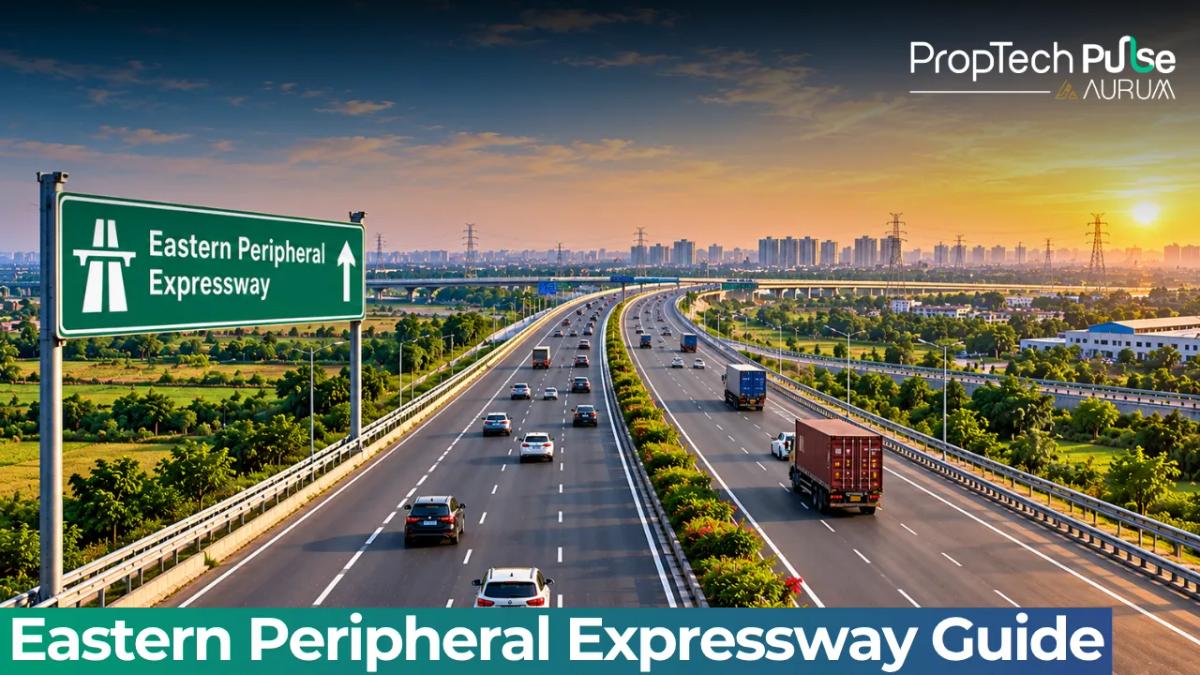
Commuting across the National Capital Region often means losing hours stuck on crowded NH24 or NH44. The eastern peripheral expressway solves that friction by routing traffic away from Delhi's core and connecting outer belts directly.
This guide covers the exact route, current toll mathematics, exit locations, and how the corridor affects property access in Noida, Faridabad, and Baghpat.
Eastern Peripheral Expressway Overview and Route
Quick answer
The eastern peripheral expressway spans roughly 135 kilometres across Haryana and Uttar Pradesh. Opened on 27 May 2018, the six-lane KGP Expressway (NE-2) connects Kundli to Palwal, bypassing Delhi entirely. Toll rates vary by vehicle class, with cars paying approximately ₹2.50 per kilometre under the standard closed-network system.
Built as National Expressway 2, the eastern peripheral expressway spans roughly 135 kilometres across Haryana and Uttar Pradesh. It forms the northern arc of a massive ring road that circles the NCR region.
The alignment starts near Kundli in Sonipat district, cuts through Baghpat and Ghaziabad, passes close to the Noida expansion zones, threads past Faridabad, and terminates at Palwal. When connected to the western loop, it completes the full satellite peripheral circuit around the capital.
The highway opened on May 27, 2018 after construction was finished in just five hundred working days, beating the original timeline by half. The six-lane design accommodates heavy commercial movement while carrying thousands of daily commuter vehicles. The rise of peripheral areas in NCR's real estate market shows why this alignment reshapes land values along its path.
Toll Mechanics and Current Rates
The highway operates on a closed network system. Drivers receive an entry slip or RFID trigger at the start point, and the final charge calculates purely on distance travelled between entry and exit points.
Moving to full FASTag compliance cuts the queue time at plazas. Cash booths still operate for drivers who prefer paper slips.
Understanding epe toll rates matters because costs vary significantly depending on whether you use the main terminal gates or the smaller interchange tollgates scattered along the corridor.
Vehicle classification dictates the base price. A standard passenger car typically pays around ₹2.50 per kilometre under the standard tariff order. Heavy goods vehicles attract higher multipliers due to road wear.
Monthly passes exist for regular commuters, but they require separate registration and monthly renewal at the designated office.
Authorities recently adjusted fares upward by roughly four to five percent. You should verify your current balance before hitting the ramp.
| Vehicle Category | Estimated Base Rate per km |
|---|---|
| Two-wheeler | ₹1.50 |
| Car / Sedan | ₹2.50 |
| Mini Bus / Taxi | ₹3.00 |
| Heavy Commercial Truck | ₹8.00 – ₹10.50 |
| Full Route Estimate (Car) | Approximately ₹300 – ₹330 |
A practical calculation helps clarify the actual outflow. Suppose you enter at the Dasna interchange and exit at the Baghpath gate, covering roughly twenty kilometres.
At the baseline rate, you multiply the distance by the per-kilometre charge. Twenty times ₹2.50 equals ₹50. Adding the applicable service cess pushes the final slip payment closer to ₹55 to ₹60.
If you drive the entire span from Kundli to Palwal, expect to pay well over three hundred rupees for a single journey. Keep your FASTag account topped up before long hauls.
Rate Alert A fresh tariff adjustment applies to all vehicle categories. Always confirm the latest schedule at the entry plaza display boards or the official authority portal.
Exit Points, Interchanges and City Mappings
The kgp expressway features multiple access points that serve distinct corridors. While people often ask about the eastern peripheral expressway toll plaza at either end, the real utility lies in the seven major interchanges distributed across the route.
These exits connect directly to established highways and local arteries, allowing direct transfers without cutting through city centres.
Exit villages along the route serve as local markers. Baghpath connects to Meerut via NH24. Duhai provides quick access to the Noida-Greater Noida sector borders.
Dasna bridges the gap toward Dadri and the industrial belt. Atali-Chasna offers routing toward Ghaziabad's southern fringes. Mapping these villages to their destination cities removes guesswork during navigation.
Intersections with national highways dictate the flow. Kundli joins NH1, which funnels traffic toward Ambala and Chandigarh. Palwal anchors the southern end at NH2, directing loads toward Rajasthan and South India. Muradnagar sits on NH58, while Dasna links firmly to NH24. Bheelakbarpur touches NH91. If you commute daily from Ghaziabad, you likely use the Dasna interchange more than the terminus plazas. Builders in Ghaziabad 2026 rely heavily on this interchange for site access, and properties near these nodes command a premium for logistical ease. Builders in Faridabad 2026 similarly benefit from the southern corridor reach.
Impact on Mobility and Property Access
Travel time reduction drives most of the value proposition. Commuters who previously navigated congested arterial roads near Delhi now bypass the urban grid entirely.
Industrial parks situated outside the Metro boundary gain viable logistics routes. Warehousing developments thrive on predictable transit windows. Residential buyers targeting Greater Noida West or Baghpat appreciate the direct feeder connections. Developers track these mobility upgrades when planning new township projects. The best cities to invest in real estate in India 2025 frequently highlight NCR peripheral clusters because infrastructure velocity correlates strongly with capital appreciation. Checking current rates and trends in Noida alongside expressway proximity reveals which micro-markets offer genuine yield potential versus speculative hype.
Before You Commute
Verify your toll tag balance and keep a backup UPI method handy, even though FASTag dominates.
Cross-check exit coordinates against your destination mapping to avoid missing interchange ramps.
Plan peak hour departures carefully, as volume spikes still occur despite reduced congestion.
The eastern peripheral expressway delivers a solid structural advantage for daily commutes and asset positioning alike. Treat the route as a permanent fixture in your NCR navigation toolkit.
Frequently asked questions
What is the total length and lane configuration of the eastern peripheral expressway?
The eastern peripheral expressway stretches approximately 135 kilometres and features a wide six-lane carriageway designed to handle high-speed traffic flow. The alignment traverses parts of Haryana and Uttar Pradesh, linking key districts such as Sonipat, Baghpat, Ghaziabad, and Faridabad. This extensive span ensures that vehicles bypass congested urban corridors entirely while maintaining smooth transit speeds.
Are monthly passes available for regular commuters on this corridor?
Yes, regular commuters can secure monthly passes tailored to frequent usage along specific segments. These passes simplify repeated travel by deducting fees directly from a registered account rather than charging per entry-slip calculation. Interested drivers must visit the designated toll office to complete registration documents and set up automatic renewals before activating the pass for daily commutes.
How do the interchange tollgates differ from the main plazas?
The main plazas located at the extreme termini handle full-route transactions, whereas the scattered interchange tollgates manage shorter segment journeys. Plazias feature wider lanes and dedicated booths for heavy commercial vehicles, while interchanges operate with compact Fastag scanners to maintain steady traffic movement. Choosing the right gateway depends entirely on your specific origin and destination coordinates within the network.
Which exits provide direct access to Noida Greater Noida West sectors?
Several interchanges act as direct feeders into the rapidly developing sectors beyond the municipal boundaries. The Dasna intersection links smoothly toward Dadri and the larger industrial zones, providing swift access without navigating inner-city bottlenecks. Meanwhile, the Duhai exit drops you closer to the residential expansions near Sector 124 and surrounding greenfield territories, making it highly convenient for daily workplace travel.
Is there a speed limit enforced throughout the six-lane highway?
Strict adherence to safety guidelines requires all vehicles to maintain regulated cruising speeds across the divided highway sections. Enforcement cameras monitor compliance continuously to prevent reckless driving and reduce collision risks during night hours. Drivers should observe the posted limits closely, as violations incur immediate penalties deducted from the registered tag balance alongside standard fines processed by authorities.
Does the expressway connect directly to major national highways?
Strategic positioning guarantees that the corridor touches several critical national highways to facilitate direct interstate transfers. The northern anchor interfaces with NH1 toward Punjab and Haryana capitals, while the southern endpoint merges with NH2 connecting to Rajasthan and southern states. Additional bridges link directly to NH24, NH58, and NH91, creating a web of freight and passenger routes across multiple states.
How much will a car owner pay for the full stretch from Kundli to Palwal?
A standard passenger vehicle travelling the entire distance from Kundli down to Palwal will encounter a calculated fee near three hundred rupees based on current baseline tariffs. This estimate accounts for the full one hundred and thirty-five kilometre span and adjusts slightly according to recent policy revisions implemented by the governing agency. Check the latest tariff schedule before planning long-distance trips.
Sources
- National Highways Authority of India: Project specifications and toll framework (accessed October 2026)
Enjoyed this blog article? Visit PropTech Pulse for more interesting blogs.


Ask Pulse Ai anything about real estate

Unlock the Latest in Real Estate
News, Infographics, Blogs & More! Delivered to your inbox.

