New Launch - India Real Estate Report 2026.

Services
Knowledge Hub
Resources
Tools

Ask Pulse Ai
©PropTech Pulse 2025, All rights reserved.


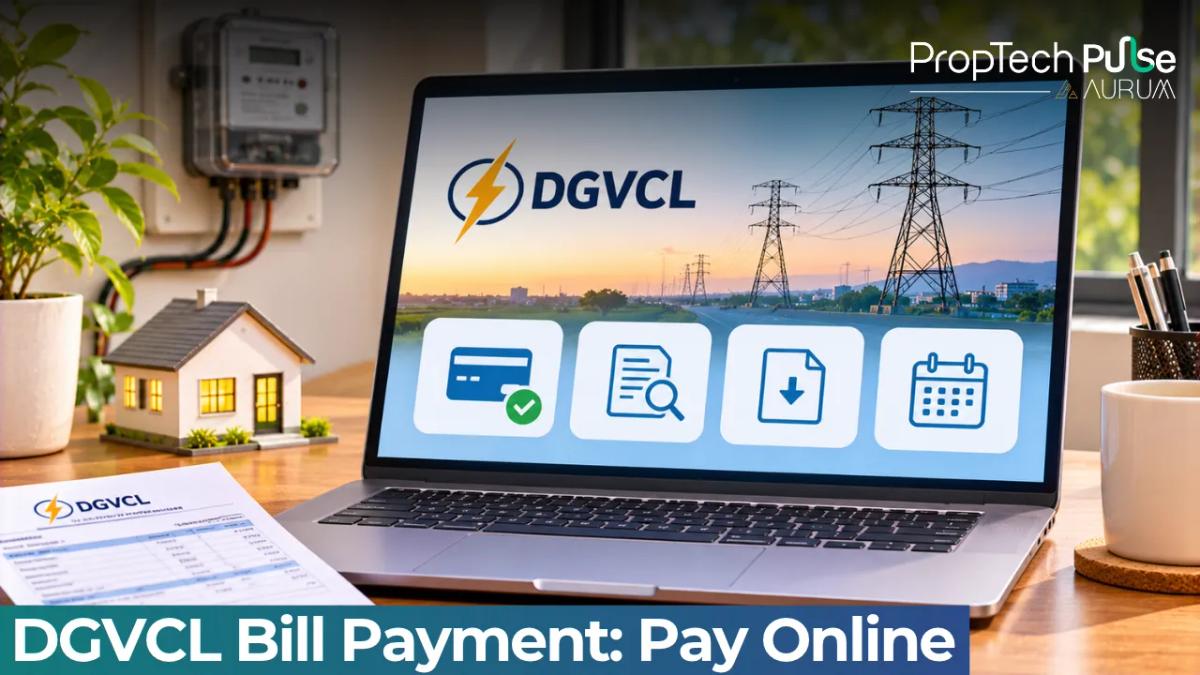
If you stare at a sudden jump in your power outgo while organising rent documents, you are not alone. For landlords and homeowners across South Gujarat, tracking your Gujarat electricity bill is often the missing piece in property management.
Landlords need to process reimbursements or submit recent bills for applications. Sometimes you are simply clearing a pending balance before penalties stack up. Managing this transaction quickly saves both time and cash.
This guide walks you through the full cycle of dgvcl bill payment, starting with your 11-digit consumer number and the cheapest digital method available right now.
We cover the active urban and rural tariff slabs for FY 2026-27. The guide breaks down the fuel price pass-through surcharge that quietly inflates your meter reading.
We also map out the official portals versus third-party apps so you can pay quickly without hidden service charges.
How to do DGVCL bill payment online in 2026
Quick answer
You can make a DGVCL bill payment instantly through the official MPay portal at mpay.guvnl.in or via any BBPS-integrated banking app. Locate your 11-digit consumer number on the top-left of your light bill, enter it along with your registered mobile number, select your preferred digital wallet, and confirm the transfer. Bills paid directly through the primary portal incur zero extra fees for net banking and prepaid wallets.
Start with the official portal since it is the most direct route for a dgvcl bill download or instant settlement.
The Dakshin Gujarat Vij Company Limited covers the Surat, Bharuch and Valsad distribution circles and runs its dedicated payments dashboard at mpay.guvnl.in. You do not need to register a new account here.
Simply click 'Pay Bill'. Punch in your 11-digit consumer number from the top-left of your last invoice.
Type the OTP sent to your registered mobile. Once the screen renders your outstanding amount, use BHIM UPI, mobile wallets, debit cards or net banking to proceed.
Because the portal runs on government servers instead of private intermediaries, gateway charges stay minimal. Net banking transactions usually face no extra fees.
Alternatively, many homeowners prefer clearing their dues through their existing banking applications via the Bharat Bill Payment System (BBPS). If you already manage your home loan EMI, stamp duty or local property tax rates from the same app, keep your power bills there too. Routing your power bill through the utility section keeps everything consolidated.
Search for 'Electricity' under Bill Payments. Select 'Dakshin Gujarat Vij Company Limited' as the service provider, enter your consumer code and hit pay.
While BBPS apps offer unmatched convenience, remember that some commercial fintech aggregators layer small processing fees on top of the face value. Always check the transaction summary before hitting 'Confirm'.
DGVCL bill view, download and billing history steps
Sometimes verifying past consumption matters more than paying the current statement. Landlords frequently request a dgvcl bill download as proof of residence when updating tenant registrations or applying for utility connections.
You can retrieve these historical records straight from the customer web portal without calling support.
Navigate to the login page on the main DGVCL website. Access your dashboard using your consumer number and password, then head to the 'View Old Bills' tab.
The system generates a downloadable PDF archive covering the previous twenty-four months of invoices.
Each file contains your peak and off-peak unit readings, the applicable slab breakdown and the final net payable. These records are highly credible for legal and rental documentation.
If you lost your registration credentials or cannot recall your exact password, the portal offers a self-service recovery option using your registered mobile number.
Should that fail, request a hard copy from the nearest DGVCL office during working hours.
Keep in mind that accessing these details requires you to know your exact dgvcl bill view sequence. Start with the header of your latest paper invoice.
Scan for the bold 'Consumer Number' label. Match the eleven digits printed there against the ones in your SMS reminders. This unique identifier acts as your permanent key for all future online transactions.
Gujarat electricity bill charges: Urban vs Rural slabs (FY 2026-27)
Understanding why your monthly outgo fluctuates comes down to the slab structure set by the Gujarat Electricity Regulatory Commission. DGVCL separates residential tariffs into urban and rural categories.
The distinction depends on whether your premises sit within a notified municipal corporation zone or outside it. A flat in Vesu or Athwa pays at the urban rate. Meanwhile, a farmhouse near Navsari follows the rural schedule.
| Monthly Consumption (Units) | Urban Rate per Unit | Rural Rate per Unit |
|---|---|---|
| 0 to 50 units | ₹3.05 | ₹2.65 |
| 51 to 100 units | ₹3.50 | ₹3.10 |
| 101 to 250 units | ₹4.15 | ₹3.75 |
| Above 250 units | ₹5.20 | ₹4.90 |
These headline numbers represent the base energy cost. Your actual bill will almost always exceed them because of the Fuel Price Pass-Through Adjustment Surcharge (FPPAS).
Every month, the commission updates this surcharge to reflect wholesale coal and diesel fluctuations. As of July 2026, the active FPPAS sits at ₹2.45 per unit.
The rule adds three point nine nine percent GST on top of that surcharge too. This means even moderate consumption gets a noticeable bump on the final page.
Worked example: Calculating a realistic monthly bill
Let us run through a typical scenario for a mid-size family apartment in Surat consuming three hundred and fifty units in a single month. The fixed monthly charge for a two to four kilowatt connection applies here, costing twenty-five rupees regardless of usage.
The first fifty units draw the lowest urban rate, adding one hundred fifty-two point five rupees to your ledger.
The next fifty units rise to the second tier, contributing one hundred seventy-five rupees. Your remaining two hundred units land squarely in the third tier, pushing another eight hundred and thirty-five rupees onto the sheet.
Now apply the monthly surcharge. Three hundred and fifty units multiplied by the current ₹2.45 fuel adjustment totals eight hundred and fifty-seven point five rupees.
Adding the applicable GST rounds that component to roughly eighty-sixteen rupees.
When you combine the base energy charges, the fixed monthly fee and the adjusted surcharge, your total dgvcl bill payment demand settles around one thousand nine hundred ninety-five rupees.
Switching to a prepaid meter changes this rhythm entirely. Prepaid users purchase power credits digitally upfront.
This approach effectively avoids fixed monthly overheads and gives you early warnings before supply cuts out at zero balance.
Processing fees, UPI limits and credit card charges
Digital payments bring massive speed. They rarely come completely free of structural costs though. If you prefer UPI or want bank rewards via credit card, factor in the transaction markup from payment gateways.
DGVCL's integrated processors generally waive these fees for consumers using standard net banking and prepaid e-wallets on direct portal purchases. Moving to external channels shifts the pricing structure noticeably.
| Payment Method | Processing Fee Structure |
|---|---|
| Net Banking / Wallets (Official Portal) | Zero extra fees |
| BHIM UPI | Generally waived by banks for utility payments |
| Credit Card (via Aggregator) | Approximately 0.85% + GST |
| Debit Card (via Aggregator) | Roughly similar to credit card, depending on the issuing bank |
Credit cards offer interest-free days. They attract a processing cut calculated on the full outstanding amount though.
For a large metropolitan bill, that percentage adds up faster than a smaller town equivalent.
If your financial planning relies heavily on optimising personal liquidity, stick to UPI for standard settlements. Reserve credit card spending strictly for emergency overrides or specific reward campaigns.
When to pay and what happens if you delay
Utility regulators operate on strict timelines designed to keep grid infrastructure funded.
A standard DGVCL invoice carries a printed issue date and a built-in grace window. You are permitted to clear your dues within ten days of that publication date without triggering any penal measures.
Banks and digital wallets usually process these transfers within minutes.
Sometimes they take longer depending on server load. Initiating your dgvcl bill payment immediately once the notification hits your email or phone eliminates guesswork.
After the initial ten-day buffer closes, the regulatory framework shifts towards penalty accrual. The company applies an annualised late payment interest rate of fifteen percent to the unpaid principal.
While fifteen percent annually might seem manageable compared to personal loan interest, compounding daily across hundreds of thousands of consumers creates severe accumulation if ignored.
Persistent neglect eventually leads to a disconnection notice. Deregistration remains the absolute last resort, reserved for chronic defaulters. It halts your domestic power supply until every outstanding liability, arrears and reconnection penalties are settled in full.
Tracking dates matters simply to protect your peace of mind.
Before you decide on a payment method
Deciding how to settle your power bill depends on balancing speed against margin. Use the official MPay portal for zero-friction settlements.
Rely on your regular banking BBPS app if you need consolidated statements. Track the monthly FPPAS adjustments to anticipate true monthly costs clearly.
Clear balances within the first week of receiving the invoice. Doing so sidesteps interest traps and guarantees uninterrupted domestic supply for your home.
To fully evaluate holding costs and verify local valuation benchmarks before purchasing a new property, start with a circle rate calculator. Running one provides immediate clarity on baseline market values.
Avoiding excessive debt burdens is just as important as securing affordable rates. Review strategies on how to reduce home loan EMI burden. This keeps your monthly cash flow healthy alongside utility obligations.
When tracking asset appreciation alongside maintenance costs, check registered real estate projects in Gujarat. This step helps align your long-term investment with your daily operational expenditures.
Frequently asked questions
How to download old DGVCL electricity bills online?
Access the customer web portal on the DGVCL website and log into your account using your consumer number and registered password. Navigate to the 'View Old Bills' section located in your main dashboard. The system generates a downloadable PDF archive covering the previous twenty-four months of invoices. Each document includes your detailed peak and off-peak unit readings alongside the final net payable amounts, providing accurate records for rental verification and expense audits.
What is the late payment charge for DGVCL bills?
After your ten-day grace period expires, the distributor applies an annualised late payment interest rate of fifteen percent to the unpaid principal. This surcharge accumulates daily as the regulatory framework prioritises grid funding continuity. Ignoring these notices indefinitely triggers eventual disconnection procedures. Permanent deregistration stands as the absolute final escalation, requiring clearance of all accumulated liabilities, outstanding arrears, and mandatory reconnection penalties before restoring your domestic power supply.
How to pay DGVCL bill using credit card or UPI?
Both BHIM UPI and credit cards are widely accepted across aggregator platforms and the primary MPay portal. Standard internet banking and prepaid electronic wallets generally incur zero transaction fees when processed directly through the official government channel. External banking apps usually waive UPI charges for utility payments. Credit card integrations typically apply a nominal service charge of approximately zero point eight five percent plus applicable taxes on the total face value of your outstanding balance.
Where to find the 11-digit consumer number on a DGVCL light bill?
Locate the upper left-hand corner of any physical DGVCL invoice or light bill envelope to find your identification marker. The label explicitly states 'Consumer Number' in bold formatting above a clearly printed eleven-digit string. Match this exact sequence against the records stored in your previous SMS payment alerts. This numerical code serves as your permanent authentication key for all subsequent digital logins, portal transactions, and offline service centre visits across your designated distribution circle.
How can I check my DGVCL electricity usage history?
Log in to your customer dashboard through the secure DGVCL web interface or the affiliated MPay mobile application. Look for the consumption graph or detailed usage tab situated prominently on your primary landing page. These visual trackers translate your raw meter readings into digestible charts spanning multiple years. Reviewing the month-over-month variance reveals seasonal spikes driven by air conditioning loads or festive lighting, allowing you to adjust appliance habits before the next monthly statement generates.
Enjoyed this blog article? Visit PropTech Pulse for more interesting blogs.


Ask Pulse Ai anything about real estate

Unlock the Latest in Real Estate
News, Infographics, Blogs & More! Delivered to your inbox.

