New Launch - India Real Estate Report 2026.

Services
Knowledge Hub
Resources
Tools

Ask Pulse Ai
©PropTech Pulse 2025, All rights reserved.


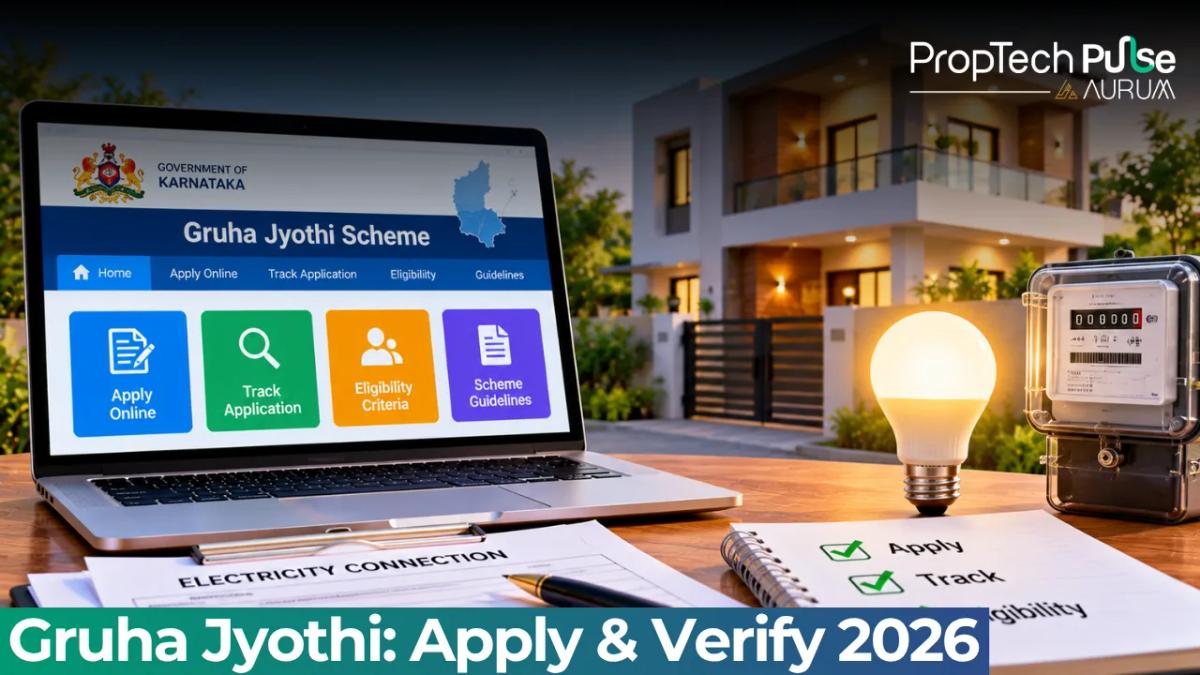
If you live in Karnataka, the two-hundred-unit free electricity guarantee under the Gruha Jyothi scheme is active, but this month requires your immediate attention. As of October 2026, distribution companies across the state have started physical verification visits.
Applications sitting in pending status are now under audit against your actual power consumption. Residents are waking up to meter readers carrying tablets and demanding physical paperwork that goes far beyond a quick Aadhaar scan.
This guide cuts through the administrative noise. It explains how the updated unit caps work.
You will get the correct registration path on the Seva Sindhu portal plus a clear action plan for the ongoing field verification drive. Know exactly which documents to print, how to read portal messages, and where to stand your ground if an official asks for fees.
What is the Gruha Jyothi scheme and what are its current benefits?
Quick answer
Karnataka’s Gruha Jyothi scheme guarantees up to 200 units of free electricity every month for eligible households. If your average monthly consumption sits at 50 units or lower, you receive an additional flat 10 bonus units. You apply and track your application exclusively through the Seva Sindhu Guarantee Schemes Portal.
The programme replaced fragmented free-connection models with a standardized unit cap based on your preceding financial year’s usage data.
The baseline benefit protects residential users from paying for the first two hundred units each calendar month. On a standard domestic tariff slab, wiping out those units saves roughly fourteen hundred to sixteen hundred rupees every single month.
A critical update landed earlier this year. Households that actively conserve energy now qualify for a top-up.
Families averaging fifty units or less receive an extra ten free units monthly. That raises the total potential waiver to two hundred and ten units.
The rule rewards low-consumption homes with higher relief. Heavier users remain capped at the base two-hundred limit.
Consider two practical examples. A Koramangala household running basic appliances averages thirty-five units and draws the full fifty-grace allowance.
A Jayanagar home with cooling equipment and pumps hits one-fifty units. Both stay within the baseline two-hundred cap, keeping monthly bills near zero. Most Gruha Jyothi enrollees simply monitor usage through the standard app dashboard.
Gruha Jyothi eligibility criteria for 2026: Who can apply?
Eligibility hinges on one primary metric: average monthly consumption. Your historical usage over the trailing twelve months must not exceed two hundred units.
The system pulls this data directly from your previous financial year’s readings to prevent edge-case exploitation. If your average sits at two hundred and five units, the algorithm flags you for exclusion, though a formal reconsideration window sometimes opens after manual audits.
The connection must be residential. Commercial premises, industrial feeders, and municipal street-lighting accounts fall outside the scope. Property types do matter less than the sanctioned load category stamped on the meter plate.
Renters gain direct access this round. The portal allows applicants to register using a personal mobile-linked Aadhaar, even when the main meter belongs to the landlord.
This design stops owners from blocking meter access to protect their own quota.
If you are currently finding a rented flat in Bangalore, secure your registration immediately upon signing the agreement. Do not wait for the annual reset.
Duplicate connections disqualify applicants. If a house already holds an existing beneficiary number under a different member’s Aadhaar, the new application will fail validation unless the previous record is formally delinked or closed.
Step-by-step Gruha Jyothi registration through Seva Sindhu portal
The entire application lifecycle runs through the Karnataka government’s dedicated portal. Follow these actions sequentially to avoid rejection loops.
- Navigate directly to the Guarantee Schemes subdomain and select the Gruha Jyothi tile.
- Click Register New Application and enter the fifteen-digit consumer number found on your most recent electricity bill.
- The system fetches your mobile number via Aadhaar-based OTP verification. Ensure the SIM is active and inserted in the phone.
- Allow the portal to auto-populate your previous twelve-month consumption graph. This step locks in your base unit calculation.
- Verify your permanent address matches the billing circle. Mismatches trigger manual intervention delays.
- Upload a clear passport-size photograph if prompted, then review the summary sheet and submit.
Legacy transformers sometimes cause loading failures. Use the manual submission route instead.
Upload scanned copies of your last three bills alongside your ration card, then wait four days for processing. Once submitted, treat the generated application reference number as your permanent identifier.
How to track your Gruha Jyothi application status online
The portal hosts a separate status tracker that reads your application ID or scans your Aadhaar QR code. Regular checks catch processing bottlenecks early, saving you from losing subsidies when the new financial quarter begins.
| Status Label | What It Means | Action Required |
|---|---|---|
| Processing | Your data has synced with the district distribution office queue. | No action. Wait forty-eight hours and refresh the page. |
| Verification Pending | Field agents have been assigned to cross-check your address and meter plate. | Prepare physical documents. Expect a knock within seven business days. |
| Approved | The subsidy bucket is activated on your consumer number. | Download the approval receipt PDF. Free units will appear on your next monthly bill statement. |
| Failed | Consumption exceeded the limit, duplicate connection detected, or mismatched addresses. | Review the error code on-screen. File a grievance ticket through the portal or visit the local ESCom helpline desk. |
Always download the final approved slip. Field staff sometimes struggle to see digital approvals on low-battery tablets, and handing over a laminated copy prevents unnecessary back-and-forth.
The October 2026 update: Handling door-to-door verification by ESCom staff
This is where most beneficiaries stumble. Starting late September, distribution companies launched aggressive field verification waves targeting high-density residential wards.
Agents move neighborhood by neighborhood, validating approved IDs against actual occupancy. The goal is to weed out ghost connections and reroute wasted subsidy funds.
Field agents rely on handheld scanners but expect printed backups. Keep your Aadhaar, recent passport photo, voter ID, ration card, and tenancy agreement ready at the entrance.
Some teams cross-check income tax records to verify broader welfare criteria. Political backlash followed these privacy demands, yet compliance remains mandatory at your doorstep.
Before you open the door Bring original files. An officer cannot strip your approved benefits simply because a single paper is missing, but having everything printed accelerates their tablet entry. Politely refuse any suggestion to hand over cash tokens or gift vouchers; field representatives hold zero authority to collect payments under this scheme.
Landlords and tenants frequently clash over meter accountability during these sweeps. If the property owner objects to the tenant receiving the subsidy credit, refer to established landlord rights in India 2026 frameworks, which generally back the actual bill payer. Familiarize yourself with tenant rights in India regarding uninterrupted basic utilities, which reinforce the government mandate for separate subsidy lines.
Agents stamp acknowledgements on your ration card or hand out verbal reference codes. Take a clear photograph of that exchange immediately. Corporate billing updates create lag, and a photo becomes your only proof if the credit drops next month.
What to do before the fiscal year resets
If your tracked average consumption inches past two hundred units right now, upgrade your cooling equipment or install smart plugs immediately.
Applications lock based on trailing data, so cutting heavy draws today secures a cleaner profile for the next cycle. Do not wait until December to panic when the system rejects your renewal.
Active Gruha Jyothi subscribers should mark their calendar for the annual re-application window in March.
The portal activates nationwide simultaneously, traffic crashes spike on day one, and successful entries drop by midnight. Pre-fill your consumer number and keep browser tabs closed before refreshing. Consistency beats speed here.
Frequently asked questions
Is Gruha Jyothi still active in 2026?
Yes. The Karnataka government renewed the scheme for the current fiscal year with expanded verification protocols. Over 1.7 crore families remain registered as beneficiaries. Active portal operations continue without interruption, and new registration windows open alongside the annual financial reset in April each year.
What documents are required for the Gruha Jyothi verification visit?
Meter readers typically carry handheld devices but expect residents to present physical proofs for matching. Prepare your Aadhaar card for digital verification, a recent passport-size photograph, voter ID, ration card, and the tenancy agreement if you rent your home. Some teams also scan PAN cards and caste certificates to align welfare lists.
Why is the government asking for my PAN card for free electricity?
Distribution companies are running ground-level audits to prevent fake registrations and duplicate connections. Field agents request PAN cards to cross-check income tax data against welfare eligibility thresholds. Although this practice drew political criticism, the requirement stems from district administration directives rather than the central Seva Sindhu portal interface itself.
How much free power does a household get under Gruha Jyothi?
Eligible residential consumers receive up to two hundred units of electricity completely free every calendar month. A new rule effective this year grants an additional ten bonus units to households whose average monthly consumption stays at fifty units or less, effectively protecting low-energy families from baseline tariffs.
Can I apply for Gruha Jyothi if I am a tenant and the electricity bill is in the owner's name?
Yes. The Seva Sindhu system includes a specific override feature that allows tenants to register using their own mobile-linked Aadhaar, even if the main consumer number belongs to the property landlord. This bypasses the traditional bottleneck where owners blocked access to their meter numbers.
Sources
- Seva Sindhu Guarantee Schemes Portal: Base unit limits, bonus unit parameters, and tenant application overrides (accessed October 2026)
- Seva Sindhu Status Tracker: Direct URL path and interface mapping (accessed October 2026)
Enjoyed this blog article? Visit PropTech Pulse for more interesting blogs.



Ask Pulse Ai anything about real estate

Unlock the Latest in Real Estate
News, Infographics, Blogs & More! Delivered to your inbox.

