New Launch - India Real Estate Report 2026.

Services
Knowledge Hub
Resources
Tools

Ask Pulse Ai
©PropTech Pulse 2025, All rights reserved.


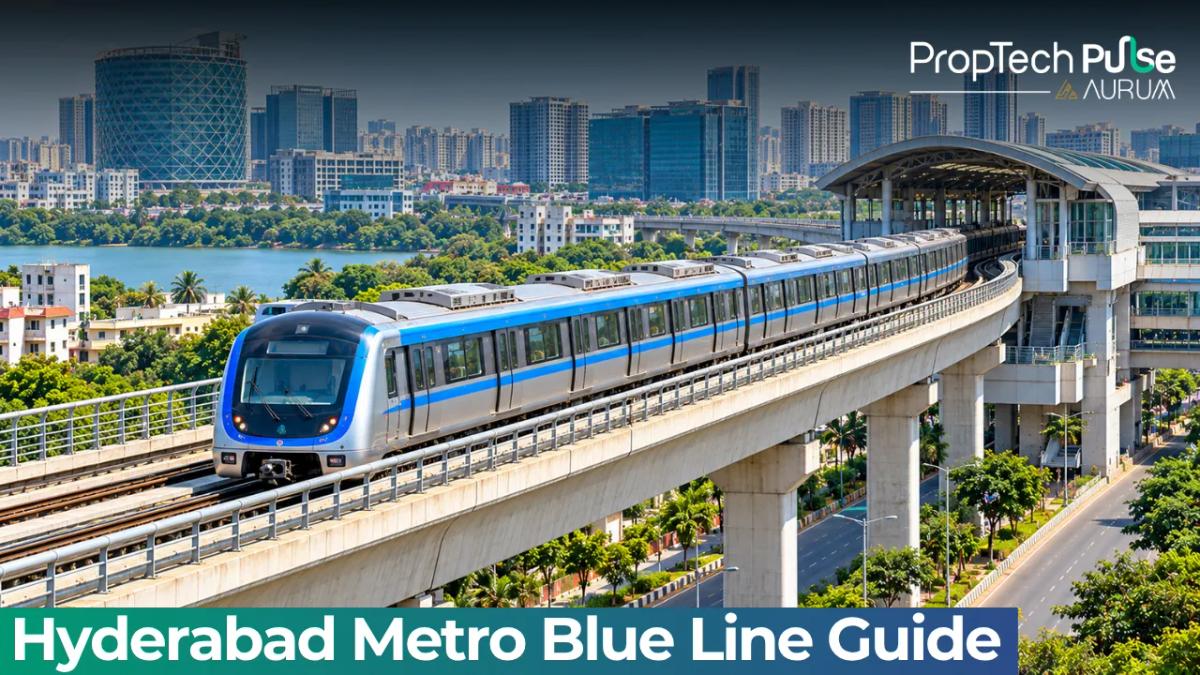
Commuting between Jubilee Hills and Madhapur used to mean fighting gridlock on the Outer Ring Road for nearly two hours. Then came the hyderabad metro blue line.
Covering the same stretch now takes roughly forty minutes. That cuts your daily travel time in half and shifts where people want to live and work across the city.
Planning your daily commute? Tracking how Phase 2 expansions reshape western Hyderabad? You get the latest route data, exact station lists, current ticketing rules, and property outlooks right here.
Hyderabad Metro Blue Line Route Overview
Quick answer
The blue line metro runs twenty-seven kilometres from Nagole in east Hyderabad to Raidurg in the west. It covers twenty-three above-ground stations passing directly through the city’s main IT belt, including HITEC City, Madhapur, and Gachibowli. Trains operate daily between 06:00 and 23:00, with peak frequencies dropping to four-minute headways.
This corridor acts as the backbone of Hyderabad’s public transit system. Construction unfolded in three distinct phases. The eastern segment opened in November 2017, reaching Ameerpet in March 2019. Builders pushed the guideway further to HITEC City later that year. Final extension work to Raidurg commenced passenger service shortly after.
The railway did more than connect neighbourhoods. Companies relocated campuses closer to these stations. Employees chose homes within walking distance of the platforms. Road traffic volumes on parallel streets like NH 65 stabilised once ridership peaked.
Note on ownership: In April 2026, the Government of Telangana completed its full takeover of Hyderabad Metro Rail Limited. The private concessionaire, L&T Metro Rail Hyderabad, exited completely. Operational decisions, fare revision processes, and the upcoming Phase 2 approvals now rest entirely with state authorities.
Nagole to Raidurg Metro: Key Stops & Travel Times
If you rely on the hyderabad metro blue line for your daily commute, knowing the exact travel times saves you from overbooking meetings. The trains maintain steady speeds between stops because they avoid the signal congestion that plagues surface buses and autos.
| Segment | Metro Duration | Typical Road Duration | Time Saved |
|---|---|---|---|
| Nagole → Ameerpet | 22 minutes | 50 to 70 minutes | 30+ minutes |
| Ameerpet → Madhapur | 15 minutes | 45 to 60 minutes | 30 minutes |
| Madhapur → HITEC City | 5 minutes | 25 to 35 minutes | 20 minutes |
| Hitec City → Raidurg | 8 minutes | 35 to 50 minutes | 27 minutes |
| Nagole → Raidurg (Total) | ~40 minutes | 105 to 155 minutes | Up to 2 hours |
These averages assume normal weekday conditions. Bus services on the Outer Ring Road often take significantly longer during evening rush hours due to truck movement and construction activity. Dedicated elevated guideways let the trains bypass those bottlenecks entirely.
Drivers switching to rail find the time consistency reliable enough to calculate exact arrival windows. Board a carriage at Madhapur at 09:20 for a 10:00 AM meeting starting in Raidurg. Arrival happens well before the scheduled hour.
All Hyderabad Blue Line Stations & Interchange Details
All stops run above street level. This above-grade design simplifies emergency evacuation and reduces flood risks during heavy monsoon rains. Zero underground tunnels exist on this specific route.
Line transfers occur at two key junctions. Ameerpet connects you to the Red Line, which stretches toward Lallaguda and the Old City markets. Parade Ground allows you to hop onto the Green Line heading toward Sanjeev Reddy Park and Miyapur.
| Station Name | Nearest Commercial Hub / Landmark | Zone |
|---|---|---|
| Nagole | Sector 35 CBD, National Institute of Fashion Technology | East Hyderabad |
| Lakdi-ka-pul | BHEL Township, Medical College Campus | Central Hyderabad |
| Ameerpet | IT Office Parks, Multiple Colleges, Bus Depot | Central Hyderabad |
| Madhapur | Cyber Towers, Cyber Pearl, DLF CyberCity | IT Corridor |
| Raidurg | Raidurg Metro Station Tower, Financial District access road | Western Corridor |
Facilities include automated ticket barriers, escalators, elevators for accessibility, and air-conditioned waiting lounges. Security checks at entry points scan bags quickly, keeping queue sizes manageable even when thousands of office workers pass through simultaneously.
Investors tracking transit-oriented developments watch these hubs closely. Every metro station creates a micro-market where retail shops, quick-service restaurants, and premium serviced apartments cluster naturally. Review our analysis on which locations near metro stations have higher rental premiums to frame those investment decisions better.
Commuters using the hyderabad metro blue line benefit from direct platform crossings rather than vertical climbs or complex tunnel walks. The layout at Ameerpet mirrors international standards, allowing smooth transitions between different corridors without exiting the paid zone or buying new tokens.
Blue Line Metro Timings, Frequency & Peak Hours
The operational window spans seventeen continuous hours daily. Services begin precisely at 06:00 from both termini, with the final train departing shortly before 23:00.
Late shifts at HITEC City or the Financial District still offer viable last-mile connections back toward Secunderabad or East Hyderabad.
Headway frequency dictates your waiting experience. Early morning boarding periods and weekday rush hours see trains arriving approximately every four minutes.
Late evening runs stretch slightly, but remain frequent enough that scheduling your trip around a strict timetable is unnecessary.
Last departures shift marginally on Fridays and public holidays depending on scheduled maintenance activities. Checking the official portal before weekend outings prevents unexpected delays.
Automatic train protection signalling supports tighter headways without compromising safety margins.
Evening crowds look different across the length of the route. Wagons filling near Madhapur tend to empty gradually as the train moves eastward. Reverse commuters boarding at Raidurg heading toward the corporate parks fill seats quickly after ten o'clock in the morning.
Current Fares, Payment Options & Ticketing Rules
Ticket pricing follows a distance-based slab system. Short hops start at ₹10 and scale upward as you cross multiple stations, capping at ₹80 for the full Nagole to Raidurg journey. Student concessions and senior citizen discounts apply where eligible, provided you carry valid identification documents at the guard desk.
Fare adjustments: Following the state government's full acquisition of the operator in April 2026, tariff revision authority shifted entirely to public administration channels. Any future slab corrections require municipal committee approval before implementation.
Digital payment acceptance has expanded significantly since the previous concession era. Unified Payments Interface scanning works directly at automated ticket vending machines and gateway readers throughout the day. Popular mobile wallets link directly to the token issuance systems. This removes the friction of carrying cash during peak commuting windows.
Smart passes loaded with value or monthly credits eliminate repetitive transactions for regular travellers. These reloadable cards function across other lines too, making them practical if you combine the hyderabad metro blue line with Red or Green network trips for client visits outside your home sector.
Card replacements activate a temporary freeze mechanism instantly via customer care helplines or mobile apps. Lost card refunds trigger a hold mechanism while ownership verification completes. Paper slips remain available at counters for infrequent visitors who prefer transactional transparency without account creation.
Phase 2 Extensions: Airport Express & LB Nagar Corridor Update
The existing network represents just the opening chapter for Hyderabad's transit architecture. Two major extensions dominate the current development pipeline, both receiving strong backing from state infrastructure bodies after the operator transition.
The Airport Express branch diverges from Raidurg, spanning roughly thirty-one kilometres.
That spur heads straight for the Rajiv Gandhi International Airport, connecting corporate campuses directly to domestic and international terminals without touching busy arterial roads.
Construction preparation continues ahead of financial sanction deadlines expected in late 2026 or early 2027.
Network activation timelines also push the eastern terminus beyond Nagole by five kilometres toward LB Nagar. Bridging that gap improves accessibility for residents currently reliant solely on buses or private vehicles.
Tracking these macro-level shifts requires looking beyond individual projects. Broader analyses on real estate investment in India demonstrate how transit expansion consistently outperforms isolated township developments in generating compounding wealth over five to seven year horizons.
Property & Rental Trends Along the Blue Line
Connectivity dictates pricing power in Hyderabad's residential market. Apartments situated within one kilometre of any blue line metro station command premium rents because employers prioritise proximity to minimise downtime.
Serviced apartments near Madhapur and Nanakramguda see vacancy rates consistently below fifteen percent during hiring seasons.
Builders factor rail access directly into their brochures and pricing models. Most developers understand transit time as a hard cost, comparable to fuel expenses or car maintenance bills.
Properties marketed as 'walking distance to metro' sell faster and retain value better during market corrections.
New projects concentrate heavily around Cyber Gateway and Kondapalli, where land parcels allow mixed-use complexes combining retail podiums with residential towers above.
These designs capture double revenue streams by leasing ground-floor spaces to cafés and convenience stores catering to daily commuters.
Property managers track tenant turnover metrics relative to new station openings. Vacancy drops almost immediately following official inauguration dates, allowing landlords to reset asking rates upwards within ninety days. Working with top builders in Hyderabad ensures compliance with RERA timelines, protecting your capital against execution delays.
Office parks lining the guideway benefit similarly. Showrooms and co-working facilities thrive where footfall from rail passengers merges with vehicular traffic. Zoning regulations permit mixed usage in specific corridors, creating environments where workers grab lunch without leaving the block.
Before you plan your next commute or investment
The rail link operates as more than a utility. Track alignment shapes how money flows through western Hyderabad. Neighbourhood selection follows directly from station proximity.
Daily efficiency guides living quarters. Target locations differ based on budget constraints. Investment opportunities sit near interim stops where developer supply remains limited. Permanent assets beat temporary hype every time.
Corporate professionals cluster around central hubs. Budget-conscious households settle further out.
Verify project approvals independently before committing capital. Walk the routes yourself. Check the timetable against your actual work hours. Trust the numbers over brochure promises.
Frequently asked questions
How many stations are there on the hyderabad metro blue line?
The corridor features twenty-three stations from end to end. Every station sits above grade, built on concrete pillars running alongside existing roads without requiring land acquisition for sub-surface tunnels. This configuration keeps construction costs down and speeds up maintenance compared to underground lines in older cities.
What are the operating hours for the blue line metro?
Trains run daily from six in the morning until eleven at night. The last departure from both Nagole and Raidurg happens just before midnight. During weekday peaks, headways drop to four minutes, meaning you rarely wait long at platforms in sectors like Madhapur and HITEC City when heading back home.
Where do the blue line and red line intersect?
Passengers switch between the two networks at the Ameerpet station. Located centrally within the old city boundaries, this transfer hub connects the eastern corridor running from Nagole directly to the western tracks originating at Lallaguda. You can walk straight across the platform without exiting the paid area.
Is the airport express part of the current hyderabad metro blue line network?
It is not active yet, but the alignment runs parallel and branches off from Raidurg. When Phase 2 clears its final funding clearances, the thirty-one kilometre Airport Express will pull passengers from the western IT corridor straight to the Rajiv Gandhi International Airport terminal.
Can I pay for my metro ticket using UPI or digital wallets?
Yes, Hyderabad Metro Rail Limited now accepts unified payments interface scans alongside smart cards and physical tickets. Most vending machines and gate readers accept QR codes from Paytm, PhonePe, and Google Pay. Digital payments also function reliably when buying monthly commutation passes at customer help desks.
Enjoyed this blog article? Visit PropTech Pulse for more interesting blogs.



Ask Pulse Ai anything about real estate

Unlock the Latest in Real Estate
News, Infographics, Blogs & More! Delivered to your inbox.

