New Launch - India Real Estate Report 2026.

Services
Knowledge Hub
Resources
Tools

Ask Pulse Ai
©PropTech Pulse 2025, All rights reserved.


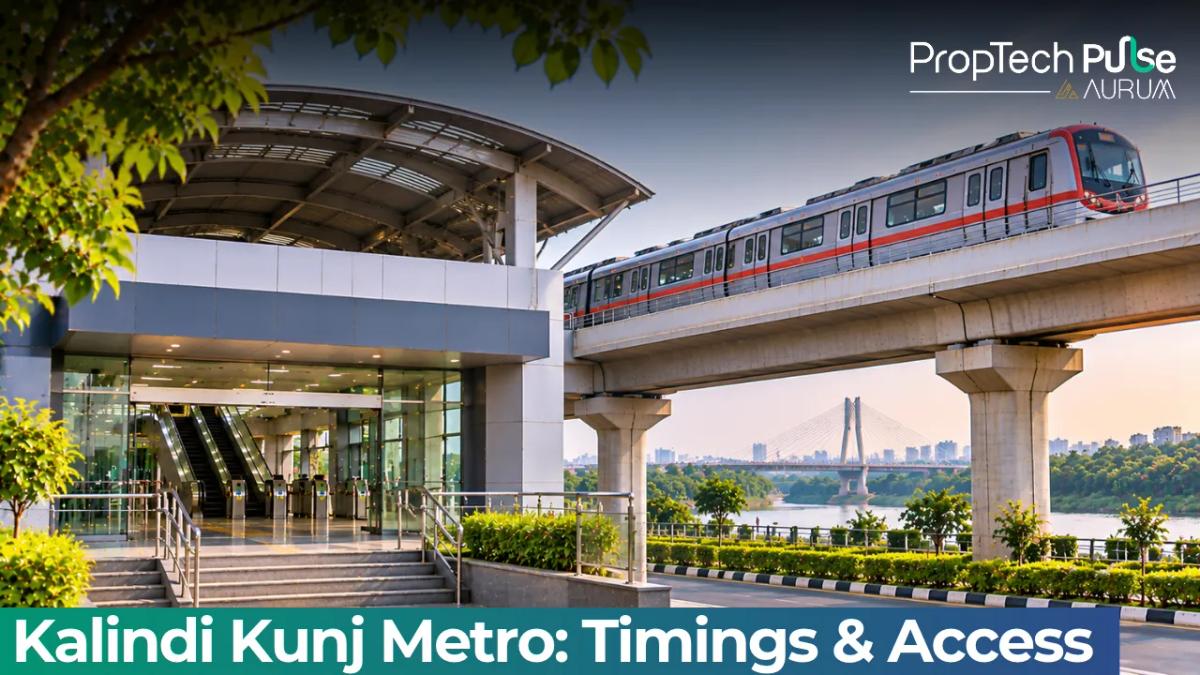
You need to know whether the 23:56 last train to Botanical Garden leaves before your shift ends. Alternatively, a 2 BHK in Madanpur Khadar might hold its rent even after the next interchange opens.
Kalindi Kunj works as a quiet junction on the Magenta Line. Its positioning right on the Delhi–Uttar Pradesh border dictates pace and pricing for half a dozen adjacent neighbourhoods.
What is Kalindi Kunj Metro Station?
Quick answer
Kalindi Kunj metro station sits on the Magenta Line in Madanpur Khadar, New Delhi. Opened in December 2017, the station features side platforms, runs first trains at 06:03 towards Botanical Garden and 06:06 back towards Krishna Park Extension, and serves as the current southern terminus while the network extends to the planned Madanpur Khadar interchange on the Golden Line.
The station falls under the North Central Terminal zone of the Delhi Metro Rail Corporation. Trains reverse here every ten to fifteen minutes depending on the roster, which shapes both the daily commute rhythm and how locals plan evening trips across South and East Delhi.
Kalindi Kunj Metro Location & Connectivity
Calculated coordinates place the facility squarely in Madanpur Khadar, postal code 110076.
The station cluster sits just north of the Kalindi Kunj Toll Booth. That geographic placement matters. It funnels cross-border commuters who work in East Delhi or Sarita Vihar but prefer to pay Delhi municipal rates.
Roads connecting directly to the Khasra Khera bypass feed into the older stretch that becomes the Mathura Road corridor further west.
If you rely on feeder buses, the stand outside Gate 1 pulls routes from Jasola, Mithapur, and parts of Greater Kailash. The station sits between Jasola Vihar Shaheen Bagh and the line's physical end point until the Golden Line tunnel reaches up from the south.
Kalindi Kunj Metro Timings
Daily headways change slightly between peak work hours and late-night slots. Locking down the exact first and last departure windows avoids missed rides on weekdays. The table below maps the split directions.
| Direction | First Train | Last Train |
|---|---|---|
| Towards Botanical Garden | 06:03 | 23:56 |
| Towards Krishna Park Extension | 06:06 | 23:06 |
During morning rush, intervals tighten to five minutes twenty seconds. After 10:00 am and again after 4:00 pm, gaps stretch to six minutes five seconds.
Weekends push the off-peak schedule earlier, and DMRC trims the evening tail for depot maintenance. Always verify the weekly engineering window notice posted at station entrances.
Kalindi Kunj Metro Fares & Ticketing
Fares follow DMRC’s distance-based slab system. A single journey from Kalindi Kunj to Rajiv Chowk costs ₹43 on regular weekdays and drops to ₹32 on Sundays.
Short hops stay under ₹10, while cross-city runs to Kashmere Gate or Dwarka Sector 21 sit between ₹55 and ₹70.
Ticket vending machines take cards, QR scans, and cash. NCNC users must tap out at every interchange to avoid double charges. Concession quotas exist for students and senior citizens.
Platform Layout, Gates & Facilities in Kalindi Kunj Delhi
Design favours function here over grandeur. Built on a raised concrete base, the structure manages monsoon runoff from the adjacent flat terrain.
Station Access
Gate 1 funnels everyone into one concourse level, then splits onto two separate side platforms.
Step down onto Platform 1 for Botanical Garden trains, or board Platform 2 heading towards Krishna Park Extension.
There are no cross-over bridges at grade zero, so choosing the wrong deck means waiting for a reversal cycle rather than switching tracks midway.
Moving equipment includes three lifts positioned along the concourse wall and escalators leading straight to the boarding decks.
The entire setup qualifies as Divyang-friendly, covering tactile guidance paths, braille signage at ticket windows, and dedicated seating zones. Paid concourse toilets operate from early morning until station closure. First aid rooms staff a single rotating paramedic desk linked to the nearest community health centre.
Nearby Landmarks & Destinations
Within walking distance or a short autorickshaw ride, the area clusters several functional destinations. Atlantic Water World sits roughly 1.5 kilometres east, pulling weekend footfall that stretches queue times at Gate 1.
Shaheen Bagh Market lies half a kilometre south, drawing bulk grocery and textile shoppers who transfer between bus and rail. Indraprastha Apollo Hospital anchors the medical travel corridor about 2.8 kilometres away; patients and attendants frequently use the station because parking inside hospital grounds remains tight.
Localities and Property Impact Near Kalindi Kunj Metro
Transit nodes quietly regrade surrounding pins. Proximity to a Delhi metro gateway usually lifts asking rents by 8 to 12 percent compared to parallel streets that lack direct feeder access.
The mechanics are simple: fewer commuting hours mean landlords price in convenience, and developers bundle rooftop terraces or covered parking premiums to justify higher sale rates.
Residential Demand in Madanpur Khadar and Jaitpur
Jaitpur and Mithapur absorb most of the overflow from East Delhi's core. They offer lower density than Nehru Place or Mayur Vihar, and the land parcels sit closer to highway corridors.
Tenants working in Gurugram or Noida via the Eastern Peripheral Expressway often settle here to avoid peak-hour bottlenecks on NH-44. Landlords capitalise by pushing up brokerage percentages whenever vacancy dips below 14 percent annually.
If you are factoring resale value, measure the actual walking time to the platform gates rather than straight-line distance.
A building two blocks inland feels significantly different from one facing the station exit, especially during July rainfall. Study how proximity to a metro station affects apartment pricing to model the premium accurately before committing to an agreement or booking token.
Future Development: Connection to Golden Line & Madanpur Khadar
The line currently stops here, but DMRC's blueprints designate Madanpur Khadar as a major interchange where the emerging Yellow-Green alignment converges.
Once the interchange corridor breaks ground and completes grading, foot traffic shifts from purely directional to genuinely cross-sectional. Properties within a six-block radius typically see speculative bidding rise 6 to 9 percent in the twelve months preceding station commissioning.
Rental yields in pocket-sized apartments tend to climb faster than gross values because business travellers and mid-level corporate employees prefer furnished flats near multi-line hubs.
Investors tracking growth around Kalindi Kunj Metro Station should test baseline numbers before construction ramps up. Run your own projections using a rental yield calculator to separate realistic returns from brochure hype.
Before You Move Near Kalindi Kunj Metro Station
Decide your anchor point first. Workplaces near Akshardham or Kashmere Gate sit a thirty-eight-minute Magenta Line commute away, keeping travel comfortably under forty-five minutes. Offices spanning multiple districts require extra checks on monsoon-ready feeder routes.
First-time renters should inspect drainage slopes behind buildings facing Gate 1. Basement waterproofing details consistently outperform surface painting jobs during July rains.
When evaluating sales inventory, demand the RERA registration number and cross-check plot approval on the Delhi development authority portal. Avoid properties claiming prime metro adjacency without verifying actual access roads on latest survey maps. Complete your due diligence with a checklist tailored to current market conditions before signing. Read home buying in India in 2026 to align your document verification steps with updated compliance rules.
Frequently asked questions
What is the first and last metro time at Kalindi Kunj?
The earliest departure heads toward Botanical Garden at 06:03, with the final train leaving at 23:56. Back toward Krishna Park Extension, the first service starts at 06:06 and concludes at 23:06. These slots adjust slightly during monthly maintenance windows, so check the weekly notice board at Gate 1 before late-night commutes.
How many gates are there at Kalindi Kunj metro station?
There is a single passenger entrance labelled Gate 1, positioned on the south-west corner of the elevated platform. All access roads, lift shafts, and fare vending machines converge here. Pedestrians moving between the station and neighbouring plots simply walk straight onto the raised driveway without navigating additional tiered crossings.
Is parking available at Kalindi Kunj metro station?
Parking space exists primarily for bicycles and limited two-wheelers tucked behind the concourse fence. Four-wheeler lots have not been constructed because the elevated footprint restricts surface expansion. Daily commuters usually leave vehicles at private compounds along the adjacent bypass and walk the remaining distance.
Which metro line stops at Kalindi Kunj?
Only the Magenta Line serves this station today. It functions as the southernmost terminal for Phase III extensions, meaning all trains reverse direction here. Connectors to the planned Yellow-Green interchange sit a few hundred metres downstream, pending ongoing tunnel breakthroughs.
How far is Kalindi Kunj metro station from Atlantic Water Park?
The water park entrance sits roughly 1.5 kilometres east of Gate 1. Most visitors cover the gap in fifteen minutes on foot or take a local autorickshaw that waits near the bus stand. Traffic peaks between Friday evenings and Sunday afternoons when family groups return from afternoon sessions.
Does Kalindi Kunj metro station support disabled passengers?
Yes. The facility carries full Divangjan-friendly certification. Tactile paving lines guide visually impaired travellers from the street curb to ticket counters. Elevators match platform height precisely, and wheelchair seating zones mark both boarding decks. Staff remain trained to assist with ramp deployment if temporary power fluctuations occur.
Sources
- Delhi Metro Rail Corporation: Operating hours, peak frequency, fare slabs, lift/escalator counts, facility details, and zone classification (accessed October 2026)
Enjoyed this blog article? Visit PropTech Pulse for more interesting blogs.

Ask Pulse Ai anything about real estate

Unlock the Latest in Real Estate
News, Infographics, Blogs & More! Delivered to your inbox.

