New Launch - India Real Estate Report 2026.

Services
Knowledge Hub
Resources
Tools

Ask Pulse Ai
©PropTech Pulse 2025, All rights reserved.


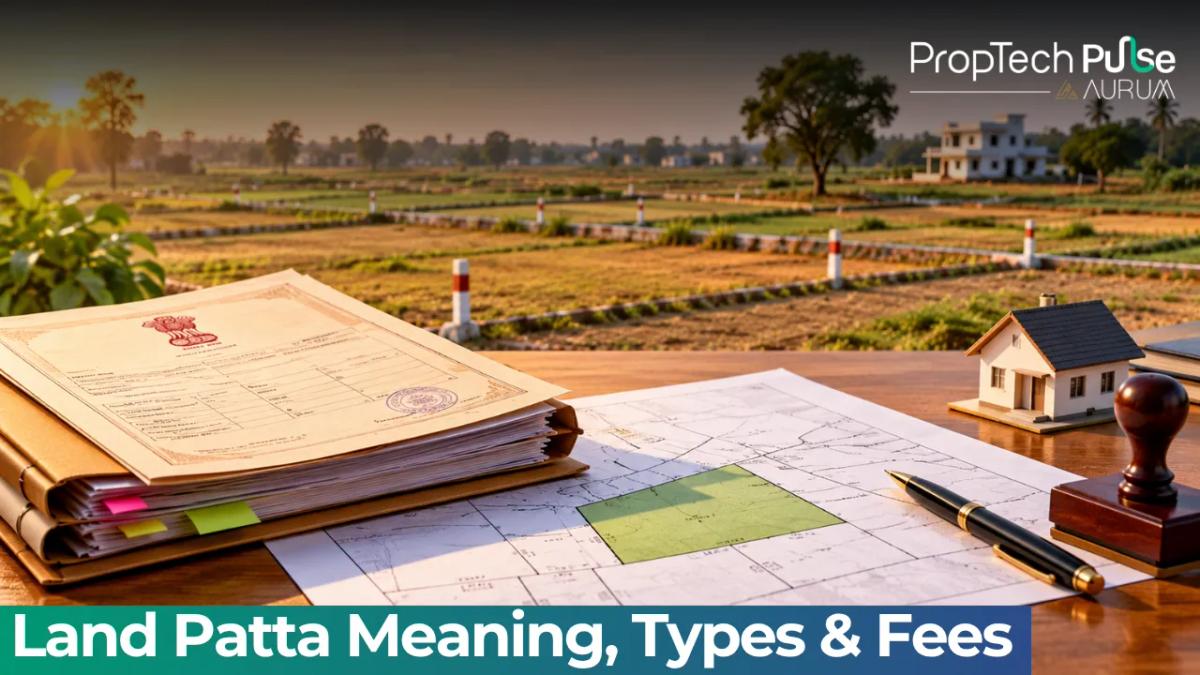
You have found a vacant plot or inherited ancestral agricultural land. The paperwork includes a document called a patta. You need to know if it grants legal ownership. It is not merely a tax receipt.
In many states across South and Northeast India, this revenue record is mandatory. You must have it before you build a house or apply for domestic electricity. It is also required before selling the land.
This post explains the land patta meaning. It shows you where it fits into your property documents. You will walk away knowing how to avoid getting stuck at the local revenue office.
What is Land Patta Meaning?
Quick answer
A land patta is a legal document issued by the state revenue department that serves as proof of possession and ownership for a specific plot of land. It is primarily used for vacant residential sites and agricultural fields in South and Northeast Indian states, and it allows the holder to register their name with the local tax authority.
The term refers to a revenue certificate. It maps a specific parcel of land to a specific owner. In Hindi, the word translates to पट्टा (pattā).
Historically it meant a strip of land allotted to a cultivator. Modern property law relies heavily on registered sale deeds. The patta remains the foundational document nonetheless.
It tells the government exactly who pays land taxes in rural and peri-urban zones. Understanding the basic land patta meaning protects you from title disputes.
Which Properties Need a Patta Document?
A patta is essential when dealing with vacant land, agricultural fields, and homestead plots. It bridges the gap between raw land records and the individual buyer.
If you buy a ready-to-move apartment in Bangalore or Chennai, you will rarely see a standalone patta. The builder handles the collective title instead. Flat owners rely on society bye-laws rather than personal pattas.
For plot investments, however, the patta remains non-negotiable.
Related terms often appear alongside it in revenue databases. Review our glossary on patta and chitta land records to clarify why some regions demand two separate sheets. Other areas issue them together.
The role of the Pahani is equally helpful. It functions as an updated version of the original allotment letter. Read our guide on what is a Pahani land record document.
You will see how digital updates replaced older paper trails.
Who Issues the Land Patta?
The authority responsible for issuing this document sits at the local revenue administration level. The specific official depends on the state.
It could be the Tahsildar. It might be the Revenue Divisional Officer (RDO). The District Collector is another option.
These officials operate under their respective State Land Revenue Acts. They hold the power to record mutations. Updating land titles in the government database falls within their scope.
Once the mutation gains approval, the government reissues the patta. Your name gets stamped on it.
Understanding the Land Patta Document: Key Details Inside
Every legitimate patta carries specific metadata. The document makes itself verifiable. You will never receive a blank sheet.
The layout revolves around unique identifiers from the state's survey department. When you hold a patta document, scan these five elements immediately:
- Name of the holder: Must match the government ID (Aadhaar, PAN, or Voter ID) of the person claiming ownership.
- Survey Number and Subdivision: Every plot is carved out of a larger master survey. Look for the exact subdivision notation, such as 45/1A, which distinguishes your slice of land from neighbouring farms.
- Admeasurement (Area): This is the total area of the plot measured in acres, guntas, cents, or square feet. Note that this figure represents the legal extent of the land.
- Location and Village/Town Name: Pinpoints the gram panchayat or municipality where the land physically sits.
- Assessment and Tax Type: Shows whether the land is classified as wet (irrigated), dry (rain-fed), residential, or commercial, which dictates the tax rate.
Watch the Survey Number closely A single typo in the survey division on a patta can trigger years of litigation. If the number does not match the metal boards or boundary stones on the ground, walk away from the deal until the discrepancy is fixed at the Tehsil.
Types of Land Allotments: Permanent vs Temporary Lease
Not all pattas carry the same weight. The government allocates land for different durations based on the intended use.
Homebuyers and farmers usually seek a permanent patta. It allows unrestricted usage for residential construction, agriculture, or livestock. You can freely sell or inherit it.
You do not ask for fresh permission every decade. The holder effectively controls the asset indefinitely. Standard zoning laws apply regardless.
A temporary lease or short-term patta serves specific public or ecological purposes. You might receive a temporary allotment for planting trees on barren land.
Creating a community pond is another common goal. Setting up a small craft unit in a village hub works too.
These pattas come with strict duration clauses. They are usually valid for only three to five years.
You cannot always convert them into saleable property. A formal amendment by the revenue board becomes necessary.
Always read the footer clauses. Check the expiry date right away.
Land Patta vs Khata vs Registry
This area confuses most first-time buyers of vacant land. People often assume the patta serves as the ultimate proof of ownership.
It actually operates in a different ecosystem than metro documents. To buy land with confidence, you must distinguish between three things.
You need the revenue record. You need the municipal assessment. You also need the legal deed.
| Feature | Land Patta | Khata (Katha) | Sale Registry / Deed |
|---|---|---|---|
| Issuing Authority | State Revenue Department (Tehsil) | Municipal Corporation or City Council | Sub-Registrar Office |
| Primary Purpose | Proves possession and sets liability for land tax | Used for municipal water, electricity and building permits | Legal proof of ownership transferred via a sale transaction |
| Geographic Focus | Tamil Nadu, Karnataka, Kerala, Telangana, and parts of Northeast India | Urban centres across almost all Indian states | Pan-India standard for property transfers |
The confusion stems from how these documents interact during a transaction.
You sign a registry with the seller when you buy a plot in a satellite town. This transfers the legal rights. After registration, you take the sale deed to the local Tehsil office.
You submit it to mutate the records. The patta shifts from the old owner's name to yours. Simultaneously, you approach the municipal corporation. You open a new Khata in your name.
Building legally becomes possible. Think of the registry as the contract. View the patta as the revenue acknowledgement. Consider the Khata as the permission slip for utilities.
Many buyers skip the Khata phase. They think the patta covers everything. That assumption causes blocked approvals later.
See our breakdown on the difference between a katha and a patta.
You will understand why both documents support compliant construction.
Step-by-Step: How to Apply for Land Patta Online & Offline
Applying for a patta involves administrative work. Bureaucracy varies sharply between states.
Applicants once stood in long queues at the Taluk office. Repeatedly chasing peons for file movements defined the experience.
Several states have migrated the workflow online today. Cutting corruption and reducing delays drove the change. Core documentation requirements remain identical across the country.
Documents Required for Mutation and Patta Transfer
Whether you apply digitally via the state's e-District portal or submit a physical file in person, the evidence packet must be complete before the clerk touches it.
Gather these files before initiating the mutation request:
- Original Patta/Khasar: The current revenue extract held by the seller.
- Duly Registered Sale Deed: Proof that the legal transfer of title happened.
- No Objection Certificate (NOC): Sometimes required if the land was joint family property or involves a deceased person's estate.
- Property Tax Receipts: Shows the applicant is willing to take over tax liabilities.
- Identity and Address Proof: Aadhaar card or Voter ID for KYC compliance.
- Application Form: Usually Form X in southern states, completed in triplicate.
Do a thorough property legal verification first Before you even fill out the mutation form, run a comprehensive background check on the land. Review our property legal verification checklist to spot hidden liabilities or unrecorded agreements that could derail your patta application later.
Online Application Steps
Karnataka pioneered digitising land records. The Bhoomi portal allows citizens to view ownership details. Applying for corrections happens digitally there.
Tamil Nadu routes applications through the e-District and e-Sevai kiosks. If you sit in Andhra Pradesh or Telangana, state mapping initiatives help you.
Interactive map interfaces display your plot alongside revenue details. The typical flow follows a set path.
Register on the state portal. Upload scanned copies of the sale deed. Add identity proofs. Track status using a reference number.
Most states still demand a physical signature. The Tahsildar officially sanctions the new patta only after the notary signs off.
Important Caveats: When You Cannot Get a Patta
A patta is not a universal right. It stays conditional on physical characteristics and legal history.
The government refuses to issue pattas in three scenarios. Buyers frequently overlook them.
Shifting riverbeds and sandbars known as chars cannot legally receive settlement documents.
Rivers like the Brahmaputra in Assam or the Kosi in Bihar alter their courses during heavy monsoons. Land sitting on a char becomes ecologically unstable. It proves legally unassignable.
Government reserved forests exclude private claims. Wildlife sanctuaries fall outside the private market.
Heritage archaeological zones face the same restriction. Squatting on forest land triggers immediate eviction notices.
Demanding a patta under the Forest Conservation Act guarantees refusal.
Active court litigation creates roadblocks too. Disputed boundaries place a red flag on the record. Issuance freezes completely until civil courts resolve the case.
Your Next Move Before Buying a Plot
Refusing to proceed without clean paperwork offers the strongest defence against fraud.
Never hand over a token amount to a local broker. Promises that they will arrange the patta later hold little weight.
Demand to see the existing patta. Ask for the corresponding Encumbrance Certificate simultaneously.
Cross-verify the survey number on the patta. Check it against physical boundary boards on the field.
If the seller holds the title under a trust, verify board resolutions. Attach them to the registry.
Ensuring freedom from banking liens demands scrutiny. Tracing the land patta meaning back to its origin reveals why it matters for tax compliance.
Learn how to check an Encumbrance Certificate. Confirm no secret loans stack against the site.
Release funds only after verification.
Frequently asked questions
Is a land patta the same as a registered sale deed?
No, they serve entirely different legal functions. A registered sale deed is created by the buyer and seller to prove that money exchanged hands and ownership was transferred, executed under the Registration Act. A land patta is a unilateral government document issued by the revenue department that acknowledges the buyer's entry into the tax grid. You must present the sale deed to the Tehsil office to force the migration of the patta onto your name.
How do I check my land patta status online?
You can check the status using your state's dedicated land records portal. Karnataka users visit the official Bhoomi website and enter their district, taluk, and survey number to pull up the electronic extract. Tamil Nadu residents log into the Tamil Nadu e-District portal to track their submitted Form X application. Each state maintains its own independent server, so a centralised national search function does not currently exist for private land pattas.
Can we sell land without a patta?
Technically yes, but it severely damages the market value and complicates the transfer process. Without a valid patta matching the seller's name, the buyer cannot secure the land title mutation after paying. Most reputable buyers and lenders refuse to touch un-mutated land because the risk of fraudulent title assignment is too high. The transaction remains possible but requires significant negotiating power from the buyer.
Who issues the land patta and where do I go?
The issuing authority sits within the state's revenue administration tier, typically the Tahsildar of the local Taluk office or the Revenue Divisional Officer (RDO). In urbanised towns, the Deputy Collector may handle complex requests. Applicants deal directly with the Taluk headquarters in the geographic zone where the physical land borders are located. Digital submissions now route through the same regional controllers electronically.
What is the difference between a patta and chitta?
Historically, South Indian revenue offices issued two separate certificates: the Patta recorded the owner's name and tax liability, while the Chitta served as a map extract showing the exact dimensions and boundaries of the plot. Modern consolidation efforts in states like Tamil Nadu have merged these into a single unified document, eliminating the need to carry two separate physical folders during transactions.
Sources
- Tamil Nadu e-Governance Agency (tn.gov.in): e-District application procedures for land mutation and title updates (accessed October 2026)
- Odisha State Government (odisha.gov.in): Jaga Mission guidelines for slum dwelling colony regularisation and patta distribution (accessed October 2026)
Enjoyed this blog article? Visit PropTech Pulse for more interesting blogs.





Ask Pulse Ai anything about real estate

Unlock the Latest in Real Estate
News, Infographics, Blogs & More! Delivered to your inbox.

