New Launch - India Real Estate Report 2026.

Services
Knowledge Hub
Resources
Tools

Ask Pulse Ai
©PropTech Pulse 2025, All rights reserved.


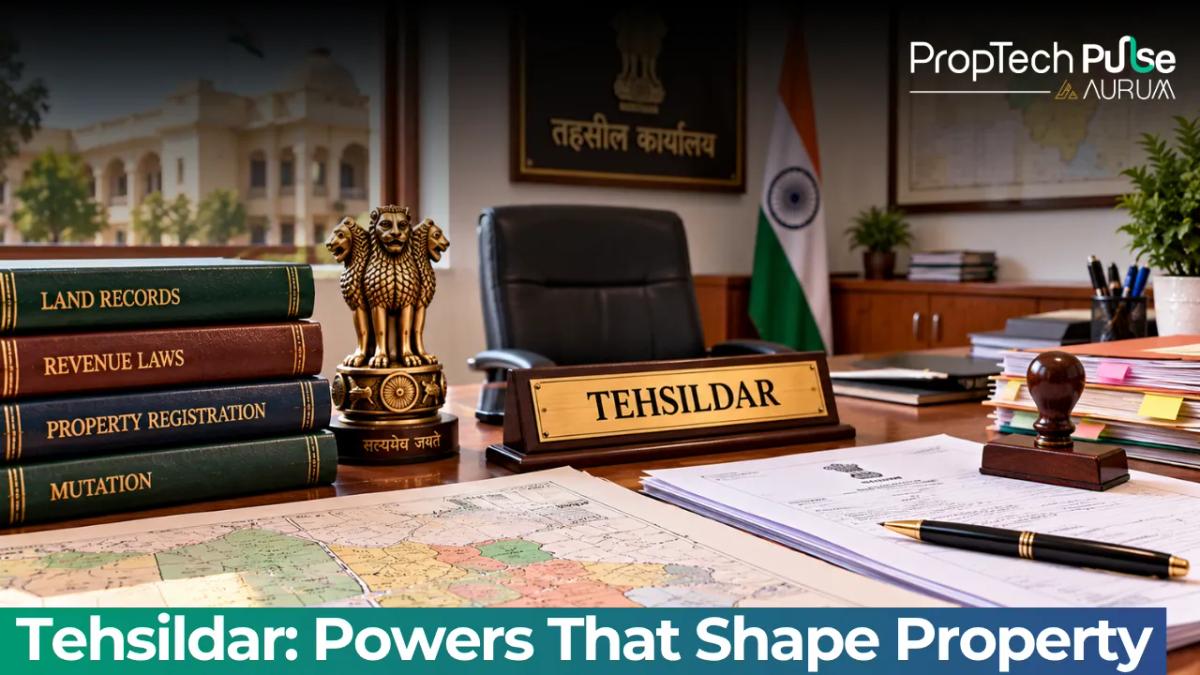
Buying property involves signing deeds and paying stamp duty. However, the authority shaping your ownership rights sits elsewhere. It occupies the tehsildar's office across rural districts.
This revenue officer updates land records, issues housing certificates, and guides local disputes. Knowing exactly what they do separates a stalled file from a closed deal.
This guide breaks down the tahsildar meaning, their administrative hierarchy, and their actual work. It also explains why their digital shift matters for securing your investment.
What is a Tehsildar?
Quick answer
A Tehsildar (often spelled Tahsildar) is a senior revenue administrator in India responsible for managing land records, collecting local taxes, and overseeing property mutations within a specific sub-division or tehsil. They act as both an executive magistrate and the lowest rung of the formal revenue court system, reporting directly to the Sub-Divisional Magistrate.
The word traces back to Persian. Daily conversation often translates the tahsildar meaning in English as a village headman or local revenue chief. Professionally, the postholder ranks as a Class I Gazetted Officer. You cannot inherit the seat.
Candidates must clear rigorous State Public Service Commission examinations like the UP-PSC. They start as junior assistants and earn promotion through verified performance reviews over decades.
The title changes depending on where you stand on the map. In Kerala and Tamil Nadu, they are known as Talukdars. In Maharashtra, the equivalent role falls to the Mamlatdar. Bihar calls theirs the Amaldar.
Regardless of the spelling, the mandate remains identical: keep revenue records accurate, collect the government's share, and resolve boundary issues before they escalate into lengthy civil litigation.
Where the Tehsildar Fits in the Administration
To understand the tehsildar work, it helps to see where they sit in the state machinery. Administration moves upward from the ground level, and the officer operates right above the field workers but below the highest district authorities.
- Direct Superior: The Sub-Divisional Magistrate (SDM). The SDM oversees several tehsils combined, while the Tehsildar focuses exclusively on one.
- Immediate Subordinates: Naib Tehsildars assist with specific blocks or towns. Further down, Patwaris and Lekhpals maintain the original physical maps and hand over the raw data to the officer.
- District Level: The District Collector supervises all revenue administrators in the region, ensuring policies align with state directives.
The hierarchy exists because land disputes multiply quickly. A buyer moving into a new neighborhood needs to know that complaints regarding encroachment or wrong measurements start at the office desk, not the Collector's cabin.
The Core Work of a Tehsildar
In modern real estate, this official controls the paper trail that proves you actually own what you bought. Their daily responsibilities cover three major pillars that affect property value and liquidity.
Maintaining Land Records and Overseeing Mutation
Every state maintains a master register called the Jamabandi. It tracks ownership changes dating back to the 1950s. Sales and inheritances do not update it automatically, which is why buyers must apply for mutation. This step officially renames the owner in the register.
The officer verifies the application and inspects boundaries if anyone complains. Their signature finalizes the record update. Without it, your title deed of property remains an unregistered claim in the eyes of the revenue department.
Issuance of Essential Certificates
Housing subsidies and loan approvals require proof of identity and economic standing. The office issues the Income Certificate, Domicile Certificate, Caste Certificate, and Life of Parent Certificate. Banks routinely ask for these documents during the pre-sanction stage to confirm eligibility for subsidized rates.
Managing Revenue and Arrears
Land cesses, water charges, and agricultural levies flow through this office. The officer ensures timely payments. Unpaid dues do not vanish; they attach to the asset permanently, creating a heavy cloud on the property's future marketability.
Mutation Tip: Don't wait for the developer or seller to trigger the process. In most districts, the burden rests on the new buyer. If the file stays in limbo, any subsequent sale or bank loan faces immediate rejection. Submit your application alongside the stamp payment to lock in the current valuation.
This workflow connects directly to the broader documentation stack. Before applying for mutation, you must clean your previous history. Checking your encumbrance certificate ensures no hidden loans exist, while understanding what a sale deed legally achieves guarantees you stop paying rent and start accumulating equity.
Tehsildar Powers as an Executive Magistrate
Homebuyers frequently mistake revenue officials for clerks, but an officer wields significant powers granted by criminal procedure statutes. These statutes, accessible through the national legal repository on indiacode.nic.in, allow the office to step in during emergencies and enforce compliance.
As an Executive Magistrate, the official operates under Sections 20 and 107 of the CrPC. Section 107 allows the officer to demand a security bond from anyone threatening to break the peace over a boundary line. Failure to comply can result in immediate arrest until the dispute cools down.
Equally important is the power to attach and seize property. A resident who ignores formal tax writs risks severe consequences.
The officer can physically seal parts of the land, restrict utilities, or initiate recovery auctions to settle the debt. While rarely triggered for minor balances, this enforcement capability exists specifically to protect municipal infrastructure funding.
This judicial capacity places the officer at the base of the revenue court chain. Lower decisions by Patwaris appeal directly to this court. A ruling faces further challenges in a divisional revenue tribunal.
Crucially, the office cannot adjudicate complex civil title disputes. If two parties claim absolute ownership through contradictory deeds, the case bypasses revenue courts entirely. It heads straight to the Civil Court or NCLT.
How Digitization Changed the Tehsildar Office
For decades, the revenue office meant sitting on a plastic chair in a crowded corridor, carrying stamped receipts, and hoping the file clerk remembered your name.
That era ended abruptly following the launch of the Digital India Land Records Modernisation Programme. Spearheaded by the Ministry of Rural Development, the initiative replaced yellowing ledger books with searchable databases hosted on state portals like Bhulekh.
Digitization now covers roughly 96 percent of rural India's land records. Citizens can view Jamabani extracts, track mutation status, and download encumbrance certificate copies without leaving their homes. The physical queues remain, but mostly for those submitting irreplaceable physical affidavits or handling active boundary fights that software cannot resolve.
Tehsildar vs Collector: Key Differences
| Feature | Tehsildar | Collector |
|---|---|---|
| Primary focus | Execution of revenue policy and day-to-day dispute resolution within a tehsil | Overall district administration and policy coordination across multiple tehsils |
| Reporting line | Sub-Divisional Magistrate (SDM) | Chief Secretary of the state and Governor of India |
| Judicial authority | Hears appeals from lower revenue staff and executes magisterial orders (Sections 20 & 107) | Serves as District Magistrate, holding supreme administrative and penal authority in the district |
| Typical buyer interaction | Mutation approvals, certificate issuance, immediate boundary clarification | Mega-infrastructure acquisition, large-scale displacement rehabilitation, district-wide disaster relief |
When You Actually Need to Visit the Tehsildar Office
Digital portals handle most routine queries now. However, stepping into the physical office remains unavoidable in four specific scenarios where paperwork hits friction.
- Active Boundary Disputes: Neighbors fencing off part of your garden or blocking access roads trigger mandatory physical surveys. The officer dispatches a survey team to verify the original sketch against ground reality.
- Mutation Rejections: If the digital portal rejects your application citing missing signatures or conflicting measurements, you must appear in person to provide the original certified copies and argue your case before the reviewing officer.
- Loss of Original Documents: If the initial sale papers burn in a fire or wash away during a flood, replacing them requires filing an indemnity bond under oath at the counters. The official notarizes the declaration right there.
- Resolving Attachment Orders: Paying outstanding land dues requires clearing a physical demand notice, securing payment challans at designated banks, and delivering the receipt stamps to the office before they can lift restrictions on your property.
Stepping into the revenue office wastes weeks if you lack the original title chain. Gather the registered sale deed, previous tax receipts, your PAN card, and Aadhaar card. Bring any mutation history before requesting action. Bureaucracy moves fastest when the file contains everything upfront.
Before You Close the Deal
Pending litigation near your plot demands caution. Ignore verbal assurances from the seller. File a caveat at the District Munsif Court immediately. Submit the mutation application directly to the revenue office so the transaction logs before boundaries shift.
Lock in your income certificates and encumbrance clearances before paying the final balance cheque. The system rewards speed. A documented claim protects your investment against waiting buyers.
Frequently asked questions
What is the full form and English meaning of Tehsildar?
The word Tehsildar derives from Persian roots indicating a revenue collector or local administrator. In everyday English usage, the tahsildar meaning in English refers to a district headman or village tax official responsible for overseeing land assessments and keeping local property registries updated within a specific subdivision.
Can a Tehsildar cancel a property sale deed?
No. A Tehsildar cannot unilaterally cancel a registered sale deed. Once a deed is stamped and recorded by the Sub-Registrar under the Registration Act, its validity belongs to the civil judiciary. The Tehsildar can halt unregistered transfers or refuse mutation updates due to fraud, but undoing a registered document requires a High Court order.
What is the difference between a Tehsildar and a Collector?
A Collector administers an entire district, coordinating development projects, election logistics, and law enforcement across multiple regions. A Tehsildar manages only one subdivision or tehsil, handling daily revenue collection and localized land disputes. The Tehsildar reports to the Sub-Divisional Magistrate, who in turn supports the Collector.
How to file a complaint against a Tehsildar?
You can file an administrative grievance directly with the District Collector or the State Board of Revenue. Most state governments also operate dedicated online citizen portal portals where you can upload evidence of negligence or corruption, triggering an automatic inquiry review by higher treasury authorities within thirty days.
Who reports to a Tehsildar?
Naib Tehsildars work under the direct supervision of the Tehsildar to manage individual townships or revenue villages. Beneath them, field officers such as Patwaris and Lekhpals handle the original mapping, measure plot boundaries, and compile the raw numerical data that the Tehsildar uses to update official registers.
Sources
- Indiacode: Full text of the Code of Criminal Procedure, 1973, detailing Sections 20 and 107 regarding Executive Magistrate powers (accessed October 2026)
- Legislative Department, Ministry of Law and Justice: Official gazette notifications defining Class I Gazetted Officer ranks and state administrative hierarchies (accessed October 2026)
Enjoyed this blog article? Visit PropTech Pulse for more interesting blogs.





Ask Pulse Ai anything about real estate

Unlock the Latest in Real Estate
News, Infographics, Blogs & More! Delivered to your inbox.

