New Launch - India Real Estate Report 2026.

Services
Knowledge Hub
Resources
Tools

Ask Pulse Ai
©PropTech Pulse 2025, All rights reserved.


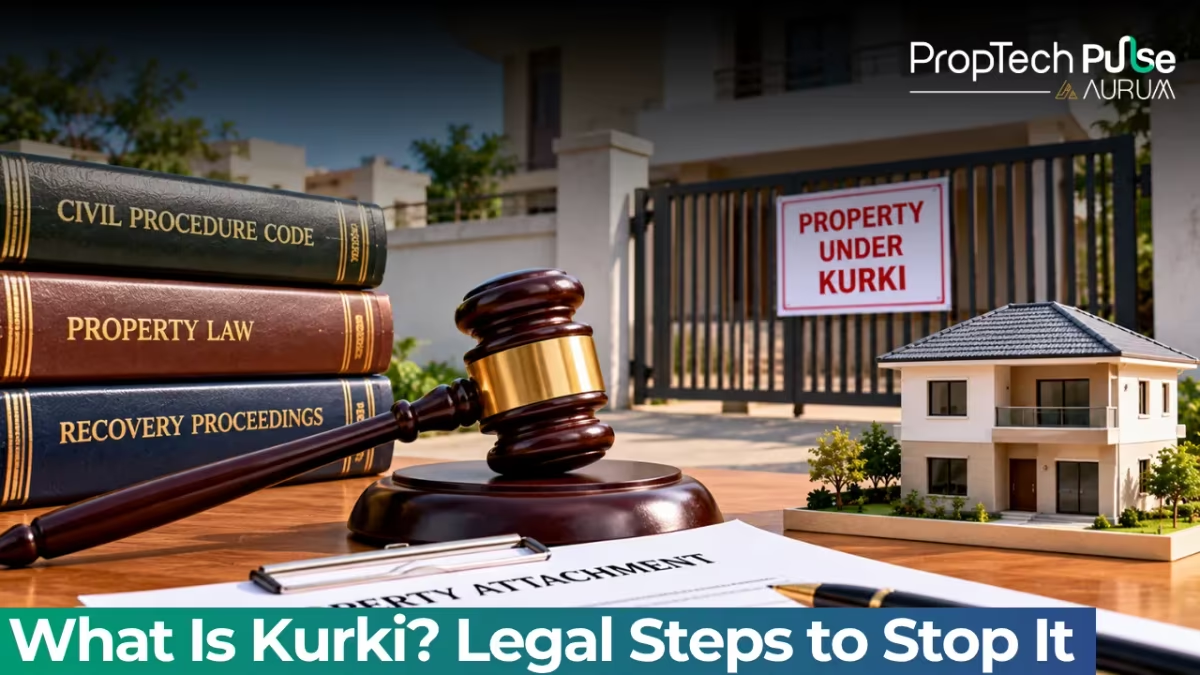
You have received a legal notice or a sealed envelope mentioning Kurki, and suddenly your anxiety spikes. Far beyond a vague term hidden in land records, Kurki represents the formal court-ordered attachment and public auction of a debtor's property to recover unpaid debts.
Losing an asset quietly versus keeping it depends on three factors. First, identify the authority holding the warrant. Second, understand which assets remain protected under Section 60 of the CPC. Finally, act within a narrow window to file objections or arrange a settlement.
What Is Kurki? Meaning in Land Records and Law
Quick answer
Kurki is the court-supervised attachment and subsequent public auction of a borrower's immovable or movable property to settle overdue debts. Unlike police raids, Kurki is strictly governed by civil procedure laws and requires a formal decree from a competent civil court before enforcement officers can seize assets.
When a borrower defaults on a secured loan, the lending institution first sends reminders and notices.
If the outstanding amount remains unpaid over several months, the bank files a civil suit against the borrower.
This marks a shift to direct judicial action. The word traces back to Persian legal terms. Kurki describes the physical seizure or attachment of assets authorized directly by a civil court.
A court bailiff or executive magistrate then physically seals the premises or attaches the title deeds. This prevents any transfer while the debt collection unfolds.
This reveals the judicial reality. Banks reserve this path for significant arrears. The loan typically sits classified as a Non-Performing Asset for over ninety days before restructuring options get explored. Once the case reaches civil court, an execution petition and eventual attachment follow swiftly.
Checking if a specific plot or building carries such an encumbrance requires diligent research. Verify local revenue records alongside property legal verification reports to ensure no prior court orders exist against the seller.
Kurki vs Jabti: What’s the Real Difference?
Confusion often arises because both terms describe seizing property, but they operate entirely different legal domains.
Understanding the exact kurki meaning goes beyond simple vocabulary translation. It represents a financial dispute resolution mechanism, whereas Jabti relates directly to criminal law and peacekeeping.
| Feature | Kurki | Jabti |
|---|---|---|
| Primary Trigger | Unpaid financial debt or breach of contract | Breach of peace or criminal offense |
| Governing Authority | Civil Courts and Court Bailiffs | Executive Magistrates and Police |
| Governing Statute | Code of Civil Procedure (CPC), 1908 | Code of Criminal Procedure (CrPC), 1973 |
| End Outcome | Public auction to recover dues | Temporary holding until parties comply with court orders |
Under criminal procedure law, specifically Section 145, a magistrate can order Jabti to seize properties caught up in violent boundary disputes or ownership conflicts.
The goal remains strictly temporary. Authorities hold the items until a higher court settles the underlying ownership question.
Kurki follows a completely different path. The property either stays in the borrower's possession under court seal or gets physically handed over to the court's custody for liquidation.
Every step demands judicial oversight. The process moves slower than administrative seizures. The rigid procedural safeguards protect the debtor.
The Step-by-Step Kurki Process
Understanding the timeline helps borrowers spot intervention points. The schedule stretches across months or years. Court backlogs and response strategies dictate the pace.
Stage 1: Filing the Suit
Lenders initiate proceedings by filing a regular or summary suit in the relevant civil court with territorial jurisdiction. Summons reach the borrower shortly after. You have thirty days to submit a written statement disputing the claim or acknowledging partial liability.
Stage 2: Decree Pronouncement
After hearing both sides, the judge quantifies the exact amount owed. The decree covers the principal, penal interest, and legal costs. Failure to appear allows the court to pass an ex parte decree without further delay.
Stage 3: Execution Petition
Winning a lawsuit does not guarantee automatic possession. The bank must file an execution petition to enforce the decree. This paperwork triggers the attachment phase. Borrowers often miss this intermediate step.
Stage 4: Issuance of Kurki Warrant
The court clerk issues the formal Kurki warrant. The document targets the executing officer or local bailiff. It explicitly lists which assets require attachment and prohibits transfers outside court premises.
Stage 5: Physical Attachment
Officers visit the property location. They inventory the assets, affix official seals, and prepare a detailed memo. Borrowers must verify that the inventory matches their actual holdings perfectly. Any mismatch provides grounds for an immediate appellate objection.
Stage 6: Public Auction Notification
The court announces auction dates through local newspapers. Officials often pin notices at the sub-registrar office as well. Approved panel valuers handle the pricing.
Stage 7: Surplus Return or Adjustment
A hammer price exceeding total dues benefits you. The surplus credits directly back to your account. Any shortfall keeps you liable for immediate repayment.
Which Properties Face a Kurki Order?
Not every portfolio asset qualifies for judicial attachment. The law draws strict lines around exemptions designed to protect basic human dignity and livelihoods.
Section 60 of the CPC protects specific assets from attachment during money decree execution. These exemptions exist to safeguard basic human dignity and livelihoods.
Protected categories cover farm tools, essential clothing, basic furniture, scientific apparatus, and daily wages above a strict minimum threshold.
| Category | Status |
|---|---|
| Residential house or commercial building | Attachable (subject to homestead exemption limits in some states) |
| Plots of land and vacant sites | Attachable |
| Savings accounts and demat shares | Attachable |
| Tools of profession or artisans | Exempt |
| Necessary clothing and food grains | Exempt |
| Life insurance proceeds | Exempt |
| Motor vehicles | Generally attachable if mortgaged to the creditor |
Borrowers also retain protection for life insurance policies holding cash surrender value. Creditors cannot touch these policies without explicit consent.
State governments wield override powers for agricultural lands. For instance, Punjab banned Kurki on farm lands in 2017 to shield cooperative bank borrowers. Traders and moneylenders later bypassed this rule by forcing farmers to sign promissory notes. Converting raw debt into standard court decrees allowed them to slip past statutory protections.
Secured loan holders face tighter constraints than unsecured borrowers. Checking types of mortgage in india clarifies exactly which collateral banks prioritize during distress, allowing you to evaluate exposure accurately.
Legal Framework: CPC 1908 and CrPC Sections Explained
The enforcement machinery relies on two pillars of procedural law. Grasping their boundaries prevents panic and guides precise legal responses.
The CPC governs Kurki mechanics for financial creditors. Order XXXVIII covers provisional attachments before final judgment. Orders XXI and XXII dictate decree execution, warrant issuance, inventory drawing, and objection hearings under Rule 57.
Conversely, the CrPC handles Kurki when Executive Magistrates trigger it. Sections 82 to 86 outline general search and seizure powers. Section 145 authorises magistrates to seize disputed property temporarily to prevent violence.
While technically labelled Kurki in older vernacular usage, this remains functionally distinct from financial debt recovery.
Note on SARFAESI vs Kurki: Banks increasingly prefer the Security Interest Enforcement Rules over traditional Kurki. Under these rules, secured lenders can auction collateral directly without waiting for a lengthy civil trial. Kurki remains mandatory only for unsecured loans or banks choosing civil jurisdiction for complex multi-party disputes.
Referencing authoritative statutes like the Code of Civil Procedure on indiacode.nic.in ensures accuracy when drafting appeals or reviewing court orders.
Impact of a Kurki Notice on Your Credit Score and Future Loans
A single missed payment drops your CIBIL score marginally.
When a court officially attaches your property, lenders classify the account as severely defaulted immediately. Negative data feeds directly into Credit Information Companies as a Non-Performing Asset classification.
An attached asset signals high risk to every future lender.
Clearing the debt removes the attachment, but the severe default lingers for seven years. Your credit report retains the stain. Securing fresh financing becomes exceptionally difficult during this window.
Lenders treat active borrowers carrying unresolved encumbrances or recent judicial attachments as flight risks.
Reversing this damage requires immediate action once the legal battle ends. Checking proven strategies on how to improve your credit score fast becomes critical. Paying remaining utility bills, credit card dues, and any residual instalments consistently forms the bedrock of recovering trust.
How to Avoid or Cancel a Kurki Notice
The window to halt proceedings narrows rapidly. Once the warrant leaves the registry, action demands speed and documented evidence, not vague promises.
Banks routinely offer schemes to reduce bad book ratios. Contacting the bank's asset reconstruction department upfront accelerates resolution. Negotiating a lump-sum reduction early significantly lowers your payable amount. Escalating penal interest at auction drives costs higher.
Filing formal written objections works wonders if the inventory wrongly includes exempt assets. Judges frequently pause auctions pending inquiries into legitimate third-party claims. Challenging co-owner rights who never signed the guarantee halts the liquidation calendar instantly.
Approaching the lender with a revised repayment plan shows genuine goodwill. Backing it with credible income projections improves settlement chances. Courts respect documented attempts and may grant adjournments.
Final Decision Rule for Distressed Borrowers
Never ignore a summons. Hire a property lawyer versed in civil execution procedures the moment you receive a Kurki warning. Simultaneously contact the bank's resolution cell for OTS details. Staying passive guarantees liquidation. Active resistance preserves ownership.
Frequently asked questions
What happens if I ignore a Kurki notice?
Ignoring the notice invites an ex parte decree, meaning the court decides entirely based on the bank's version of events. You lose the right to contest the valuation, challenge the attached assets, or present financial hardship. The auction proceeds unchecked, and you remain financially liable for any shortfall even after losing the property. Immediate legal intervention is mandatory.
Who has the authority to issue a Kurki warrant?
Only a competent civil court possessing jurisdiction over the defendant's residence or the property's location can authorize a Kurki warrant. High courts or district judges issue the directive, which then hands to local executive magistrates or court bailiffs for physical execution. Private entities like collection agencies possess absolutely zero power to initiate this process independently.
Can a personal loan lead to property attachment?
Yes, though it requires additional legal ground. Since unsecured personal loans lack mortgage tags, banks must secure a money decree first by proving the debt in civil court. Once obtained, they execute the decree under civil procedure rules to attach salaried accounts, vehicles, or real estate belonging to the defaulter just like any secured creditor would.
How long does the Kurki process take in India?
Typically spans 12 to 24 months from initial suit filing to final auction, heavily dependent on metropolitan court backlogs and borrower objections. Smaller districts may resolve cases faster, roughly eight months, while complex multi-party litigation involving family trusts or corporate overlays can drag on for three years or longer. Timelines vary drastically by jurisdiction.
What is the difference between Kurki and Jabti?
Kurki targets unpaid financial debt and leads to permanent asset auction under civil courts. Jabti serves as a temporary seizure tool for property disputes threatening public peace, managed by police or magistrates under criminal codes. Jabti merely stalls movement until ownership clarifies; Kurki permanently transfers or liquidates assets to satisfy loans.
Enjoyed this blog article? Visit PropTech Pulse for more interesting blogs.





Ask Pulse Ai anything about real estate

Unlock the Latest in Real Estate
News, Infographics, Blogs & More! Delivered to your inbox.

