New Launch - India Real Estate Report 2026.

Services
Knowledge Hub
Resources
Tools

Ask Pulse Ai
©PropTech Pulse 2025, All rights reserved.


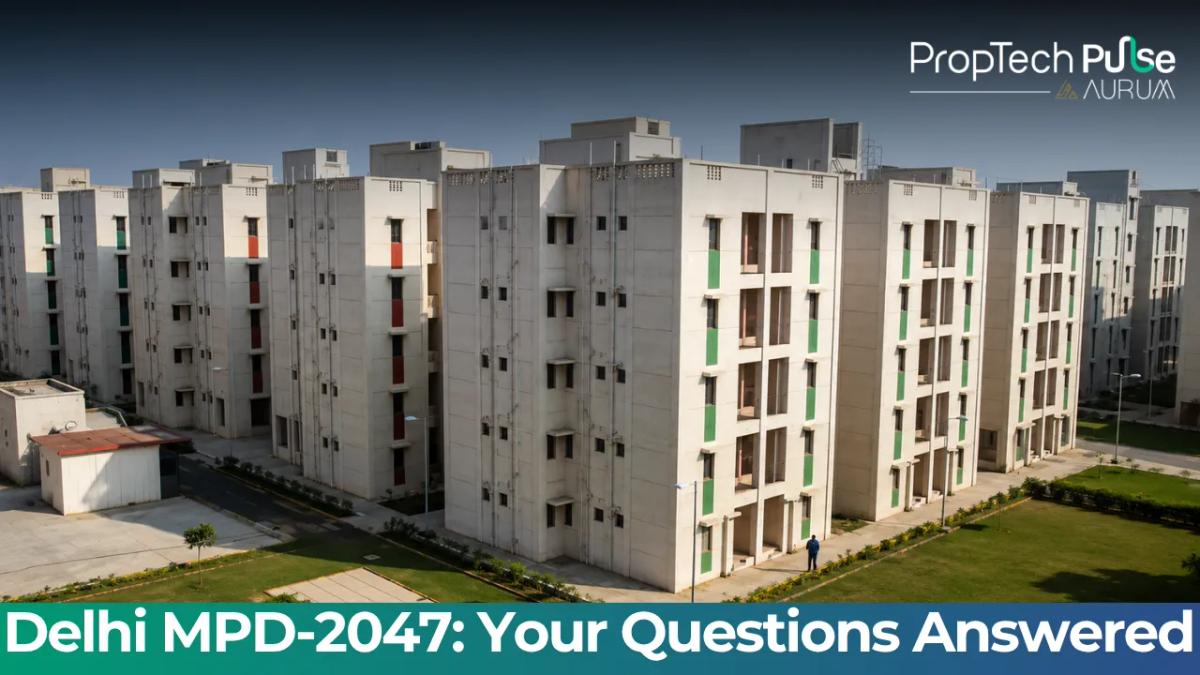
The Delhi Development Authority has published a set of Frequently Asked Questions on the Master Plan for Delhi 2047, providing citizens, property owners, developers and other stakeholders with simplified guidance on its provisions.
MPD-2047 came into force on 20 August 2026.
It supersedes MPD-2021 and sets out Delhi's long-term land-use and development framework covering construction norms, redevelopment, land pooling, transit-oriented development and in-situ slum rehabilitation.
When Does MPD-2047 Apply?
MPD-2047 is in force from the date of its notification in the Official Gazette 20 August 2026. Plans approved prior to notification shall continue as per earlier norms.
New norms apply only when additional FAR is availed, where applicable, or when a revised plan is sanctioned.
Redevelopment: What Is and Isn't Allowed
MPD-2047 allows redevelopment at the plot level, with minimum plot areas defining eligibility:
- Residential areas: minimum plot area of 3,000 sqm for redevelopment
- Commercial, Industrial and Public & Semi-Public areas: minimum 1,000 sqm
- Government and Employer Housing, CGHS/DDA Housing: redevelopment provisions in residential areas
- Commercial: District Centres, Community Centres, Local Shopping Centres and Convenience Shopping Centres; standalone cinema sites may also be redeveloped
- Industrial: provisions for regeneration of plotted and flatted industrial areas
- PSP areas: redevelopment permitted at both scheme and individual plot level
- Special areas (Walled City, Walled City Extension, Karol Bagh): heritage-sensitive regeneration under dedicated area-specific schemes
On residential plotted development specifically, only reconstruction is allowed as per the prescribed FAR. Redevelopment shall not be allowed unless otherwise specified.
Also Read: DDA Approves Delhi Master Plan 2047 for Affordable Housing
FAR: Group Housing, TOD and High Density
The maximum FAR for Group Housing is 200, with a minimum plot area of 3,000 sqm. In Lal Dora and Extended Lal Dora areas, the minimum plot area is 2,000 sqm.
Under the TOD Policy, the base FAR is 400, subject to payment of TOD charges. The maximum permissible FAR under TOD is 500, subject to additional FAR charges on top of TOD charges.
Participation in TOD policy is voluntary plot owners not willing to participate may continue with existing use as per master plan provisions.
Land Pooling: A New Urban Development Framework
Land Pooling is a framework for urban development where private entities or landowners participate in land development alongside DDA through assembly of land, Town Planning Scheme or other models.
Under the present development model for assembly of land by a group of 10 landowners, a maximum of 60% of pooled land is available to landowners for development.
The remaining 40% is surrendered to DDA for city-level commercial and services development, including recreational, PSP, roads and circulation, and a saleable component.
Also Read: Delhi Master Plan 2047: 40 Lakh Homes Planned by 2047
Transferable Development Rights (TDR)
TDR is an award specifying the extent of unutilised FAR on a plot that can be sold or utilised on an alternate site as specified by the Master Plan.
The plot from which TDR originates is the Generating Site. Where it is utilised is the Receiving Site. Under MPD-2047, TDR may be generated from conservation or preservation of heritage buildings, regeneration of buildings in the Walled City and in-situ slum rehabilitation schemes.
Generated TDR may be utilised only in TDR receiving areas identified by DDA from time to time. A dedicated single window portal will be developed and maintained by DDA to facilitate TDR trading.
Enjoyed this update? Visit PropTech Pulse for more real estate news, investment insights and property market trends.


