








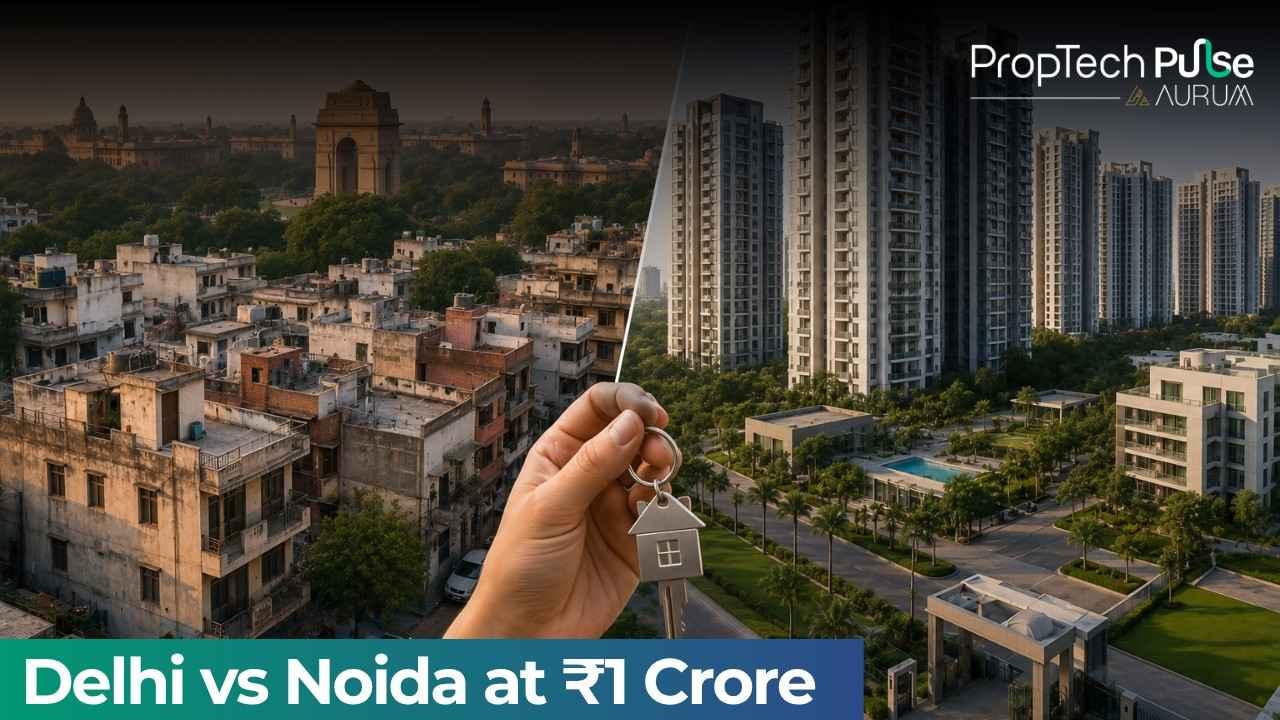
The ₹1 crore budget sits at an interesting crossroads in the NCR property market. It is enough to buy in Delhi, but the question of what you actually get for that money compared with Noida has become increasingly pointed in 2026. The gap between the two cities has widened on almost every measurable dimension, and for buyers choosing between a central address and genuine living space, the trade-off has never been starker.
Delhi vs Noida: the space gap at ₹1 crore
The numbers tell the story bluntly. In Delhi, ₹1 crore typically buys between 650 and 900 sq ft, usually a compact 2BHK or an older builder floor, depending on the locality. Prime locations command between ₹11,000 and ₹14,000 per sq ft, which leaves limited room for anything larger. In Noida, the same budget stretches to between 1,100 and 1,500 sq ft, enough for a spacious 2BHK or an entry-level 3BHK in a gated community, at popular sector prices of ₹7,500 to ₹8,500 per sq ft. According to Knight Frank India's latest residential market report, average apartment prices in established Delhi localities are considerably higher than in Noida, making the size differential a structural feature of the two markets rather than a temporary anomaly.
What Delhi's premium actually buys
Delhi's higher price per sq ft is not arbitrary. The city offers something Noida cannot replicate: a central address in the national capital, proximity to government offices and well-established institutional infrastructure, mature neighbourhoods with developed markets and cultural landmarks, and public transport connectivity that has been refined over decades. For buyers whose work or lifestyle anchors them to central Delhi, paying a space premium is a rational choice. Limited land availability in popular residential pockets means supply is structurally constrained, which historically supports long-term value even if near-term appreciation runs at a steady rather than rapid pace. Delhi's rental yield sits at 2.5% to 3.0%, reflecting a mature market where capital values are high relative to rents.
💰 Budget
₹1 Crore
A common home-buying budget, but the outcome differs significantly between Delhi and Noida.
🏠 Delhi
Compact Living
Typically buys an older apartment, smaller carpet area, or a home in an established neighbourhood.
🌆 Noida
More Space
Often offers larger apartments, newer projects, and access to modern amenities within gated communities.
⚖️ The Real Deal
Location vs Lifestyle
Delhi prioritises centrality and established infrastructure, while Noida delivers better space and amenities for the same budget.
Why Noida's infrastructure case has strengthened
Noida has changed materially as an investment proposition. What was once a satellite town is now one of NCR's fastest-growing real estate markets, underpinned by improved expressways, expanding Metro connectivity and the recently inaugurated Noida International Airport. New developments come standard with amenities, including dedicated parking, clubhouses, pools, gyms and landscaped gardens, that older Delhi stock simply does not offer at the same price point. Rental yields in Noida run between 3.0% and 4.0%, meaningfully higher than Delhi's range, and ANAROCK Research data points to roughly 90% average price appreciation between 2020 and 2025 in popular Noida sectors, reflecting the pace at which the city has repriced as infrastructure has caught up.
The investment lens: stability versus growth
For buyers thinking beyond a primary residence, the two cities offer genuinely different investment profiles. Delhi's constrained land supply and established reputation deliver long-term stability, making it a lower-volatility hold. Noida's ongoing infrastructure pipeline and planned corridor expansion continue to fuel demand in new sectors, offering stronger growth potential from a lower base. For a ₹1 crore budget specifically, Noida's higher yield and steeper appreciation trajectory make it the more compelling investment case in the current cycle, while Delhi remains the rational choice for anyone for whom location, connectivity and a capital-city address outweigh the size and yield arithmetic.
How to frame the decision
The honest answer is that neither city is objectively better: the right choice depends entirely on what the buyer is optimising for. Noida wins on space, amenities, yield and near-term growth potential. Delhi wins on address, maturity, institutional proximity, and the kind of intangible premium that established cities carry over time. What has shifted in 2026 is that Noida's infrastructure gap, the traditional reason buyers accepted Delhi's premium without question, has narrowed considerably. That makes the Delhi-or-Noida question genuinely open for the first time in a decade, and the answer increasingly comes down to lifestyle priorities rather than a simple calculation of what the money can buy.
Enjoyed this update? Visit PropTech Pulse for more real estate news and market insights.


