New Launch - India Real Estate Report 2026.

Services
Knowledge Hub
Resources
Tools

Ask Pulse Ai
©PropTech Pulse 2025, All rights reserved.


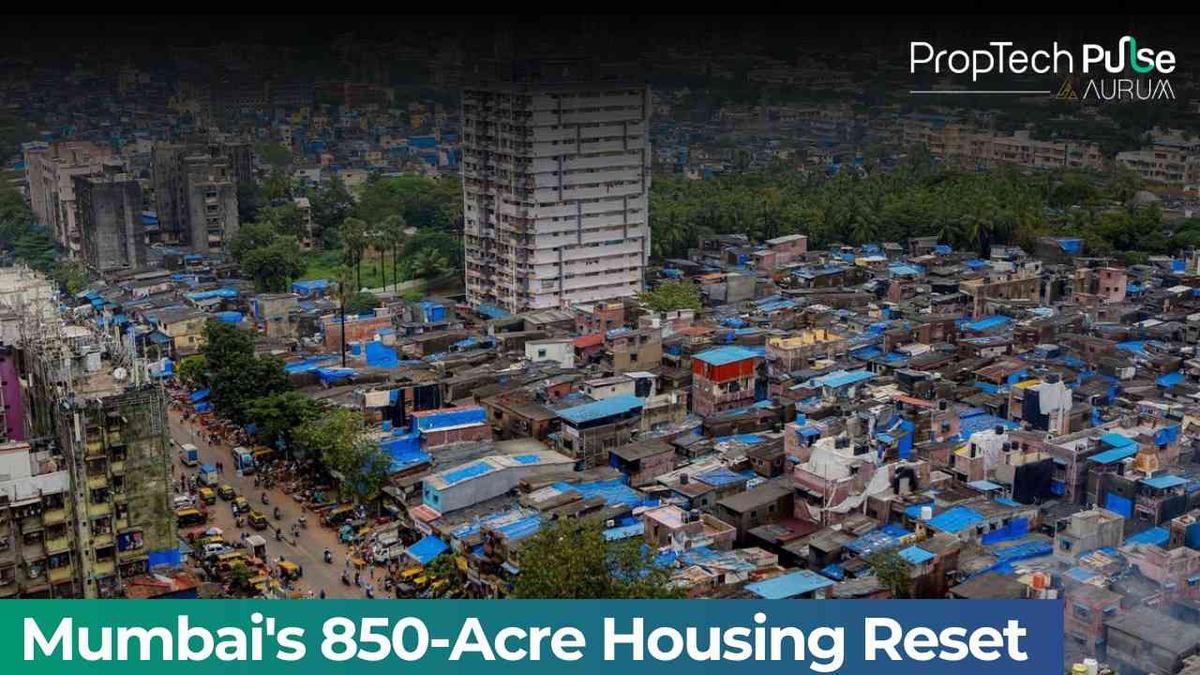
Something significant is shifting in Mumbai's urban fabric. The city's Slum Rehabilitation Authority is moving three of its largest informal settlements into active redevelopment — Antop Hill in Wadala spanning 450 acres, Majaswadi in Jogeshwari East at 260 acres, and Behrampada in Bandra East covering 140 acres. Together, these three clusters represent a combined 850 acres of some of the most densely settled land in the country, and their redevelopment would mark a step-change in how Mumbai tackles its housing deficit.
Mumbai slum redevelopment gathers pace after Juhu Galli
The push follows the success of the Juhu Galli pilot project in Andheri West, a 101.4-acre cluster that became the first slum cluster redevelopment of its kind in the city. That project is expected to deliver over 28,000 rehabilitation homes for eligible slum dwellers, with the winning consortium committing to a cumulative transit rent of approximately Rs 750 crore for two years with the SRA, plus one year's rent in post-dated cheques. The financial conditions were deliberately strict, designed to protect residents through the transition. The fact that the model held together is what has given the SRA confidence to scale.
What the three new clusters represent
The SRA has begun seeking approval from the state's high-powered committee for all three projects. The consortium behind the Juhu Galli model offered a 35.1% premium to the SRA, exceeding the standard 25% benchmark by a full ten percentage points, which signals that the financial model can attract competitive private interest even at a large scale. SRA CEO Mahindra Kalyankar confirmed the authority has identified 18 additional slum cluster areas for future redevelopment, each with land parcels over 50 acres, suggesting this is a programme rather than a one-off exercise.
The policy framework making it possible
The redevelopment push is underpinned by Housing Policy 2025, which Kalyankar described as introducing several progressive measures aimed at transforming Mumbai into a slum-free city and ensuring access to safe, dignified and permanent homes. What the policy does structurally is shift rehabilitation away from the piecemeal project-by-project approach that has characterised Mumbai's slum work for decades, towards large-scale cluster redevelopment where the economies of scale make it viable for serious developers to participate. That shift matters because smaller, fragmented projects have historically struggled to attract funding and execution capacity.
Delhi moves in the same direction
Mumbai is not alone in rethinking its approach. Delhi has approved the Delhi Slum and JJ Cluster Rehabilitation and Relocation Policy 2026, targeting around four lakh families living in JJ clusters across the capital. Approved at a meeting chaired by Union Home Minister Amit Shah on June 16, the policy uses a public-private partnership model in which developers build multi-storey housing for residents while commercially developing part of the land to fund costs. A key eligibility change extends the cut-off date from January 1, 2015, to January 1, 2025, bringing significantly more residents within the rehabilitation net. Delhi plans to issue tenders for at least five PPP-based projects every month, with initial clusters in Mayur Vihar, Seelampur, Pitampura, Sultanpuri and Lajpat Nagar.
What this means for the broader housing market
The scale of land being unlocked deserves attention beyond the affordable housing conversation. Large, well-located clusters like Behrampada in Bandra East sit on some of the city's most commercially valuable ground. Redevelopment does not just produce rehabilitation homes; it also generates free-sale inventory that funds the project, and that inventory lands in prime locations. As Mumbai and Delhi both move towards cluster-scale PPP models, the supply of mid-to-premium housing in central city locations could rise meaningfully over the next decade, with implications for pricing, developer pipelines and urban density that will reach well beyond the slum dwellers being rehabilitated.
Enjoyed this update? Visit PropTech Pulse for more real estate news and market insights.


