New Launch - India Real Estate Report 2026.











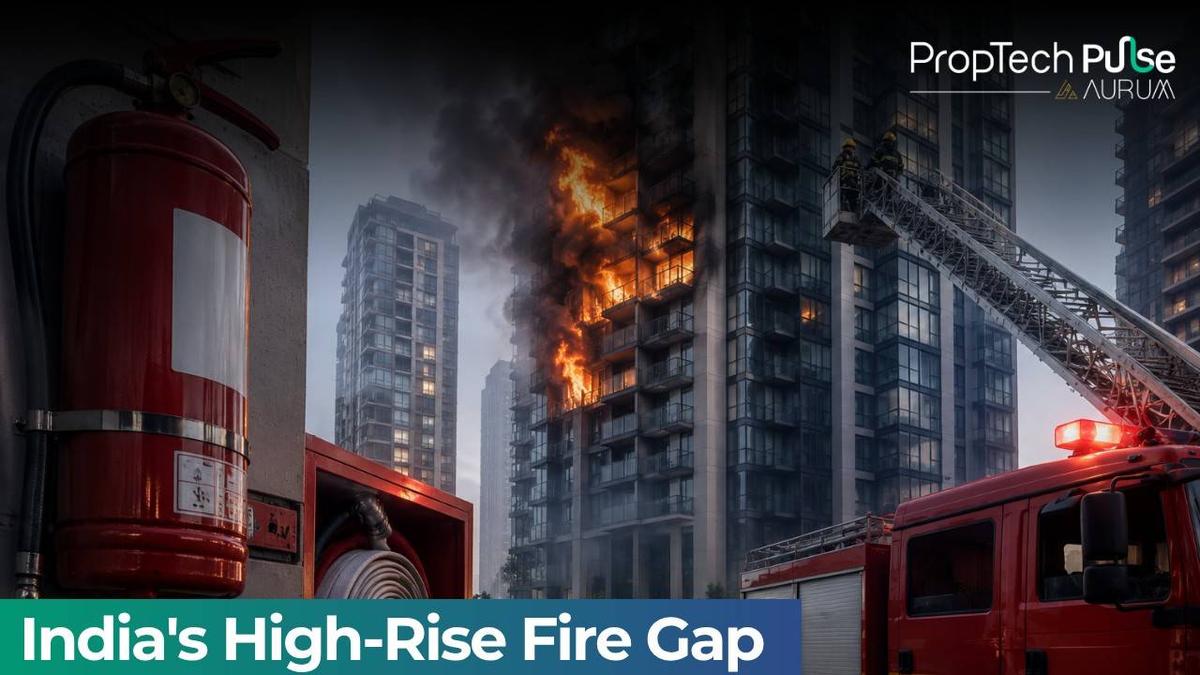
India's skyline is climbing fast, but the safety systems meant to protect the people living inside those towers are struggling to keep pace. High-rise fires present a category of emergency that conventional firefighting equipment simply cannot handle, and with nearly 7,000 people dying in fire accidents across the country every year, the gap between rising construction and adequate fire preparedness has become impossible to ignore. Recent incidents have sharpened that focus, raising hard questions about whether building codes are being enforced or merely filed away.
Why high-rise fire safety is a different problem entirely
The fundamental challenge with skyscraper fires is physical. Smoke spreads faster through vertical shafts than fire crews can respond, evacuation routes become compromised quickly, and the reach of most firefighting equipment falls well short of the upper floors. DIG Tripathi of the fire services noted that high-rise structures are designed to be fought from the inside, not from outside. External hydraulic platforms, the kind that can extend to meaningful heights, are still being procured in India. Bids have gone out to companies from Norway, Finland and Germany, with platforms reaching 72 metres, 90 metres and potentially 102 metres under consideration. Until those arrive, internal fire-fighting systems carry the full burden. Drone-based firefighting has its own ceiling: beyond a certain altitude, the weight of a water load and connecting pipe makes it unworkable.
The real estate sector's answer
Developers point out that the technology itself is not the weakest link. The bigger issue, many argue, is what happens after a building is handed over. Rishabh Periwal, Senior Vice President at Pioneer Urban Land and Infrastructure, put it plainly: even world-class infrastructure only works if it functions flawlessly when needed, which means the focus must be on rigorous, continuous maintenance of detection and response systems rather than one-time installation. That view is widely shared in the sector. Pyush Lohia, Managing Director of Iram Developments, highlighted that fire safety is a living commitment, not a one-time exercise, and that developers must design multiple uncompromised emergency egress pathways to ensure orderly evacuation under real conditions.
Compartmentalisation and design standards
One of the most effective tools available is also one of the least visible: compartmentalisation, which involves dividing a building into fire-resistant sections that slow the spread of flames and buy time for evacuation. It is a widely accepted international standard, but its effectiveness depends entirely on construction quality and the integrity of fire-rated materials. The National Building Code sets out requirements for high-rise fire safety in India, covering everything from sprinkler systems and fire doors to refuge floors and stairwell pressurisation. The persistent concern among experts is not the existence of these standards but the consistency of their enforcement and the quality of post-completion audits.
What actually needs to change
The conversation among experts converges on three areas where the gap between policy and practice is widest. The first is maintenance: fire safety systems that are installed but never tested or serviced offer little protection when they are needed. The second is awareness: residents in high-rise buildings are rarely drilled on evacuation procedures, and many would not know where their nearest refuge floor or fire exit is. The third is accountability: developers, facility managers and regulatory bodies each have a role, and the current framework does not always make clear who is responsible when something fails.
The cost of doing nothing
As more Indians move into high-rise housing, and as towers in cities like Mumbai, Hyderabad and Bengaluru continue to climb past 40 and 50 floors, the stakes keep rising. A fire on the 30th floor of a building whose internal suppression system has not been serviced in three years is not a building-code problem; it is a governance failure. The technology to make tall buildings safe exists. The standards largely exist, too. What the sector has not yet solved is the sustained, building-by-building commitment to making sure both are working on the day they are needed most.
Enjoyed this update? Visit PropTech Pulse for more real estate news and market insights.