New Launch - India Real Estate Report 2026.










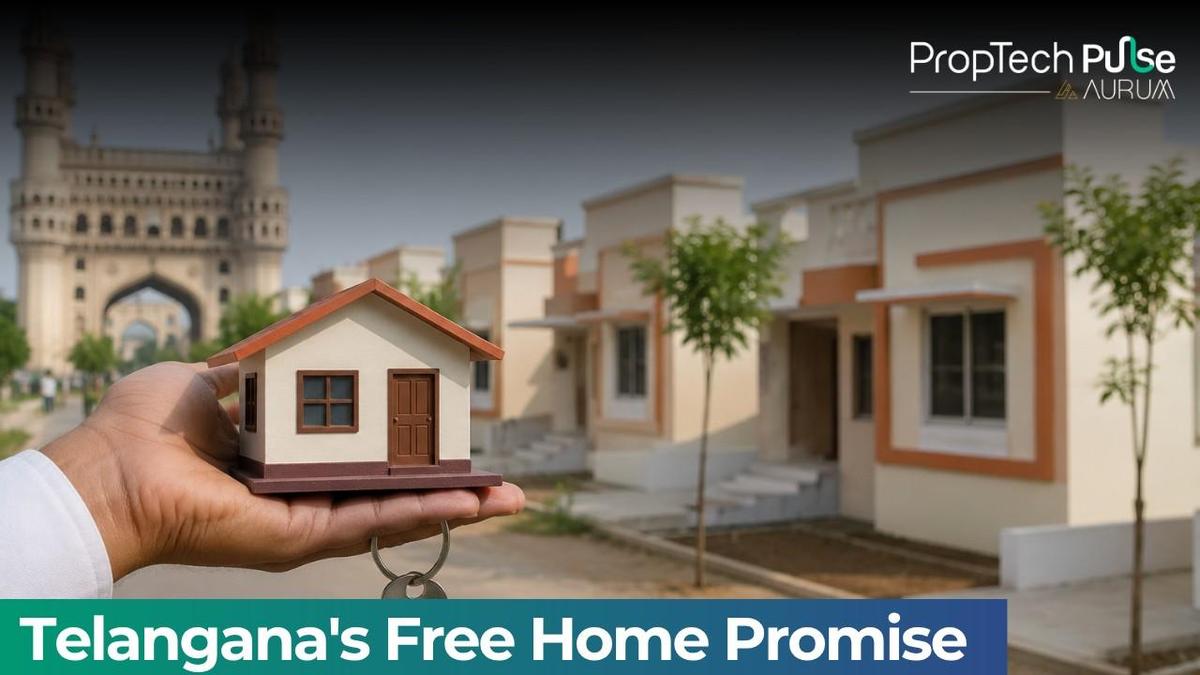
Welfare housing schemes in India rarely go as far as handing over a fully built, fully serviced home at no cost to the beneficiary. Telangana's Double Bedroom Housing Scheme, widely referred to as the 2BHK Housing Scheme, does exactly that. Aimed at poor and homeless families across the state, the programme stands apart from comparable initiatives elsewhere in the country by funding construction entirely through the state government, with no financial contribution required from the families receiving the homes.
What the Telangana 2BHK Housing Scheme actually provides
Each beneficiary receives a fully constructed house comprising two bedrooms, a hall, a kitchen and two toilets, with a total plinth area of 560 square feet. In rural areas, homes are built on plots of 125 square yards. In urban areas, beneficiaries receive flats along with an undivided share of land in multi-storey housing complexes. The scheme goes beyond the structure itself: supporting infrastructure, including water supply, electricity, roads, drainage and sewage facilities is included, so families move into functioning communities rather than isolated units. There is no home loan to service, no construction cost to contribute towards, and no repayment obligation of any kind.
Who the scheme is designed for
The programme primarily targets Below Poverty Line families who do not own a proper home in either rural or urban Telangana. Within that broad eligibility, the government has built in a structured reservation system. In rural areas, 50% of allocations are reserved for Scheduled Castes and Scheduled Tribes, with a further 7% set aside for minorities. In urban areas, the breakdown shifts, with 17% for SCs, 6% for STs and 12% for minorities. Homes are also reserved for ex-servicemen, their widows, and persons with disabilities. The layered reservation structure is designed to ensure the scheme reaches the most marginalised groups rather than flowing disproportionately to those who are merely eligible on income grounds alone.
How beneficiaries are selected
The selection process runs through multiple stages of scrutiny. The District Level Committee first identifies villages and project locations. Applications are then distributed and collected during gram sabha and ward sabha meetings, as well as through urban local bodies, producing a provisional list of eligible candidates. That list goes to the Tahsildar, who verifies eligibility and examines supporting documents. The verified list is then placed before the Gram Sabha or Ward Sabha again, where a draw of lots may be conducted if the number of eligible applicants exceeds the available homes. The final list goes to the District Collector for approval, after which completed houses are allotted to confirmed beneficiaries.
Why this model matters for India's housing conversation
Most state housing programmes in India work through partial financial assistance or home loan subsidies, which still require a beneficiary to arrange the balance and service debt. Telangana's approach removes that barrier entirely, which is significant in a country where the urban and rural poor often cannot access formal credit at all. The scheme also bundles infrastructure into the delivery rather than leaving it as an afterthought, which has historically been the point where welfare housing projects fall short. Whether the model is fiscally sustainable at the scale needed to address Telangana's full housing deficit is a separate question, but as a design for reaching the genuinely asset-less, it sets a benchmark that other states' programmes rarely match.
Enjoyed this update? Visit PropTech Pulse for more real estate news and market insights.