New Launch - India Real Estate Report 2026.

Services
Knowledge Hub
Resources
Tools

Ask Pulse Ai
©PropTech Pulse 2025, All rights reserved.


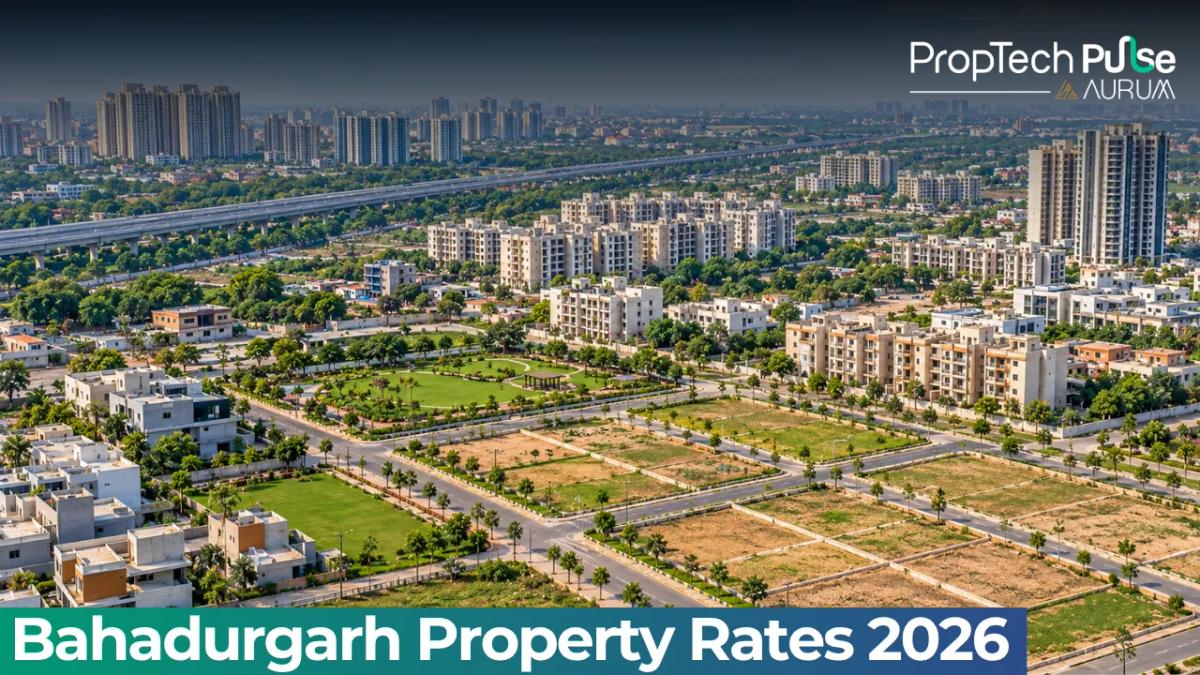
Buying a first home on the outskirts of Delhi requires balancing commute times with hard affordability limits. For most buyers priced out of Outer Delhi and Gurugram, Bahadurgarh in Haryana offers the quickest way to keep costs under control.
It sits directly on the Delhi-Rohtak Road, and the ground-level reality is that your rupee goes significantly further here than across the border.
We break down exact pricing for apartments and plots in 2026. You will also see how the collector rate creates genuine stamp duty savings, plus a map of infrastructure that has arrived versus what is still under construction.
Bahadurgarh city overview: Where it fits in Delhi-NCR
Quick answer
Bahadurgarh is a budget-friendly residential hub in Haryana located directly on the Delhi-Rohtak corridor. Strong metro connectivity, lower government circle rates, and mature HUDA sectors make it one of the most affordable NCR destinations for first-time buyers and mid-tier investors in 2026.
Bahadurgarh functions as a classic bedroom city for the national capital. Located in the Jhajjar district of Haryana, the area has expanded rapidly over the last decade because it sits at the crossroads of major arterial routes.
The town handles a mix of heavy industrial units, large-scale residential sectors, and agricultural pockets, which keeps the daily environment grounded rather than purely commercial.
Commute reality sets expectations right away. You are looking at roughly 40 to 50 minutes to reach Rajiv Chowk or Anand Vihar during normal weekday traffic.
The arrival of the Delhi Metro Green Line extension has changed the baseline expectation. Six new metro stations now bridge the gap between Mundka and Bahadurgarh, giving daily commuters a reliable alternative to buses.
If you work in central Delhi, the Green Line stop at Bahadurgarh cuts the travel time down to just over thirty minutes. Just remember to factor in weekend diversions.
Connectivity: Green Line Metro and NH-10
National Highway 10 (part of the Grand Trunk Road and Delhi-Mumbai Expressway alignment) runs straight past Bahadurgarh.
This provides direct access to Rewari and Rajasthan, making it a logistics hub as well as a residential belt. For homeowners, NH-10 means easy highway commutes to Gurgaon's western sectors and Faridabad's southern fringes without relying entirely on the Ring Road or the Yamuna Expressway.
Pincode tracking also helps when searching for specific layouts. A standard reference like the Bahadurgarh Adarsh Nagar pin code keeps search results accurate, especially when brokers mix listings from adjacent villages like Bhattu Kalan and Rithala. Keeping the postal zone correct ensures you do not waste time viewing properties on the wrong side of the municipal boundary.
Bahadurgarh property rates 2026: Sector-wise breakdown
Property values in Bahadurgarh rarely move in lockstep. You will see sharp jumps along the Delhi-Rohtak corridor, while interiors and older planned sectors sit quieter.
The current market reflects two different buyers: those looking for budget plots and those seeking ready-to-move apartments in gated communities.
Plots dominate the transaction volume because land is cheaper, and speculation runs high. Developers offer smaller parcel sizes here, catering to investors who want to hold land and wait for infrastructure value addition.
Apartments track a slower trajectory, driven mainly by families prioritising immediate occupancy over future appreciation.
Plots in Bahadurgarh: HUDA vs Private Colonies
Government-backed layouts like HUDA sectors remain the safest entry point for first-time plot buyers. These sectors have established drainage, wider roads, and clear title deeds registered with the state revenue department.
Pricing varies by proximity to the main market and the upcoming metro station. Sectors closer to the town centre carry higher base rates, while fringe plots offer better long-term holding yields.
Private colonies fill the gaps between government sectors. They often promise larger carpet areas, clubhouses, and automated society management. You pay a premium for these amenities, and the pricing usually swings higher when a known developer announces their inventory.
Because many private colonies operate outside strict municipal planning grids, verifying the layout approval becomes essential before paying a token amount.
| Sector / Area Type | Avg Plot Size (sq yards) | Price Range (₹ lakhs) | Key Feature |
|---|---|---|---|
| HUDA Sector 15 | 100–300 | 28 – 65 | Mature amenities, wide roads |
| Delhi-Rohtak Corridor | 40–200 | 20 – 55 | High appreciation potential |
| Private Colony (Tier 2) | 100–250 | 35 – 75 | Clubhouse, security |
| Fringe Agricultural Land | 200–500+ | 15 – 40 | Requires conversion, longer horizon |
Apartments: Ready-to-move vs Under Construction
Ready-to-move flats in Bahadurgarh trade between 28 and 38 lakh for a standard 2BHK configuration. Builders here favour compact designs that keep EMI burdens manageable for working families moving from Delhi.
Shared walls are common, but societies usually maintain separate water tanks and backup power for lifts.
Under-construction inventory carries slightly lower upfront costs, typically starting around 22 to 30 lakh. The waiting period usually spans 18 to 30 months.
Buyers often secure these units to hedge against price hikes. They must account for maintenance payments, ongoing EMIs during the moratorium phase, and potential delay penalties in the sale agreement.
| Configuration | Avg Carpet Area (sq ft) | RTM Price (₹ lakhs) | Under Construction Price (₹ lakhs) |
|---|---|---|---|
| 1 BHK | 500 – 650 | 22 – 28 | 19 – 24 |
| 2 BHK | 850 – 1,100 | 28 – 38 | 22 – 30 |
| 3 BHK | 1,250 – 1,500 | 42 – 55 | 35 – 46 |
| Total Transaction Cost (+ Stamp Duty/Registration) | - | Add ~7% on top | - |
The Collector Rate vs Market Rate gap: Why it matters
Every Indian property transaction uses a dual valuation system. One number belongs to the state's Sub-Registrar Office. The other comes from what buyers and sellers actually agree upon in the market.
In older NCR corridors, these two numbers often run close together, pushing registration costs upward.
Bahadurgarh operates differently because the government deliberately kept collector rates low compared to surrounding metropolitan zones.
This gap directly lowers the financial friction for homebuyers. Stamp duty in Haryana currently calculates at six percent of the circle or market value, whichever is higher.
Registration charges sit at roughly one percent. When a buyer secures a flat using the circle rate benchmark, the total government levies drop noticeably compared to buying a comparable unit in Dwarka Expressway or Sohna Road.
Worked example: How stamp duty savings work here
Consider a buyer purchasing a 900-square-foot apartment. The broker quotes a market price of forty lakh rupees. The sub-registrar office lists the circle rate for that sector at thirty-two lakh rupees. Because the purchase happens at the market price, stamp duty applies to the full forty lakh.
Six percent stamp duty lands at ₹2,40,000. The one percent registration fee adds ₹40,000. You hand over ₹2.8 lakh to the government on a ₹40-lakh deal. Shift to a plot near the municipal boundary where the circle rate nudges up to ₹36 lakh.
That same calculation pads the levy burden by nearly fifteen per cent. For investors snapping up two or three parcels, the gap compounds immediately. Retail buyers protect their downside by sticking to sectors where the collector rate still lags behind the surrounding boom.
Pro tip Always verify the latest circulars on the IGR Haryana portal before finalising agreements, as fiscal adjustments happen without public fanfare.
UER-II Phase II and infrastructure updates
The Western Dedicated Freight Corridor and its feeder lines reshape how industrial hubs interact with housing belts. Bahadurgarh sits squarely in the impact zone of the Upper Doab Expressway Phase II extensions, commonly called UER-II.
This project extends the eastern peripheral model south-westward, linking major manufacturing clusters to the outer rim of the capital region.
Tracking progress across the region remains uneven. Land acquisition for specific spur routes wraps up faster in agricultural tracts. Right-of-way clearance drags near existing municipal boundaries.
Commuter benefits, on the other hand, hinge on service road capacity.
Traffic decongestion sounds logical on paper, but daily utility depends on how many connectors feed into the main carriageway. Contractors generally target incremental lane additions instead of rapid full-route openings.
Infrastructure updates matter most when they affect property insurance premiums and flood mapping. Low-lying plots near seasonal nullahs sometimes get reclassified as green belts, which locks in development rights.
Buying close to railway sidings offers rental demand but increases vibration complaints over time. Check the master plan maps hosted by India's Urban Planning Department to confirm if your target sector falls within restricted noise zones.
Top residential projects and developers in Bahadurgarh
Several builders have established a permanent footprint in Bahadurgarh, ranging from legacy regional names to pan-India groups expanding westward.
The safest path remains verifying active project registration, because rules tighten constantly. You should never assume a brochure accurately describes approved plans.
Most developers hand over possession within eighteen months of groundbreaking, though supply chain delays occasionally stretch timelines. Large housing boards tend to pace phases slower, delivering entire sectors simultaneously.
Private developers often start with a flagship tower to establish credibility before rolling out satellite plots. The market rewards transparency over aggressive sales tactics.
Verify every project on HRERA before signing deposit slips. Cross-check the architect's name, stage of construction, and scheduled possession date against the registry.
Missing compliance flags lead to frozen bank accounts and stalled construction. Always demand the completion certificate and fire safety clearance alongside the occupancy permit.
For broader strategies on navigating local developments, reviewing a complete property due diligence checklist prevents costly oversights.
Final checklist before booking property in Bahadurgarh
Before transferring funds, run three concrete checks that separate informed moves from lucky guesses. First, confirm the builder's HRERA ID and match it to the exact sector and phase. A company might hold a valid licence in Sonipat while selling unregistered plots here.
Second, ask for the latest mutation receipt. Haryana transitioned to an automated digital system recently, and a quick glance at the Haryana's new 24-hour auto property mutation system dashboard proves the seller actually owns the land.
Third, measure the distance to your workplace using live traffic data at your exact departure hour. Commute estimates printed in brochures ignore school rush and weekend diversion logic.
Use the Haryana's online auto mutation system to prevent property fraud portal to ensure the title history stays clean before paying the initial booking advance. Walk the street at dusk to test street lighting and security patrol frequency. Infrastructure exists on paper until people actually walk there.
Frequently asked questions
Are plots in Bahadurgarh worth buying in 2026?
Yes, if you hold for more than five years. The gap between current builder prices and future utility value works in your favour. New metro connectivity and highway expansions push baseline rents higher. First-time investors should focus on HUDA sectors close to the Rohtak Road corridor, where liquidity stays strong when resale timing aligns with infrastructure completions.
What is the current collector rate for Bahadurgarh?
The sub-registrar circle rate fluctuates by micro-market, generally sitting between thirty-two and fifty-five lakh rupees per cent for standard residential sectors. Since rates adjust quarterly, you must cross-reference the exact plot on the IGR Haryana calculator before drafting any payment schedule. Using the lower threshold figure guarantees your stamp duty does not exceed statutory minimums.
How far is Bahadurgarh from Delhi Metro?
The Green Line terminus at Bahadurgarh places you literally steps from the station platform. For residents living two kilometres inland, a ten-minute bike ride covers the distance. Daily train frequencies run comfortably between five AM and midnight, cutting the psychological barrier of owning property just outside the state boundary.
Is UER-II Phase II completed yet in Bahadurgarh?
Partial stretches opened to traffic last year, with remaining land acquisitions winding through late-stage tender approvals. Full operational capacity relies on clearing narrow right-of-way bottlenecks near existing industrial zones. Most buyers treat the expressway as an active construction asset rather than an finished convenience.
Which are the best ready-to-move projects in Bahadurgarh?
Established societies near Sector 15 and the main market offer verified possession dates and complete water storage systems. Developers here prioritize compact 2BHK footprints tailored to salary brackets earning between eight and twelve lakh annually. You should always inspect the society's maintenance fund statements to confirm reserve capital exists for emergency repairs.
Sources
- Delhi Metro Rail Corporation: Green Line route extension map and station index between Mundka and Bahadurgarh (accessed October 2026)
Enjoyed this blog article? Visit PropTech Pulse for more interesting blogs.



Ask Pulse Ai anything about real estate

Unlock the Latest in Real Estate
News, Infographics, Blogs & More! Delivered to your inbox.

