New Launch - India Real Estate Report 2026.

Services
Knowledge Hub
Resources
Tools

Ask Pulse Ai
©PropTech Pulse 2025, All rights reserved.


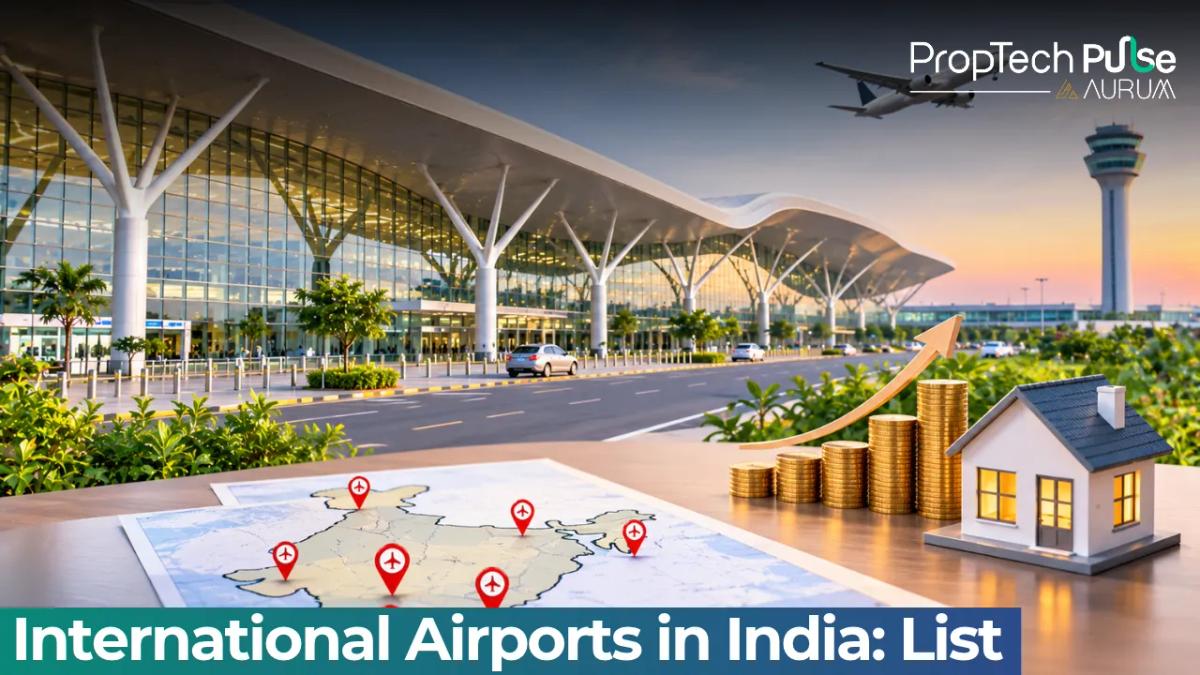
The search for international airports in India often starts as a simple directory query. For serious buyers and developers, it quickly becomes a map for capital appreciation.
PM GatiShakti pushes new cargo hubs forward. Private terminal operators are accelerating greenfield projects. Aviation nodes are shifting from transit points into primary anchors for residential and commercial demand.
Are you tracking exactly how many international airport in India currently operate under customs status? Or perhaps you are evaluating a plot in a nascent airport colony three years before the first flight lands.
The difference between a strong investment and a stagnant one usually comes down to two variables: road connectivity and zoning classification.
How Many International Airports Are There in India?
Quick answer
There are approximately 36 designated international airports in India today. They range from fully operational gateways handling millions of passengers to customs-designated terminals hosting scheduled international flights only.
The exact count shifts as new greenfield projects receive operational clearance. All active gates are tracked by the Ministry of Civil Aviation under either full or partial international status. For investors, this distinction matters because partially licensed airports often trigger faster property price spikes than legacy hubs that took decades to scale.
The count changes slowly at first. It jumps in batches when multiple regional hubs get upgraded simultaneously. The Ministry of Civil Aviation categorises these assets into three clear buckets.
Full international airports feature dedicated immigration counters and complete terminal facilities. Customs-designated airports handle international flights but sometimes share domestic terminals.
This breakdown affects property markets differently. Full-scale gateways attract multinational corporate offices, serviced apartments, and premium hospitality assets.
Customs-designated terminals create localized demand spikes in nearby mid-segment housing. Airline crew and cargo logistics firms settle where rent allows daily mobility.
As new infrastructure corridors open, previously disconnected towns integrate into national supply chains. This shifts property demand from purely speculative to structurally backed.
Complete List of International Airports by Region
| Region | Key Airports & Cities | Investment Focus |
|---|---|---|
| North | New Delhi, Chandigarh, Jaipur, Lucknow, Amritsar | Corporate housing, logistics parks, cross-border trade corridors |
| South | Bengaluru, Hyderabad, Kochi, Thiruvananthapuram, Mangaluru | Tech-sector rentals, IT park adjacencies, coastal tourism leases |
| East | Kolkata, Guwahati, Patna, Bhubaneswar | Cargo-led industrial plots, river-port integration, workforce housing |
| West | Mumbai, Pune, Ahmedabad, Goa, Rajkot | Premium residential, entertainment district spillover, port-adjacent warehousing |
Regional clustering dictates how quickly a local real estate market matures. Northern hubs sit along high-density trade routes connecting to Central Asia and Europe. This keeps warehouse and cold-storage demand constant year-round.
Southern terminals benefit from decades of information technology growth.
Airline staff, management consultants, and business travellers form a steady tenant pool here. These groups keep occupancy rates high even when overall vacancy creeps up.
Look at the established baseline in our guide on the bengaluru airports authority of india colony halasuru bengaluru to see how a fully matured node behaves over twenty years.
Eastern and Western regions operate on slightly different cycles. Kolkata handles heavy cargo volumes alongside passenger traffic. This pushes industrial plot valuations higher than residential ones.
Western hubs like Mumbai and Pune sit near financial districts and manufacturing belts.
Property values react to both aviation capacity and broader macroeconomic shifts. If you are evaluating Pune, study our locality overview of Lohegaon near Pune International Airport to understand how proximity to the apron changes builder margins and rental ceilings.
Top Airports by Passenger Traffic and Business Use
| Rank | Airport | Annual Pax Volume | Primary Real Estate Driver |
|---|---|---|---|
| 1 | New Delhi (DEL) | Very High | Short-stay hospitality, premium corporate rentals |
| 2 | Mumbai (BOM) | Very High | Daily commuter flows, western suburban housing |
| 3 | Bengaluru (BLR) | High | Tech-sector mid-income apartments |
| 4 | Hyderabad (HYD) | High | Pharma logistics, mixed-use developments |
| 5 | Chennai (MAA) | High | Manufacturing workforce housing |
| 6 | Ahmedabad (AMD) | Moderate-High | Textile trade corridors, boutique hotels |
| 7 | Kolkata (CCU) | Moderate | Cold storage, distribution centres |
| 8 | Pune (PNQ) | Moderate | Export-oriented manufacturing employees |
| 9 | Goa (GOI) | Moderate | Vacation rentals, seasonal hospitality |
| 10 | Kochi (COK) | Moderate | Gulf returnee housing, retail spillover |
When deciding which is the best airport in India for a specific portfolio, volume alone does not tell the full story. Delhi Terminal 3 processes the highest concentration of international layovers. This creates a reliable floor for short-stay hotel and extended-stay serviced apartment yields.
The occupancy curve flattens compared to pure leisure markets.
Business travel persists regardless of seasonal festivals or summer vacations. Mumbai's older terminals generate massive daily commuter movement.
Long-term rentals stay tight in western suburban corridors even when new luxury launches flood the pipeline.
The consistent footfall acts as a built-in demand absorber for well-located inventory.
Hyderabad and Bengaluru follow a tech-driven pattern where airport proximity aligns with office park density. Properties within a ten-kilometre radius of these terminals see lower vacancy rates. IT professionals prefer shorter commutes over larger homes.
Ahmedabad and Kochi operate on trade and diaspora cycles respectively. Gulf returnees fuel premium housing demand around Kochi.
Textile and engineering exports keep warehouse and light industrial plots liquid around Ahmedabad.
Choosing the right hub requires matching the asset type to the underlying economic engine rather than chasing raw passenger totals.
Emerging Gateways Driving Future Real Estate
Greenfield airports rewrite local land-value mathematics three to five years before the first runway opens. These projects attract institutional land banking.
Municipal bodies upgrade arterial roads, water grids, and sewage capacity to meet future passenger targets.
The first wave involves the Navi Mumbai International Airport. New international airports in India continue to drive land-banking activity across state borders.
Pre-launch inventory moves rapidly in Kopar Khairane, Dombivli, and Ulwe.
The Thane-Miraj Industrial Development Corporation highway provides immediate grade separation there. This reduces dependency on congested older routes. Our coverage of Navi Mumbai airport's planned smooth connections details how the expressway network sets the initial price floor.
The second wave centres on Uttar Pradesh. Maharishi Valmiki International Airport in Ayodhya and Kushinagar International Airport at Padrauna target specific markets. They support spiritual tourism circuits and eastern industrial corridors.
Yamunanagar and Chakeri sectors around Ayodhya have seen significant plot consolidation. Kushinagar connects directly to proposed freight corridors linking Bihar and UP manufacturing belts.
Both projects carry ambitious capacity targets that require feeder townships to absorb service staff.
Holding periods of five to seven years remain standard unless a metro line bridges the gap immediately.
Nashik utilises viticulture logistics and growing weekend migration from Mumbai. Shirdi continues expanding hospitality infrastructure around the shrine. These locations lack the dense commuter base of metros.
They still benefit from sustained government backing. Predictable tourist inflows stabilise lease terms for commercial properties. Investors entering these markets should prioritise land parcels zoned for mixed use over pure residential plots.
Early-stage infrastructure rarely supports high-rise construction without public transport backups.
What Is an Airport Colony and How to Invest
An airport colony refers to a residential or commercial zone developed in close proximity to an airport's perimeter. It benefits from dedicated expressway access, defined noise contour setbacks, and built-in demand from airline staff and charter operators.
These colonies form organically when developer activity outpaces municipal planning. State governments also designate special economic zones or transit corridors around newly approved terminals.
Property prices rise in these areas for structural reasons rather than speculation. Airline crews require guaranteed short commutes back to housing after red-eye rotations.
Charter companies maintain regional offices near maintenance hangars.
Freight forwarders place packing and documentation teams adjacent to cargo sheds. The cumulative effect creates a self-sustaining rental ecosystem that absorbs vacancies faster than generic suburbs.
BUYING TIMELINE CHECKLIST
Pre-announcement phase: Land moves on zoning rumours. Highest risk, highest reward. Only commit if you have verified Airport Preference Zone maps and written confirmation of the master plan.
Pre-construction phase: Values stabilise once environmental clearances are issued. Roads and basic utilities break ground. Secure units with builders who have track records of delivering non-metro infill.
Operational phase: Immediate yield potential emerges. Target apartments within five kilometres of the terminal building. Renter profiles shift from pure investors to end-users, lowering turnaround costs between tenants.
Zoning restrictions dictate how aggressively you can develop. The Airport Preference Zone imposes height limits and structural requirements designed to protect flight paths. Violating APZ clearance delays projects and triggers penalties.
Verify state RERA registration and municipal approval always precedes booking. Always run a home loan emi calculator against your projected rental income during the waiting period. Confirm that carrying costs remain manageable through the construction window.
Matching Your Investment Horizon to the Apron Stage
Your exit timeline should dictate which side of the runway you stand on. Short-term yield belongs to mature hubs like Delhi, Mumbai, Bengaluru, and Hyderabad.
These terminals already support dense rental demand, established retail corridors, and predictable vacancy cycles.
If you need monthly cash flow starting year one, purchase existing inventory in established airport colonies. Airline staff and business travellers actively compete for units.
Long-term capital appreciation belongs to greenfield and partially operational gates like Navi Mumbai, Ayodhya, Kushinagar, and select tier-two hubs.
Land values compound slowly until the terminal crosses critical passenger thresholds. Appreciation accelerates sharply then. These locations reward patience and discipline.
Avoid confusing the two models. Do not buy distressed inventory in developing zones expecting instant returns. Likewise, do not purchase peak-priced completions in mature markets hoping for explosive growth.
Investors tracking the list of international airports in india should weight road connectivity above airport size. Match the apron stage to your liquidity timeline. Let infrastructure rollouts dictate your entry point.
Frequently asked questions
How many international airport in india are currently operational?
Approximately thirty-six airports hold formal international status in India today. This includes fully operational gateways with dedicated immigration and customs facilities, plus customs-designated terminals that host scheduled international flights alongside domestic operations. The count shifts slowly as the Ministry of Civil Aviation grants operational clearance to new greenfield projects and upgrades regional airports, so the functional number used for planning purposes sits in the mid-thirties rather than remaining completely static.
What is an airport colony and why does property price increase?
An airport colony is a residential or commercial zone situated near an airport perimeter, usually benefiting from dedicated road access and structured noise-contour setbacks. Prices rise because the area generates inherent rental demand from airline crews, charter operators, cargo logistics staff, and frequent business travellers who require short commutes. This built-in tenant pool keeps vacancy rates low and gives landlords consistent advantage during lease renewals, making the zone structurally sound rather than purely speculative.
Which is the best airport in India by passenger traffic?
New Delhi's Indira Gandhi International Airport consistently handles the highest passenger volume, followed closely by Mumbai's Chhatrapati Shivaji Maharaj International Airport. Delhi leads because it serves as the primary northern gateway for transcontinental routes, while Mumbai handles the highest mix of domestic and international traffic combined. Both terminals generate massive daily commuter flows that support premium hospitality and corporate rental ecosystems, though secondary hubs like Bengaluru and Hyderabad show stronger growth trajectories in recent fiscal years.
How many total international airport in india exist including upcoming ones?
Including fully operational, partially designated, and approved greenfield terminals, the number reaches into the upper thirties. Projects such as Navi Mumbai, Ayodhya, Kushinagar, Nashik, and Shirdi sit at various stages of construction or licensing. The total grows in batches rather than individually because state infrastructure committees typically approve and commission multiple regional hubs simultaneously to relieve congestion at legacy metropolitan terminals and distribute cargo capacity across the country.
Where should I invest near an upcoming international airport?
Target the arterial roads that connect the city centre to the new terminal, particularly stretches undergoing expressway upgrades or metro extension. Prioritised corridors include the highways approaching Navi Mumbai's NMIA site, the Yamunanagar belt feeding into Ayodhya, and the freight-linked routes serving Kushinagar. Verify the Airport Preference Zone height restrictions and municipal zoning beforehand, then hold through the construction phase. Rental demand reliably materialises once the terminal crosses initial passenger capacity milestones.
Sources
- Ministry of Civil Aviation: airport expansion policy, greenfield project announcements and customs designations (accessed November 2026)
Enjoyed this blog article? Visit PropTech Pulse for more interesting blogs.




Ask Pulse Ai anything about real estate

Unlock the Latest in Real Estate
News, Infographics, Blogs & More! Delivered to your inbox.

