New Launch - India Real Estate Report 2026.

Services
Knowledge Hub
Resources
Tools

Ask Pulse Ai
©PropTech Pulse 2025, All rights reserved.


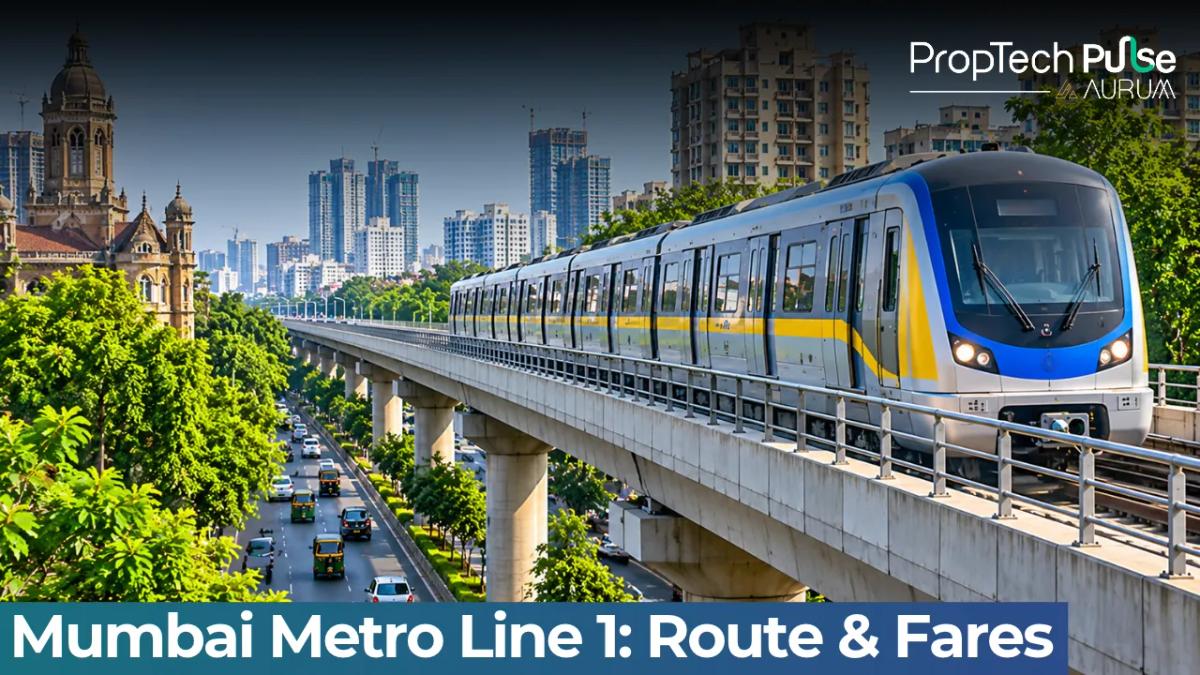
Mumbai Metro Line 1 connects the western suburbs to Ghatkopar in roughly twenty-one minutes. The eleven-point-four-kilometre overhead corridor handles twelve stations and carries regular commuters who previously faced heavy road congestion along Versova Road, Central Avenue, and the Eastern Express Highway.
For property buyers, the established route offers proven accessibility near corporate parks at SEEPZ and MIDC, while also linking directly to the busy Western and Central Railway networks.
This post lays out the complete station list, current fare structures, peak-hour frequencies, and the exact rules for changing trains across different lines.
Mumbai Metro Line 1 quick overview
Quick answer
Mumbai Metro Line 1 runs from Versova to Ghatkopar via Andheri and BKC. It covers eleven-point-four kilometres with twelve stations, operated by Mumbai Metro One Private Limited. Daily service begins at five-thirty am and concludes around eleven-fifteen pm. Fares start at ten rupees and go up to forty rupees depending on the journey distance.
The Mumbai Metropolitan Region Development Authority awarded the project to a private concessionaire, creating a special purpose vehicle called Mumbai Metro One Private Limited.
Capital expenditure totals around ₹2,356 crore, including a ₹650 crore viability gap fund from the government.
Ridership numbers have climbed steadily since opening in mid-two thousand fourteen. Daily boardings regularly surpass several lakh passengers during weekdays, cementing the route as the city's most heavily used transit artery.
Average door-to-door journey time shrank from seventy-one minutes on the road down to twenty-one minutes above ground.
Mumbai Metro Line 1 route map and station list
The corridor travels primarily along the Eastern Freeway corridor, threading through some of the densest employment zones in the western suburbs before hitting the central interchange node at Ghatkopar.
Each stop serves distinct micro-markets that drive local rental demand and asset values.
| Station name | Key connections and surroundings |
|---|---|
| Versova | Western Railway interchange, residential zone |
| West End | Local markets, residential pockets |
| Khar Road | Dense residential clusters, colleges |
| Bandra Kurla Complex | Corporate offices, financial district |
| Kriplani Corner | Commercial parks, educational institutes |
| Chakala | IT parks, hospital campuses |
| Marol Naka | Airport approach roads, logistics hubs |
| S.V. Road | Mid-range residential society cluster |
| MIDC | Industrial sheds, warehouses |
| D.N. Nagar | Upcoming Line 2B interchange point |
| Ghatkopar | Central Railway, bus depot, retail malls |
| Total overhead stations | 12 |
metro station ghatkopar list and connectivity
Every eastbound train terminates at the metro station ghatkopar. This hub acts as the main gateway for travelers moving from the western business belt into the eastern suburbs and Thane.
The interchange deck sits physically adjacent to the Central Railway platform and the state transport bus stand.
Property developers near this node cater heavily to office-going families because it eliminates the need for last-mile feeder buses. Tenants consistently pay more for flats within a fifteen-minute walk here.
The surrounding market features how proximity to a metro station affects apartment pricing, driving up base rates relative to older stock further inland.
Mumbai Metro fare, ticket types, and payment modes
Understanding the fare system means knowing how distance-based slabs work. Unlike fixed-zone metros in other countries, Mumbai charges strictly by the kilometres ridden. The standard token range spans from ten rupees for short hops to forty rupees for the longest corridor run.
| From | To | Approximate fare |
|---|---|---|
| Versova | Khar Road | ₹10 |
| Khar Road | Bandra Kurla Complex | ₹15 |
| Bandra Kurla Complex | Ghatkopar | ₹35 |
| Full corridor maximum fare | - | ₹40 |
Commuters load smart cards or link the National Common Mobility Card to skip cash handling at the turnstile. Return tickets cost slightly less than buying two singles, but bulk passes offer the deepest discount for salaried professionals riding the same path daily.
Payment infrastructure accepts QR scans directly at entry booths alongside traditional tokens.
Monthly pass calculation If you ride this line twice every working day, a monthly pass recoups its cost within the first eight days of the month. Always compare the pass price against your expected daily token spend before swiping a single-use card.
Timings and frequency
Trains begin running at five-thirty am to catch shift workers and airport travelers early. This gives residents plenty of buffer before the main rush. Headways tighten during peak windows, pushing intervals down to approximately three-and-a-half minutes.
With the peak window closed, off-peak gaps widen to seven minutes. That still beats fighting crowded local trains or sitting in gridlock traffic.
Weekend operations maintain similar start times but adjust end-of-day frequencies to manage leisure crowd volumes.
Interchanges and connectivity with other lines
Mumbai Metro Line 1 does not run alone. Passengers can switch to railway networks and other metro routes at strategic hubs. Mapping these connections is essential for anyone planning a multi-modal commute.
The western anchor at Versova hands you over to the Western Railway line instantly. Heading inward, Bandra Kurla Complex offers a footpath bridge to the new Western Expressway station.
Marol Naka acts as the critical hand-off point for Line 3, sending passengers straight toward Colaba and the airport terminal. Finally, the eastern terminus blends directly into the Central Railway mainline.
While these connections expand your geographic reach significantly, remember the physical layout dictates how you move. Mumbai Metro Line 3 status and route operates on deeper tunnels, meaning you will always face a staircase or elevator transfer rather than a flat corridor walk.
Cross-line transfer rule You must exit the paid area and tap in again whenever switching between different metro lines. Direct transfers inside the paid zone are not possible.
Look ahead to Line 2B at D N Nagar. When that connector opens, commuters avoiding the congested Andheri flyover get a direct shortcut into the eastern industrial belt.
Investment implications near Metro Line 1
Transit-oriented development drives measurable rental yield bumps. Apartments sitting within an eight-hundred-metre radius of active stations command higher vacancy rates because companies prefer housing staff near rapid mass transit.
Developers targeting young professionals cluster offerings specifically around SEEPZ and MIDC stations.
If you are evaluating resale potential, check how far the property actually sits from the station gate, rather than relying on its name. A half-kilometre uphill walk changes tenant demographics entirely. Look closely at how AI predicts property prices after a metro line opens to see the compounding effect of reduced commute times on long-term asset valuations.
For those comparing alternative transit corridors, verifying cross-connectivity ensures you are not buying into a dead-end route. Confirm whether nearby highways suffer chronic bottlenecks that could erode the metro's advantage if public transport strikes occur.
Before you buy near the metro
Secure a property near the station only if encumbrance certificates are clean and building approvals are stamped. Unresolved builder disputes erase transit premiums instantly. Check your borrowing limits before chasing inflated asset prices.
Walk the route on a weekday morning before paying any token. Compare road transit costs against your mortgage using our guide on the Harbour Line mumbai route stations timings fares 2026.
Frequently asked questions
How many stations are there on Mumbai Metro Line 1?
There are twelve stations across the entire Mumbai Metro Line 1 corridor. The route stretches continuously over an overhead track starting from Versova in the west and ending at Ghatkopar in the east. Travelers pass through major commercial districts like BKC and SEEPZ before reaching the central junction.
What is the last train time from Versova to Ghatkopar?
Service typically begins operating shortly after six in the morning and finishes around midnight. Weekday and weekend schedules differ slightly. Final departures still reach Ghatkopar well after eleven pm. This guarantees reliable late-night return travel for western suburb commuters.
Can I change trains at Andheri station without exiting?
No, you cannot switch lines freely inside the paid area. You must walk out through the exit gates, cross the platform to the new line entrance, and tap your token or smart card once more. A separate ticket or fresh tap is mandatory every time you transfer between different routes.
How much does a single journey cost from Versova to Ghatkopar?
The maximum fare for the longest stretch is forty rupees. Most passengers pay considerably less because fares scale with distance travelled. Buying a smart card or loading value through the National Common Mobility Card usually secures the lowest rate compared to purchasing paper tokens directly from the booth.
Is Mumbai Metro Line 1 fully operational?
The line has been fully operational since mid-two thousand fourteen. Train movements run reliably every few minutes throughout the day. Passengers routinely use the route for daily commuting, airport transfers, and connecting to railway networks without any ongoing suspension or construction delays affecting the entire corridor.
Sources
- Mumbai Metropolitan Region Development Authority (MMRDA): Route length, project cost, VGF details, station count, and opening date (accessed November 2026)
Enjoyed this blog article? Visit PropTech Pulse for more interesting blogs.


Ask Pulse Ai anything about real estate

Unlock the Latest in Real Estate
News, Infographics, Blogs & More! Delivered to your inbox.

