New Launch - India Real Estate Report 2026.

Services
Knowledge Hub
Resources
Tools

Ask Pulse Ai
©PropTech Pulse 2025, All rights reserved.


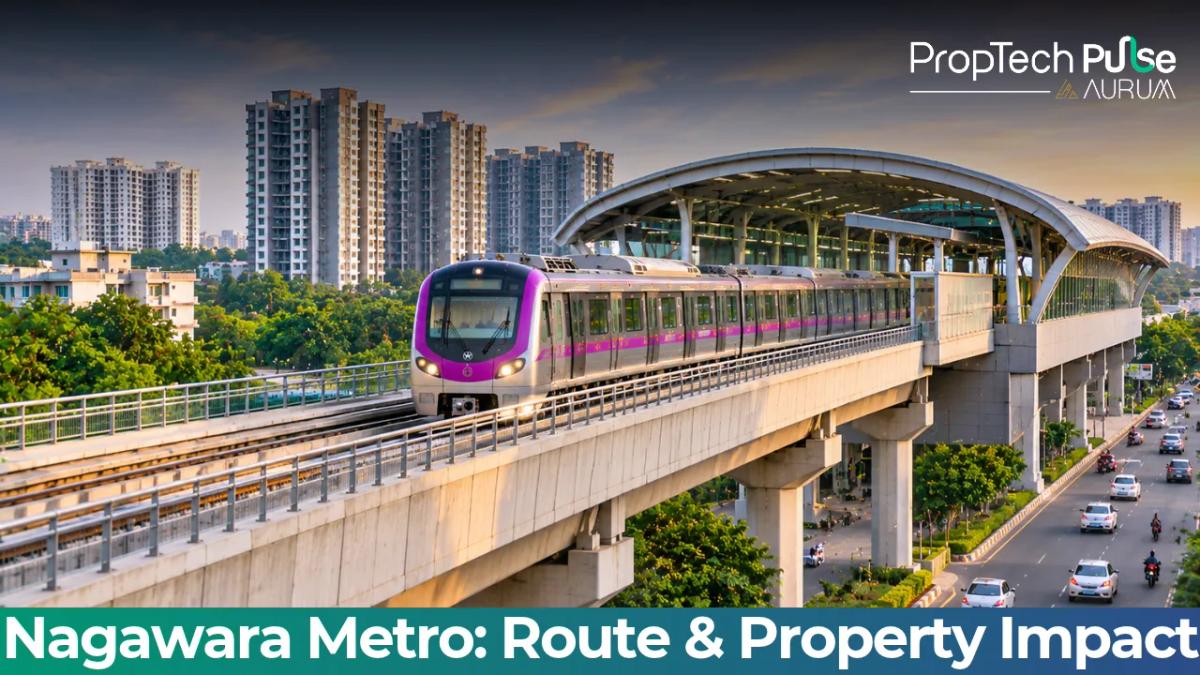
If you are tracking the Northern Bengaluru corridor, here is the short answer: the Nagawara metro station opens in stages. The Pink Line terminates here by May 2027. Full dual-line access to the Outer Ring Road and Kempegowda International Airport opens in December 2027.
Most existing guides stop at dates. Timing matters less than the physical reality. Engineers built a rare ground-level concourse around the local stormwater drain.
That decision protects surrounding flats from flash flooding. A proposed four-storey commercial complex rises directly above the tracks. Nagawara Junction shapes up as a structural and economic anomaly.
Investors evaluating HBR Layout and Thanisandra Main Road quickly learn that mechanical constraints dictate vertical integrations.
You back a property that captures sustainable rental yield, or one that stalls under perpetual construction disruption.
Master plan and route map
Quick answer
The Pink Line terminates at Nagawara metro station in May 2027, establishing immediate standalone transit access. The full dual-line interchange with the Blue Line, connecting directly to the Outer Ring Road and Kempegowda International Airport, opens in December 2027.
Pink Line terminus and Phase 1 timelines
Transit authorities treat terminus stations differently. Every train ends its run on this platform. Crowd control becomes critical when doors open simultaneously.
Wide concourses and automated fare gates are needed to push thousands of commuters through stairs and ramps in under fifteen minutes.
For residents, the May 2027 opening changes everything. Workers skip the congested bus networks entirely. Commute times to Koramangala or Indiranagar drop by up to forty percent.
Blue Line interchange and Phase 2 timelines
The full dual-line switch flips on when the Krishna Rajapura–Hebbala Blue Line connects in December 2027.
Pink Line trains dump passengers into the city centre. Blue Line cars pull them back out toward Hebbala, Whitefield, and the airport.
Nagawara bridges these two economic arteries. Once both phases run, passenger flow stops feeling seasonal. It becomes constant. People walk directly from Pink Line platforms to Blue Line elevators.
This cross-pollination turns a basic travel stop into a commercial magnet. Office-goers who previously ignored the area due to road congestion now factor the direct interchange into their housing search.
Nearby stations and corridor context
Veerannapalya lies to the north. It acts as a quiet residential feeder with fewer corporate offices nearby.
HBR Layout sits immediately to the south. That district operates as a mature, densely packed township.
To the east and southeast, the network branches toward Kalyan Nagar and Devarabeesana Halli. Those areas already host saturated IT parks.
Nagawara occupies the middle ground. It links older residential pockets in the north. It stays close to brand-new township expansions branching off NH 44.
Investors who group these zones together often miss the pivot point. Nagawara Junction operates differently. Consumer-grade retail finally makes financial sense here because daily foot traffic arrives guaranteed.
Unique ground-level engineering and flood resilience
Rajakaluve constraints and drainage advantages
Standard metro construction across Bengaluru involves digging twenty or thirty metres underground.
Concrete pillars hold up the roads above. Engineers hit a hard wall at Nagawara. A major stormwater channel runs straight through the site.
Digging deeper would have dammed the waterway. Monsoon flows would back up onto Thanisandra Main Road.
Planners shifted the plan. Platforms went underground. The concourse sits flush with the street instead.
Blue Line tracks run overhead on viaducts. The hybrid structure lets surface water pass beneath designated channels without choking the neighbourhood.
Owners get a direct benefit. Adjacent apartments avoid severe localized flooding risk.
Older low-lying areas still struggle with puddles lasting weeks after storms. Properties near this station inherit a naturally aerated footprint. Basement parking stays dry during July peaks.
Structural considerations for builders and buyers
Check foundation load calculations for buildings within five hundred metres of a metro pillar. Raised track columns require thick reinforced concrete spaced evenly along the main road.
Developers constructing high-rises nearby cannot place boundary walls too close to these supports.
Vibration dampening rules prevent tight clustering. Newer layouts space apartment blocks wider apart.
Sunlight reaches lower lanes. Cross-ventilation improves compared to tightly packed southern districts.
Initial plots cost more near a pillar. Long-term livability scores higher once traffic stabilizes.
Integrated commercial space and Nagawara One
Vertical integration and overhead development
Nagawara abandons standard transit design through planned commercial overlay.
Nagawara One proposes a four-storey complex spanning roughly 27,000 square metres directly above the infrastructure.
Building office spaces over active train movements demands massive capital. Developers rarely attempt vertical integrations that heavy.
Once operational, the facility houses boutique offices, food courts, and retail outlets targeting commuting professionals.
Ground-level shops capture walk-ups from coffee buyers. Upper floors generate lease revenue to sustain operations.
Retail yields and street-level transformation
Landlords in nearby residential towers face consistent demand for one-bedroom layouts.
Junior analysts prefer living within walking distance of their workplace.
Crossing Thanisandra Main Road currently takes patience. Dedicated skybridges will channel thousands across safely once the station opens.
Small kiranas slowly transition toward quick-service restaurants and courier counters.
Investing in plot conversions means watching municipal zoning shifts. Foot traffic eventually crosses the critical mass required for large-format retail chains. Ground-floor values decouple from pure residential metrics.
They track closer to commercial rate bands. Entrance fees for residential buildings climb dramatically as customers step straight from the metro into the lobby.
Living and investing near Nagawara Metro
Top residential micro-markets around the junction
Surface-facing units near the junction command the highest premiums. Visibility and frontage justify rates well above the local average.
Deeper lanes in older HBR Layout offer mature community infrastructure, reliable drainage, and established schools.
Apartments here trade slightly cheaper. Liquidity stays strong if you need to exit quickly.
Eastward expansion points toward Jakkur Panchaswamy Layout. The area remains quieter. Larger green plots surround it.
Families prioritise silence over being steps away from interchange gates.
Cross-check noise pollution complaints for your target tower before signing. Heavy metro traffic sometimes triggers resident welfare associations.
Builder acoustic insulation standards must be built into the outer walls. Verify this upfront.
Employment hubs and rental demand mechanics
Real estate value chases employment density.
The massive Manyata Embassy Business Park sits comfortably within a one-and-a-kilometre radius of the station.
Dozens of global technology firms occupy those campuses. The central Bengaluru commute currently drags ninety minutes. The interchange shrinks that window to a predictable forty-five-minute ride.
See how proximity affects pricing in our market analytics guide. Companies adjust relocation policies fast. Senior executives demand shorter commutes.
Mid-level managers require safe late-night transit options. Rental yields climb steadily. Landlords converting vacant plots into purpose-built rentals see faster occupancy cycles. Traditional resale flats fall behind.
Northern Bengaluru sets up a similar trajectory to Delhi suburbs that saw exponential rental growth after extensions.
Review broader data on the metro-linked housing boom across our recent coverage to understand macro momentum.
Portfolios structured around the Manyata Embassy Business Park catchment area gain a clear advantage. Tenancy stays steady thanks to blue-chip employers. Capital appreciation rides on irreversible urban upgrades.
Access the best projects in Nagawara and emerging township layouts through our listings. Buyers avoid overcrowded older complexes. Newer societies install solar-powered common areas and dedicated work-from-home pods tailored to the hybrid workforce.
Before you pay the booking amount
Transit construction alters ground conditions unpredictably. Soil compaction from heavy equipment shifts groundwater tables. Unexpected cracking appears in lightweight boundary walls.
Never commit significant capital based solely on rendered concept art pieces. Stick to completed or substantially constructed high-rise towers where developers prove structural integrity physically.
If buying a plot, wait until excavation halts and perimeter fencing stabilizes. Measure actual walking time from your gate to the projected station exit at rush hour. Roads empty fast during midday.
Capital appreciation depends on usability, not merely geography. Lock in positions now while contractors pour foundations.
Execute exits with caution once the December 2027 deadline looms. Early-bird pricing disappears quickly.
Frequently asked questions
Is Nagawara metro station open yet?
The station is currently under active construction. The Pink Line, which terminates at this junction, expects to open for public trial runs and partial operations by May 2027. Full passenger boarding begins shortly thereafter.
Which metro lines stop at Nagawara?
Two major corridors connect here. The Phase 2 Pink Line originates from Dairy Circle and ends its run at Nagawara. The Phase 2B Blue Line arrives from Kr Krishnarajapura and Hebbala, passing through the station to continue its journey toward the Outer Ring Road and the airport.
How far is Nagawara metro from Manyata Tech Park?
The station sits comfortably within a one-and-a-half-kilometre radius of the Manyata Embassy Business Park. Employees can easily walk, cycle, or take a short auto-rickshaw ride from the station exits to reach the main corporate campuses.
Why is Nagawara metro station built with a different design?
Engineers placed the Pink Line concourse at ground level instead of digging deep underground to accommodate the Rajakaluve, a vital stormwater drain. This hybrid structure prevents monsoon water from backing up into nearby streets while allowing the Blue Line to run safely overhead.
Enjoyed this blog article? Visit PropTech Pulse for more interesting blogs.


Ask Pulse Ai anything about real estate

Unlock the Latest in Real Estate
News, Infographics, Blogs & More! Delivered to your inbox.

