New Launch - India Real Estate Report 2026.

Services
Knowledge Hub
Resources
Tools

Ask Pulse Ai
©PropTech Pulse 2025, All rights reserved.


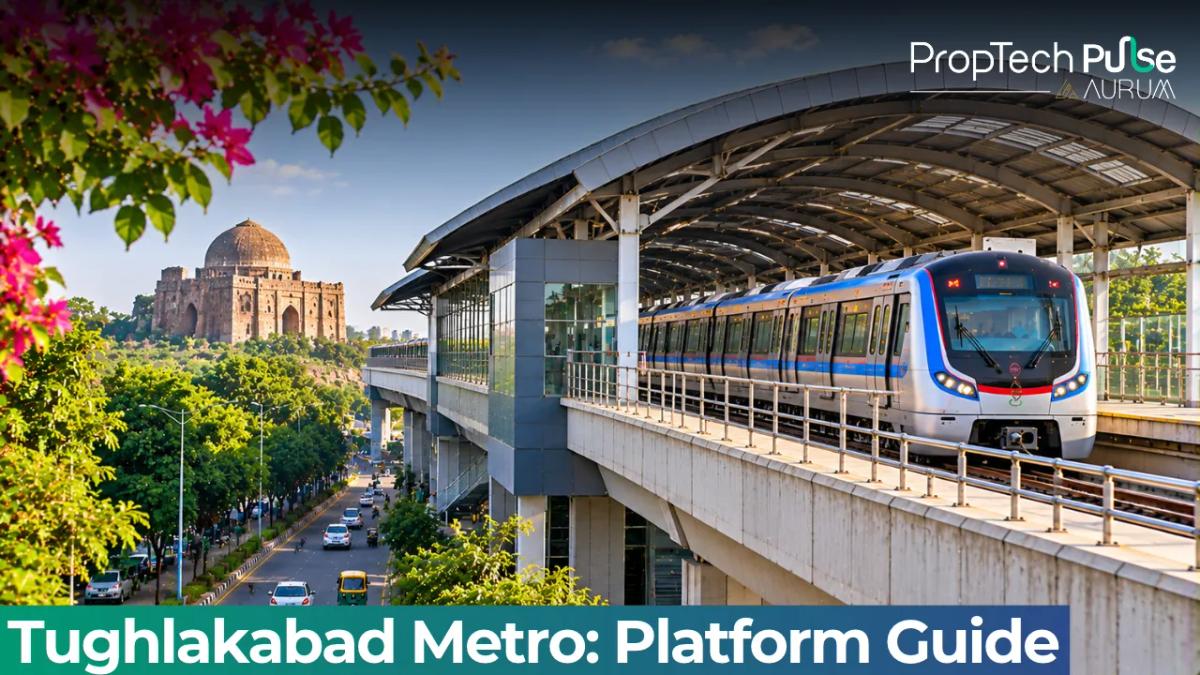
If you rely on the south-east Delhi corridor, Tughlakabad metro station is less a destination and more a junction. It sits right where the Metro crosses the Indian Railways network.
This overlap explains why commuters treat it as a multi-modal hub instead of a simple stop.
Whether you are commuting to Rajiv Chowk or heading to Badarpur Market, knowing the layout before stepping onto the platform saves time during peak hours at the tughlakabad metro station.
This guide breaks down the operational realities of the station. You get the exact gate routing to the railway terminal, current frequency windows, zone-based fares, and practical details like door positions that generic pages miss.
Why Commuters Choose the Tughlakabad metro
Quick answer
Tughlakabad metro station (station code TKDS) sits on the Violet Line, raised above National Highway 2 in MIE Phase E. It connects directly to Gate 1 of the Tughlakabad railway station via a covered footpath. Expect peak frequencies every 3 to 4 minutes and last departures just before midnight.
The stop opened in January 2011, well before recent expansion waves hit the southern belt. Its position along the highway anchors the surrounding residential pockets. For example, Gurudwara Railway Colony residents rarely travel far to catch the train because feeder routes merge right at the station approach.
Similarly, workers managing the adjacent rail yards use this halt to reach Connaught Place or central Delhi commercial hubs.
Unlike newer high-set corridors built strictly to bypass congested roads, TKDS was designed early to handle heavy interchange traffic. The station code appears clearly on all signage, and the architecture follows a standard two-level configuration.
You enter through the ground floor concourse, pay your fare or swipe your card at the automated machines, then head upstairs to the second level where the tracks sit.
Tughlakabad metro station route & line map
The station falls squarely on the Violet Line. The route runs north to south, stretching from Ishan Park in Ghaziabad down to Bhoot Kaliyon Ki Chhat in Faridabad.
Between its immediate neighbours, Mohan Estate to the north and Badarpur Border to the south, it functions as a high-volume throughput point. Most passengers ride it to bridge the gap between south Delhi and the wider tughlakabad metro station corridor.
Key interchanges
You do not change lines at Tughlakabad itself, but the route makes several critical swaps easy within a fifteen-minute window. The main alternatives are:
- Lajpat Nagar (Pink Line): Requires one stop northbound. A direct swap for shoppers heading to Sarojini Nagar or people traveling towards Anand Vihar.
- Kalkaji Mandir (Magenta Line): One stop further north. Essential if you are switching toward Okhla Bird Sanctuary or Majlis Park.
- Central Secretariat (Yellow Line): Accessible via cross-platform transfer at Akshardham or Lok Kalyan Marg, meaning you can step off a Violet Line train and walk directly to the opposite track for the Yellow Line.
If your final destination is a busy financial hub, transferring to the Yellow Line at Central Secretariat cuts through the gridlock that often forms near the market clusters. For more details on managing multi-line swaps, see our guide on Violet Line stations, fares and timings.
Tughlakabad metro station timings & frequency
DMRC operates extended hours, but frequency drops sharply once rush hour passes.
Early risers usually find trains arriving every three minutes between seven am and eleven am. Midday services stretch to four-minute intervals, while evening shifts toward five to six minutes.
Weekday peaks vs Sunday service
Weekend schedules differ slightly from the workweek roster. Schools close, office traffic thins, and the Metro trims late-night services compared to Friday nights. Here is how the windows typically shift:
| Time Window | Frequency | Direction |
|---|---|---|
| Morning Peak (07:00 – 10:00) | Every 3 minutes | Both towards Kashmere Gate and Raja Nahar Singh |
| Midday Off-Peak (12:00 – 16:00) | Every 4 minutes | Both directions |
| Evening Peak (17:00 – 20:00) | Every 3 to 4 minutes | Heavy load southbound; slight delays likely |
| Sunday Night Service | Ends shortly before 23:30 | Last departure roughly 23:15 |
Note that first and last train times fluctuate seasonally. Winter daylight saving adjustments push opening times back by fifteen minutes, while summer rosters start earlier.
Relying on a fixed morning hour risks missing the early shuttle. Check the Rajiv Chowk metro station live updates tracker if you have a tight schedule.
Platform layout, gates & the Tughlakabad railway station link
The stop sits entirely above grade. You ascend the staircases or ramps to Level 2 to reach the island platform configuration divided into two side platforms depending on the direction of travel.
Focus on the door orientation, which is the single most useful detail on this floor. Every train servicing Tughlakabad opens its doors exclusively on the left side.
This applies whether you are waiting for a northbound carriage or a southbound one. Stand clear of the right-hand boundary wall while boarding, or you will be caught in the initial flow of passengers trying to exit on the wrong flank.
Transferring to Indian Railways happens immediately after clearing the ticket barriers at Gate 1. A dedicated covered footpath leads straight into the waiting hall of the Tughlakabad railway station without exposing you to monsoon rain or summer heat.
Commuters moving between the Violet Line and long-distance freight or passenger trains usually complete the cross-transfer in under ten minutes if they avoid the crowded main staircase.
For those evaluating property values in the vicinity, understanding transit connectivity helps explain local demand. See how proximity to a metro station affects apartment pricing across similar transit corridors.
Platform navigation tip: The food stalls and waiting benches sit near the centre of the platform, creating a bottleneck during the 5 pm spike. Board the third or fourth coach if possible to secure a seat without fighting the crush.
Fares, passes & digital payment options
DMRC shifted to a distance-based zoning model years ago. The base tariff starts low and scales up as you cross the administrative boundaries of central Delhi.
Smart Card users enjoy a flat twenty percent discount on every trip, making the recharge loop significantly cheaper than buying paper tokens.
| Destination | Paper Ticket Fare | Smart Card Fare |
|---|---|---|
| Lajpat Nagar (Pink Line interchange) | ₹40 | ₹32 |
| Kalkaji Mandir (Magenta Line interchange) | ₹30 | ₹24 |
| Raja Nahar Singh (Faridabad Terminal) | ₹40 | ₹32 |
| Kashmere Gate (Yellow/Green/Red interchange) | ₹50 | ₹40 |
| Estimated cost to Rajiv Chowk | ₹40 to ₹45 | ₹32 to ₹36 |
Contactless payments now dominate entry. You can tap a Visa, Mastercard, Maestro, or RuPay credit/debit card directly at the automated gates without printing a physical token.
NFC-enabled smartphones work identically, and recharging machines accept cash, UPI QR scans, and net banking links. Just keep your card active past its expiry date, as readers sometimes reject expired magnetic strips.
Parking, ATMs & facility checklist
Space remains tight inside the high-set structure. The station provides a limited designated vehicle parking area along the approach road rather than beneath the platform, meaning two-wheelers fill the slots quickly by eight am.
Two-wheeler owners should aim for the feeder bus terminus beside the entrance to secure a bike slot before crossing the ticket counter.
On-site conveniences are basic but functional:
- Three automated teller machines positioned outside the paid area
- Wheelchair ramps and lifts connecting the street level to the concourse
- Drinking water dispensers on the platform floor
- Help desk staff available from the moment the first train arrives until the last returns
- 24-hour CCTV coverage across all exits and escalator landings
If you are visiting nearby markets like Badarpur or Khairgarh, take a feeder bus. The city transport corporation runs multiple routes that circle back to drop you within fifty meters of Gate 1.
Final commute rule of thumb
Treat Tughlakabad as a connection point first, a boarding point second. If you live in MIE Phase E or the housing board colonies, the footpath to the railway station offers a dry, reliable exit path regardless of weather.
For daily commuters, keeping a loaded Metro card in your wallet beats fumbling for mobile QR codes during the surge at 8:45 am.
When choosing between staying on the Violet Line versus swapping early, look at the crowd density at Central Secretariat.
If the Yellow Line platform shows heavy buildup, ride past Akshardham and jump at Lok Kalyan Marg. The extra two stops save you from standing in aisle congestion.
Frequently asked questions
What is the last metro time at Tughlakabad station?
Services normally wind down shortly before midnight, with final trains departing around 23:30. However, DMRC frequently adjusts closing times during exam seasons, winter months, or major public holidays. You should download the official Delhi Metro app or visit their website the evening before a late return to verify the updated roster. Missing the cutoff leaves you reliant on expensive airport taxis or risky night buses.
How can I walk to Tughlakabad railway station from the metro?
Step off the Violet Line platform, proceed downstairs to the concourse level, and locate Gate 1 on the exit map. Turn right immediately upon reaching the ground floor to find the covered skywalk. The pathway spans roughly four hundred metres and ends directly inside the railway station waiting hall. The route stays completely indoors, protecting pedestrians from summer glare or sudden rain showers.
Which Delhi Metro line connects to Tughlakabad?
The station sits exclusively on the Violet Line, marked clearly by purple colour-coded signage throughout the corridor. While you cannot board other lines here, you can access the Pink Line at Lajpat Nagar and the Magenta Line at Kalkaji Mandir with just one northbound stop. The Yellow Line remains accessible via a cross-platform exchange at either Akshardham or Lok Kalyan Marg.
Is there paid parking at Tughlakabad metro station?
The operator provides a managed parking facility along the outer approach road rather than underground vaults. Spaces fill rapidly during morning rush hours, so securing a slot requires arriving before nine am. Automated machines accept cash, cards, and mobile payments at the entry kiosks. Day-long fees scale according to vehicle category, but space remains too tight for overnight commuter storage.
What is the metro fare from Tughlakabad to Rajiv Chowk or Kashmere Gate?
Distance-based tariffs set the paper ticket rate between forty and fifty rupees depending on the exact destination zone. Carrying a registered Metro Smart Card drops the price by twenty percent on every single journey. Contactless Visa, Mastercard, or RuPay debit cards bypass the counter entirely for the same discounted toll. Students carrying valid ID cards may qualify for half-price concessions if they hold the required pass documentation.
Sources
- Delhi Metro Rail Corporation: Station details, platform structure, door orientation, and Gate 1 railway linkage (accessed November 2026)
- Delhi Metro Rail Corporation: Violet Line alignment and phase timeline data (accessed November 2026)
- Delhi Metro Rail Corporation: Operating hours, frequency roster rules, and service adjustments (accessed November 2026)
- Delhi Metro Rail Corporation: Timetable framework and weekend deviation guidelines (accessed November 2026)
- Delhi Metro Rail Corporation: Contact helpline numbers and grievance submission portal (accessed November 2026)
- Delhi Metro Rail Corporation: Official location mapping and municipal boundary pin code data (accessed November 2026)
Enjoyed this blog article? Visit PropTech Pulse for more interesting blogs.





Ask Pulse Ai anything about real estate

Unlock the Latest in Real Estate
News, Infographics, Blogs & More! Delivered to your inbox.

