New Launch - India Real Estate Report 2026.

Services
Knowledge Hub
Resources
Tools

Ask Pulse Ai
Services
FOR BUYERS & RENTERS
FOR REAL ESTATE DEVELOPERS








Refer other Connectors &
Multiply IncomeRefer other Connectors
& Multiply Income
Refer KuberX & earn
commission on every
loan they get
disbursed.


Scan & Download
©PropTech Pulse 2025, All rights reserved.


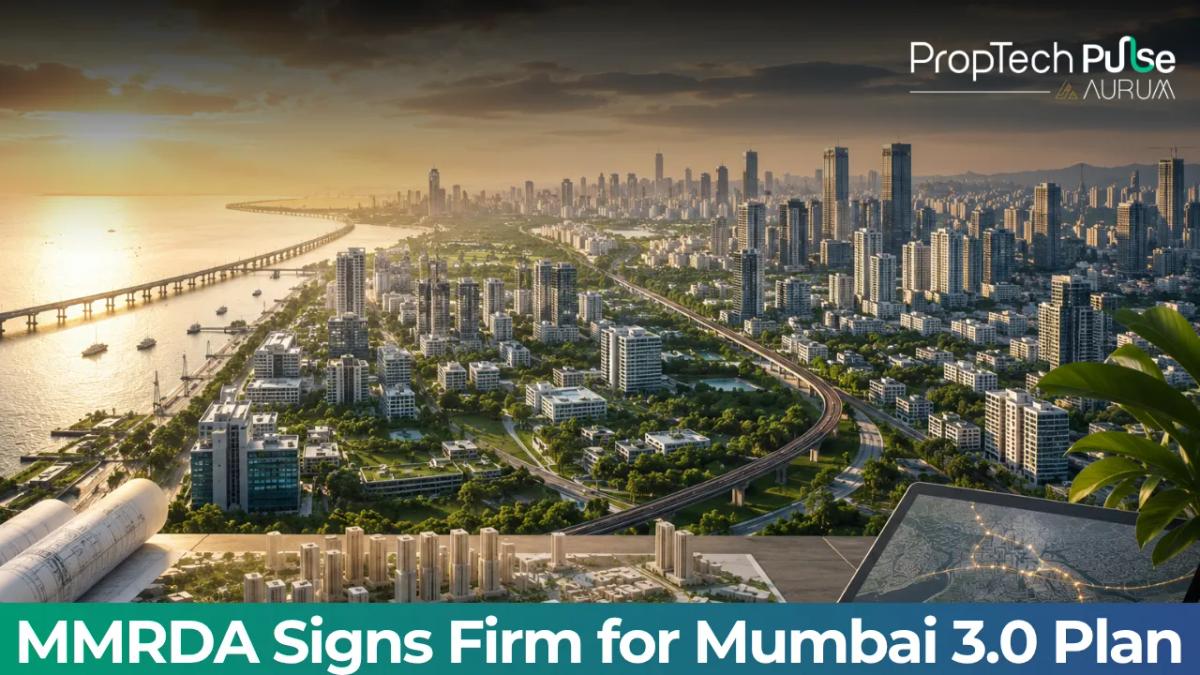
The Mumbai Metropolitan Region Development Authority (MMRDA) has entered into an agreement with Singapore-headquartered Surbana Jurong Infrastructure Pte.
Ltd. to prepare a vision document and comprehensive master plan for Mumbai 3.0. The engagement builds on an MoU signed by MMRDA and Surbana Jurong at the World Economic Forum in Davos in January 2026, formalised after the Maharashtra government approved the appointment on a Government-to-Government basis in June 2026.
What is Mumbai 3.0
Also known as Third Mumbai, Mumbai 3.0 spans approximately 323.44 sq km, covering 124 villages across the Panvel, Uran and Pen talukas of Raigad district, around 50 km from main Mumbai.
The Maharashtra government notified the project in October 2024 under the Maharashtra Regional and Town Planning Act, 1966, designating MMRDA as the New Town Development Authority.
Located within the influence area of Atal Setu and near the Navi Mumbai International Airport and Jawaharlal Nehru Port, it is conceptualised as an integrated urban and economic centre supporting residential, commercial, industrial, institutional and logistics development.
Also Read: Mumbai 3.0: India's Boldest Urban Expansion Since Navi Mumbai
What the master plan will cover and when it's due
The planning exercise will begin with an assessment of land use, transport networks, population, utilities and environmental features, before outlining the new city's economic positioning, growth strategy and key projects through a Vision Document.
The plan will draw on international practices in smart infrastructure, mixed-use development and Transit-Oriented Development and will be delivered in phases over 30 weeks:
- Inception Report: 4 weeks
- Existing Situation Report: 10 weeks
- Vision Document: 16 weeks
- Draft Concept Land Use Plan: 24 weeks
- Stakeholder Interaction Report: 26 weeks
- Final Concept Plan: 30 weeks
Also Read: MMRDA Files CRZ Bid for Thane Coastal Road Phase II
What it means for the real estate sector
According to MMRDA officials, Mumbai 3.0 could open up a major new growth market within the MMR, with the Navi Mumbai International Airport and other connectivity projects boosting investor confidence and potentially driving new residential, commercial and mixed-use hubs.
MMRDA's proposed land policy, combining monetary compensation with land-based benefits, is intended to encourage landowners to participate in development.
Metropolitan Commissioner Sanjay Mukherjee said the policy aims to make landowners stakeholders and beneficiaries in the development process, combining progressive land policy with global planning expertise.
Real estate consultants describe Mumbai 3.0 as an emerging development region rather than a built-up market, with land largely comprising villages and agricultural parcels alongside some existing industrial and residential development.
Market listings in surrounding areas broadly range from a few thousand rupees to over Rs 10,000 per sq ft depending on connectivity and proximity to infrastructure, while local brokers say plotted development parcels are available from Rs 10 lakh to Rs 1 crore depending on location, size and developer.
Enjoyed this update? Visit PropTech Pulse for more real estate news, investment insights and property market trends.


