New Launch - India Real Estate Report 2026.

Services
Knowledge Hub
Resources
Tools

Ask Pulse Ai
©PropTech Pulse 2025, All rights reserved.


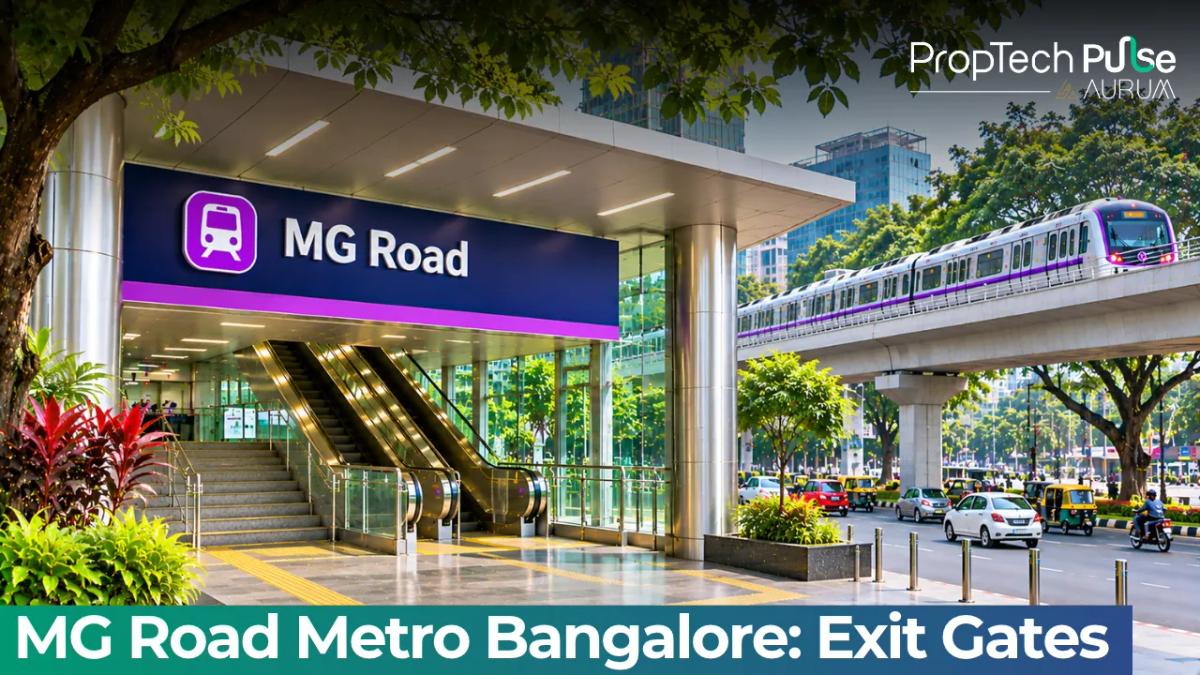
Finding your way through Bengaluru's Central Business District shouldn't mean circling traffic-choked intersections for hours. The MG Road Metro Station sits right here.
It cuts down your travel time whether you need coffee at Trinity Circle, an office on Brigade Road, or a quick shopping trip on Commercial Street.
Picking the right exit matters most. You need to know which platform heads toward Whitefield. You also need to spot the gate nearest your office and factor in how recent ground works shifted the walk along Kamaraj Road.
This guide covers the Purple Line stops, Pink Line timelines, exact hours and ticket prices.
Routes and Connectivity: The Purple Line and Upcoming Pink Line
Quick answer
The MG Road metro station currently operates on the existing Purple Line, connecting Whitefield in the northeast to Challaghatta in the southwest. Planned underground works for the Pink Line will transform it into a dual-interchange hub by late 2026, dramatically shortening travel times for eastern suburbs like Nagawara. All three ground gates open directly onto primary commercial arteries, eliminating the need to cross heavy vehicle lanes on foot.
MG Road acts as the spine of Bangalore Metro's daily commuter network. Right now, it operates strictly on the existing Purple Line. Trains heading north serve the Whitefield tech corridor.
Southbound trains connect directly to Challaghatta, linking almost every major residential neighbourhood along the city's western edge. Searching for mg road near me usually points commuters straight to this central node because it anchors the entire financial district.
| Gate | Direct Physical Link | Key Landmarks Reached Within Walking Distance |
|---|---|---|
| Gate A | Kamaraj Road | Trinity Circle, Cubbon Park approach, Vidhana Soudha (via short walk), CBD corporate offices |
| Gate B | Brigade Road | Premium shopping belt, Royal Orchid Centrum, multiple corporate plazas and lunch destinations |
| Gate C | Church Street | Heritage bars, restaurants, bookshops and late-night entertainment zones |
Underground works for the Pink Line are currently wrapping the station in reinforced concrete. When this phase finishes around late 2026, MG Road becomes a dual-interchange hub linking Nagawara to Kalena Agrahara.
Purple Line trains still run straight through from roughly five AM to past eleven PM daily. The tracks sit directly under the MG road corridor, keeping municipal traffic flowing freely above.
Operating Hours, First and Last Train Schedules
Train timing matters most when you are balancing work meetings or trying to catch evening retail activity. Morning services generally begin around five thirty-six AM, departing from both Platform 1 towards Whitefield and Platform 2 towards Challaghatta.
Evening operations extend well past eleven forty PM during weekdays, though last trains sometimes terminate slightly earlier on Sundays depending on maintenance windows.
Commuter frequency drops noticeably between working days and weekends. Weekday peak hours see trains arriving every five to seven minutes to handle the massive CBD influx.
Weekend frequencies stretch out to eight or nine minutes. You can always check live arrival times on the official BMRC app before stepping onto the escalator, especially when switching platforms mid-journey or travelling light during summer evenings.
Understanding Exit Gates A, B and C Directions
Standard side-platform design shapes the station layout. You enter through three distinct surface gates, each engineered to funnel foot traffic straight onto the corresponding main road without requiring you to cross heavy vehicle lanes.
Gate A opens directly onto Kamaraj Road. It provides the quickest pedestrian path to Trinity Circle, corporate offices near Cubbon Road and the general approach toward Vidhana Soudha without crossing busy vehicle junctions.
You will find Gate B channels pedestrians directly onto the eastern flank of Brigade Road, dropping shoppers inside fifty metres of Royal Orchid Centrum.
Finally, Gate C pushes visitors onto Church Street, the natural path for nightlife crowds heading west toward the High Court precinct.
GATE SELECTION TIP If your destination is an office near Trinity Circle or Cubbon Road, always exit through Gate A. The other two gates require crossing busy signal-controlled junctions, adding roughly ten minutes to your walk.
Boarding the right train is straightforward. When boarding a train, look for the digital displays and announcements directing you to Platform 1 for the Whitefield direction or Platform 2 for Challaghatta.
Avoid standing near middle doors unless your stop falls exactly halfway. Rushing past exiting passengers during peak hours creates bottlenecks. Delays follow quickly.
Ticket Fares, Smart Card Discounts and Payment Options
Fares scale strictly with distance rather than fixed zone systems. A two kilometre trip starting here costs roughly ten rupees.
Commuters travelling beyond twenty-five kilometres usually face charges approaching ninety rupees or slightly higher during late night slots. Smart cards save regular commuters a flat five percent. They grant extra discounts during off-peak windows too.
| Trip Distance | Standard Cash Fare | Smart Card Discounted Fare |
|---|---|---|
| Up to 2 km | ₹10 | ₹9.50 |
| 2–5 km | ₹20–₹30 | ₹19–₹28.50 |
| 5–10 km | ₹40–₹60 | ₹38–₹57 |
| 10–20 km | ₹70–₹80 | ₹66.50–₹76 |
| Above 25 km | ₹90+ | ₹85.50+ |
| Highest fare cap | Approx ₹90+ | Approx ₹85.50+ |
Digital taps and contactless debit cards work perfectly at entry barriers. Carry cash for manual counters only if phone payment fails, though technical glitches rarely block smart card readers completely.
Check the latest matrix on bmrc.co.in before planning long-distance weekend trips, as fare structures adjust occasionally to reflect operational costs.
Ground Connectivity and Traffic Update: Kamaraj Road Reopens
Pedestrians noticed a major shift early this year. Direct foot traffic between Cubbon Road and MG Road stalled for nearly six years while underground works swallowed the intersection.
Officials closed the corridor in June 2019, forcing commuters onto circuitous routes around City Market. Auto operators waiting in makeshift queues created secondary snarls that completely blocked bicycle lanes.
Reconstruction wrapped up fully on January 2, 2026. That project cost roughly three crore rupees to restore a 214-metre stretch of asphalt.
The new surface clears the old gridlock. Bus bays now sit further out, so walkers no longer dodge heavy traffic to hit the station ramps. Drivers seeking the Bangalore Purple Line stations, timings and fares often pair their train commute with auto rides. These freshly widened corridors make the transition much smoother.
Parking does not exist on-site. Drop-off zones choke around Brigade Road anyway. Ride-hailing apps or BMRC feeder buses are your only sensible options. Check our analysis on how proximity to a metro station affects apartment pricing to understand why uninterrupted access keeps leasing tight in Shivaji Nagar and Ashoknagar.
Before You Plan Your Commute
Planning your daily transit around MG Road means picking the correct gate before you even step off the train. Know your destination board, grab the smart card discount when you can and use the newly paved Kamaraj Road corridor to skip the worst traffic bottlenecks.
If your goal involves evaluating how this connectivity influences asset value in the surrounding CBD blocks, calculate expected returns using a dedicated rental yield calculator to benchmark against historical baselines.
Frequently asked questions
Which metro line serves MG Road station right now?
MG Road currently functions exclusively on the elevated Purple Line. Trains heading north reach Whitefield and surrounding IT parks, while southern trains connect directly to Challaghatta via suburban corridors.
Where does Gate A lead to at MG Road Metro Station?
Gate A opens directly onto Kamaraj Road. It provides the quickest pedestrian path to Trinity Circle, corporate offices near Cubbon Road and the general approach toward Vidhana Soudha without crossing busy vehicle junctions.
Is there parking available at MG Road metro station?
No dedicated parking exists at the station premises or immediate ramps. Vehicles attempting to drop off passengers frequently get stuck around Brigade Road signal points. Riders should use ride-hailing apps or public buses instead.
What is the last metro time from MG Road towards Whitefield?
Evening departures normally continue until around eleven twenty-one PM or later on weekdays. Trains often hold back briefly for maintenance checks during winter months, so checking live schedules avoids missing the final connection home.
How will the Pink Line affect my daily commute from MG Road?
Once underground construction completes in late 2026, MG Road becomes a dual interchange hub. You will transfer easily between Nagawara and Kalena Agrahara platforms, drastically cutting travel times for residents living east of the city.
Enjoyed this blog article? Visit PropTech Pulse for more interesting blogs.





Ask Pulse Ai anything about real estate

Unlock the Latest in Real Estate
News, Infographics, Blogs & More! Delivered to your inbox.

