New Launch - India Real Estate Report 2026.

Services
Knowledge Hub
Resources
Tools

Ask Pulse Ai
Services
FOR BUYERS & RENTERS
FOR REAL ESTATE DEVELOPERS








Refer other Connectors &
Multiply IncomeRefer other Connectors
& Multiply Income
Refer KuberX & earn
commission on every
loan they get
disbursed.


Scan & Download
©PropTech Pulse 2025, All rights reserved.


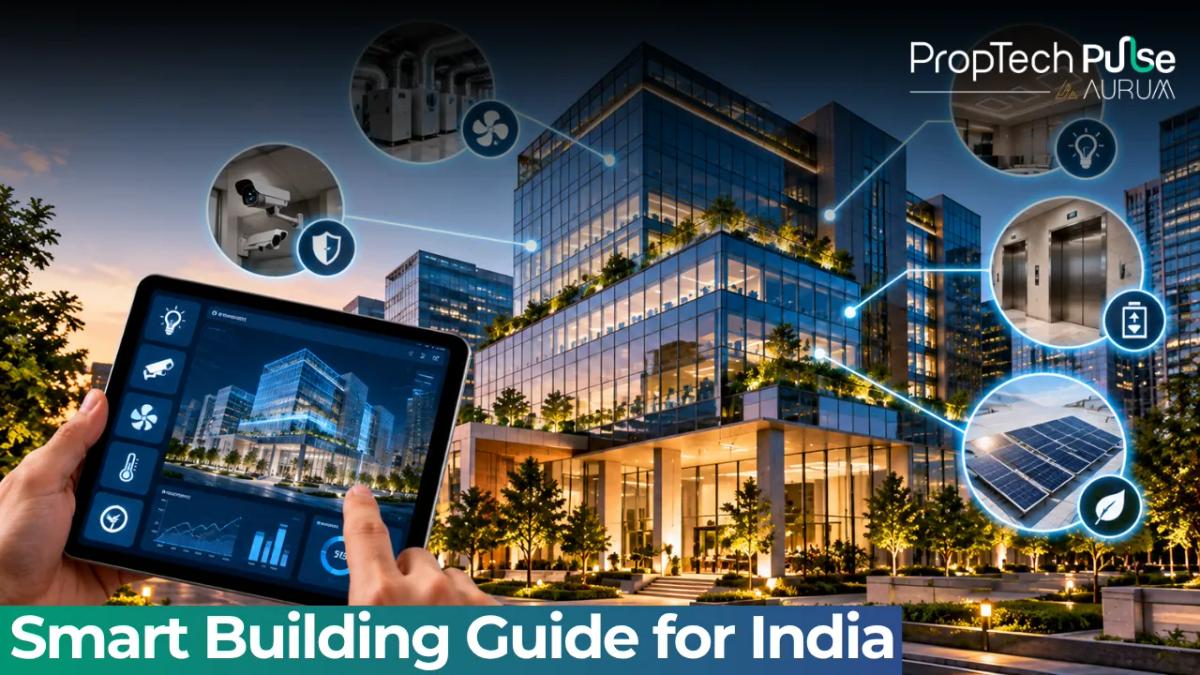
Most Indian residential towers run on timers and a watchman's judgement. Corridor lights burn all day, the overhead tank overflows at 2 a.m., and nobody knows a lift is failing until it stops. The fix is a building that watches itself.
Here is what the term means, which systems matter, what a retrofit might save, and what to ask before paying for the label.
What a smart building is
Quick answer
A smart building uses sensors, controllers and software to manage lighting, cooling, lifts, water, power and security from shared data. The aim is lower running cost, fewer breakdowns and better safety. A building is only smart if the systems talk to each other and someone acts on the data.
Some app-controlled lights do not make a smart building. One that dims corridor lights when nobody is there, warns you when a pump draws too much current and logs every entry at the gate is.
The idea sits inside the wider IoT in real estate trend. For the technology side, the Pulse note on IoT for smart buildings goes deeper into sensors and automation.
The systems that make it smart
Most smart buildings are built from a handful of systems. You can add them one at a time.
| System | What it does | Typical benefit |
|---|---|---|
| Building management system (BMS) | Central screen that monitors and controls other systems | One view of faults and energy use |
| Lighting controls | Timers, daylight and occupancy sensors for common areas | Lower electricity bill |
| HVAC controls | Adjusts cooling and ventilation by occupancy and temperature | Comfort with lower power use |
| Water management | Tank level sensors, pump control and leak alerts | Fewer overflows and dry runs |
| Lift monitoring | Tracks faults, trips and usage | Early warning before breakdown |
| Access and CCTV | Cards, app entry and visitor logs | Better security and records |
| Energy metering | Meters for blocks, floors or flats | Shows where power goes |
Source: author's summary of common building automation systems; scope varies by project.
That central layer, the BMS, ties these together. Without it you have separate gadgets, each with its own screen and its own vendor.
Smart building vs smart home
The tools overlap, but the problems differ. A home needs convenience for one family. A building needs reliability for hundreds of people, plus someone accountable for it.
| Point | Smart home | Smart building |
|---|---|---|
| Who decides | One owner | Society committee or building operator |
| Main goal | Comfort and convenience | Running cost, safety and uptime |
| Typical systems | Lights, locks, AC, cameras | Pumps, lifts, fire, access, central lighting and HVAC |
| Who maintains it | The owner or a technician | A facility team or an AMC vendor |
| Data risk | Personal to one family | Covers all residents, staff and visitors |
Source: author's comparison for typical residential use.
If your interest is inside the flat, read the Pulse guide on smart home automation instead. This post stays with shared systems.
A worked saving example
Take a 100-flat society. Assume common-area electricity costs ₹3 lakh a month, and lighting and pumps account for most of it.
Assume timers, daylight sensors and pump controls cut that bill by 20%. That is ₹60,000 a month, or ₹7.2 lakh a year.
Say the retrofit costs ₹18 lakh. Divide the cost by the yearly saving: 18 ÷ 7.2 gives 2.5 years to recover the money. After that the saving is yours, less the maintenance contract.
All three figures are made up to show the method. Your payback could be shorter or much longer, so ask any vendor to run the same sum on your actual bills. A vendor who will not show the arithmetic is selling a brochure.
What changes in an Indian building
Indian conditions shape the design. Power cuts and generator changeovers mean controllers must restart cleanly. Heat and humidity shorten the life of sensors outdoors. Monsoon puts basement pumps and sensors at risk.
The Pulse note on monsoon-ready green buildings covers the water side. For running a building day to day, see PropTech facility management and property management automation.
In a new project, ask whether the plan matches approvals. Read about the occupancy certificate and check the project on the RERA page, since promised amenities should appear in the registered details.
For larger planning context, the Pulse piece on smart city technology and the look at digital twins show where this goes next.
What to ask before you pay
- Which systems are included? Get a written list, not the word "smart".
- Do they work without the internet? Lights, pumps and gates should still run locally.
- Is the system open? If only one vendor can service it, you are locked in.
- Who maintains it and at what cost? Ask for the AMC price after the warranty ends.
- Who owns the data? Settle storage, access and deletion in the contract.
- What is the saving estimate? Ask for the method, not only a percentage.
If you're buying, the property buying guide lists the other checks to do before you sign.
Risks and limits
Networked systems can be attacked. Change default passwords, keep systems on a separate network from visitor Wi-Fi, and restrict who can reach the control panel.
Gear also dates. A system installed today may lose vendor support in a few years, so ask how long spares and updates will be available.
Cameras and access logs hold personal data. Residents should know what is recorded and for how long. The Digital Personal Data Protection Act, 2023 applies.
One last limit: a system nobody watches saves nothing. Alerts need a person who reads them and fixes the fault.
How to decide
Decision rule: pay for a smart building feature only if the vendor shows a payback on your own bills, names who maintains it and keeps the system working offline. Start with lighting, water and access, then add the rest once those prove their worth.
If you are choosing between projects, compare the real amenity list and the running-cost promise, not the marketing. If you manage a society, begin with the system that has the biggest bill.
Frequently asked questions
What is a smart building?
Sensors, controllers and software run a smart building's lighting, cooling, lifts, water, security and power with less manual effort. The systems share data, so the building can adjust itself to occupancy and conditions instead of running on fixed schedules.
What is the difference between a smart building and a smart home?
Smart homes automate one dwelling for one family. Smart buildings automate shared systems for many users, such as common lighting, lifts, pumps, fire alarms and access. Buildings also need central monitoring and a trained operator, which a home does not.
How much does it cost to make a building smart?
It varies widely with size, age and scope. Retrofits that add sensors and controls to lighting and pumps cost far less than a full building management system in a new tower. Get itemised quotes and ask for the expected saving per system .
Can an existing apartment society become smart?
Yes, in stages. Societies usually start with common-area lighting controls, water tank and pump automation, and access control, then add energy metering. Each step can pay for itself on its own, so you do not need to buy the whole system at once.
Who owns the data in a smart building?
This must be settled in the contract. Ask who owns the data, where it is stored, who can see camera and access logs, and what happens to it if you change vendors. Personal data is covered by the Digital Personal Data Protection Act, 2023 .
Enjoyed this blog article? Visit PropTech Pulse for more interesting blogs.


Ask Pulse Ai anything about real estate

Unlock the Latest in Real Estate
News, Infographics, Blogs & More! Delivered to your inbox.