New Launch - India Real Estate Report 2026.

Services
Knowledge Hub
Resources
Tools

Ask Pulse Ai
©PropTech Pulse 2025, All rights reserved.


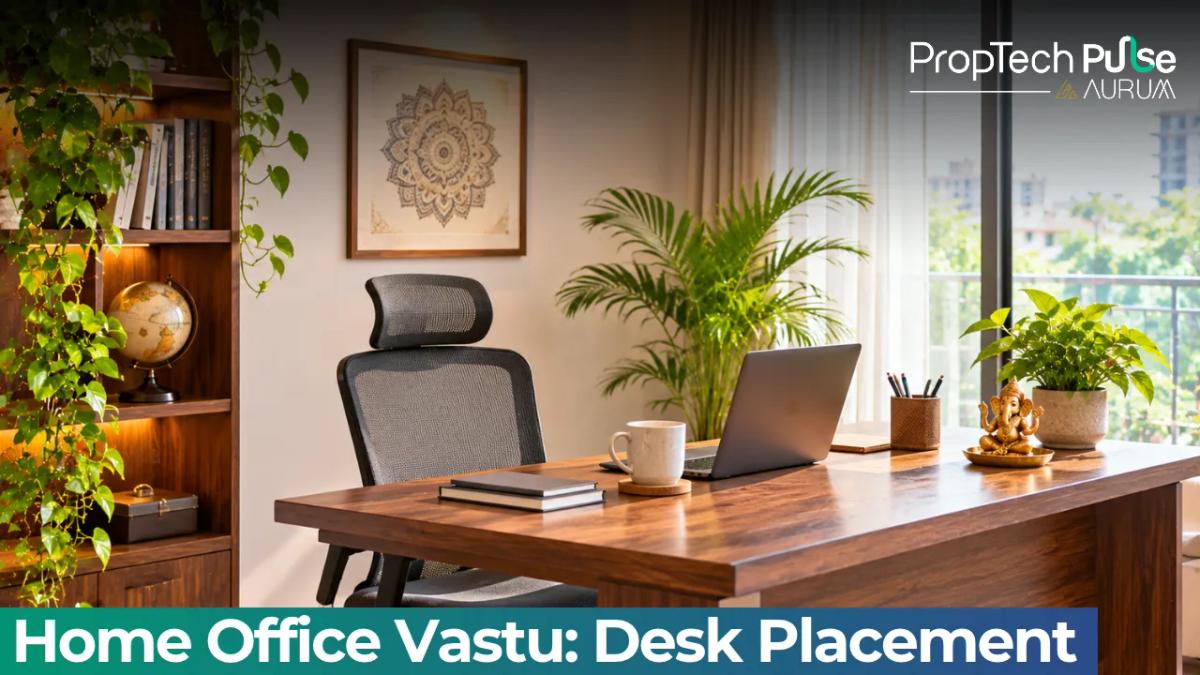
Setting up a home office often feels like solving a puzzle when every available corner is already claimed by a bed or wardrobe. Most remote workers in Indian metros compromise their workflow before they even open a laptop.
Classical Vastu Shastra doesn't demand that you knock down walls to fix this. It focuses entirely on how you orient yourself within the square footage you possess.
Adjusting your home office vastu layout aligns your physical environment with natural light, cross-ventilation and psychological cues that support sustained concentration. You can achieve remarkable improvements just by rotating your desk ninety degrees.
What Classical Texts Say About Study Spaces
Quick answer
Classical Vastu Shastra dictates placing your home office vastu desk in the South-West corner for maximum stability. You should sit facing North or East to capture positive energy and steady morning light. Keeping the room's central junction perfectly clear allows stale air to escape, ensuring consistent ventilation.
Brihat Samhita, Chapter 53, lays out the geometry for wealth and learning over a thousand years ago. Varahamihira writes that treasury, grain stores and dedicated study rooms belong in the northern quadrants. He also insists on keeping the absolute centre of the house clear.
Modern architects often miss the practical layer hidden in those verses. Clearing the central junction improves airflow in hot Indian summers. It stops stale air from lingering in narrow corridors.
Assigning study zones to the North captures steady morning illumination rather than punishing afternoon glare. When a dedicated room isn't feasible, apply the exact same geometry to the single room you share with your living area.
Understanding the underlying spatial logic helps much more than memorising isolated rules, which is why studying broader vaastu shastra real estate principles gives you a reliable framework for any floorplan.
Where to Place Your Desk: Best Rooms and Corners
Physical placement dictates how the room operates. The South-West zone carries structural heaviness and stability.
Position the bulk of the desk here to ground the workspace energetically. If you manage sales pipelines, lead engineering squads or handle high-stakes negotiations, SW placement supports authority and decisive action.
This placement applies to work surfaces only. Your sleeping quarters might sit perfectly elsewhere, but your work surface earns its place in the firmest corner of the room.
Implementing strict home office vastu rules in shared spaces ensures productivity remains separate from relaxation.
If apartment dimensions limit you to a single occupied space, treat the layout as two distinct zones. Map the South-West corner for heavy items: the desk, steel filing cabinets and safes.
Reserve the North-East corner for light activities, reference books or a small prayer niche. Never stack electronic equipment in the North-East. That sector governs mental clarity; introducing clutter there fragments attention during conference calls.
Choosing the Right Office Table Direction at Home
Office table direction at home is rarely about dragging furniture across tiles. It is almost always about how you sit and which way your eyes meet the room. Facing North draws energy linked to financial stability.
Bankers, auditors and compliance officers frequently report that working toward the North enforces discipline and sharpens detail orientation. Facing East aligns with sunrise, actively supporting skill acquisition and creative brainstorming.
South and West orientations operate differently. Working while facing South places the Sun behind you for most of the morning. This direction demands steady confidence and suits leadership roles.
However, several buyers mistakenly choose South simply because it sounds authoritative, only to exhaust their mental reserves by mid-afternoon. Compensate with adjustable task lighting on your monitor to balance reduced ambient daylight.
| Professional Focus | Recommended Facing Direction | Why It Works |
|---|---|---|
| Finance, Banking, Compliance | North | Aligns with traditional wealth sectors; sustains routine precision. |
| Creative, Research, Academia | East | Captures early sunlight; lowers screen glare; eases cognitive load. |
| Sales, Executive Leadership | South | Builds assertiveness and rapid decision-making, though demands strong lighting. |
| Administration, Teaching | North-East | Maximises intellectual flow; requires keeping the immediate corner uncluttered. |
Which Way Should You Face Your WFH Desk?
WFH desk vastu overlaps heavily with commercial layout planning, but residential units lack custom-built partitions.
You don't need to install drywall between your sleeping area and working zone to satisfy directional requirements. Sit facing the chosen direction and let the wall support your back.
If fixed wall angles force the chair toward a window, rotate the desk ninety degrees. The objective is securing a solid barrier behind your chair while keeping the sightline ahead open.
Open-plan apartments respond well to visual zoning instead of solid barriers. A half-height bookshelf placed diagonally creates enough boundary to stop casual glances from breaking focus. Many residents ask how hybrid work has permanently changed office space demand, and the shift proves that home setups require flexible zones rather than rigid cubicles. As long as your neck stays straight and peripheral vision tracks the entry point, the room satisfies classical standards simultaneously.
Fixing Common Problems in Bedrooms and Small Flats
Sharing a bedroom with your workstation dominates one-BHK layouts across Mumbai and Pune. Vastu Shastra does not penalise you for occupying a dual-purpose room, but it does require deliberate signalling of boundaries.
Coil laptop power cables. Slide the charger into a drawer and shut the laptop lid the moment a video call concludes.
Leaving work hardware visible alongside nightwear confuses the brain's transition signals. Pull a curtain across the work quadrant every night. Treat that specific square footage as dormant until morning resets the sequence.
Do not trust smartphone compass apps near steel wardrobes. Ferrous metal skews magnetic sensors, pushing your directional readings off by twenty degrees or more. Purchase a basic brass compass from a local hardware store or align your desk using the main corridor entrance, which builders typically orient true to cardinal points.
Avoid anchoring your desk directly in the line of the bedroom door. Sitting with your back exposed to the entry route triggers a low-grade alert state in your nervous system. Cortisol levels stay slightly higher because your brain anticipates random footfalls.
If the existing layout forces the door behind you, swivel the chair thirty degrees outward. You sacrifice a flush-wall position, but you restore side visibility of the doorway and lower nighttime anxiety. Managing smart home automation in india can also help by powering down ambient desk lamps automatically, reinforcing the visual boundary between work and rest.
Ceiling beams present another frequent complaint. A structural beam hovering directly over your head restricts vertical airflow according to tradition.
Practically, it acts as a physical pressure point that compresses the shoulders and triggers tension headaches. Shift your chair forward by six inches until the beam clears your skull, or reposition the desk so you sit perpendicular to the span.
When Your Layout Isn't Ideal: Simple Corrections
Most developer-finished apartments arrive misaligned to cardinal directions. Unit density consistently outranks traditional orientation guidelines.
Corrective tactics succeed because they resolve physical friction rather than rely on abstract symbolism. Indoor plants act as dual-purpose stabilisers.
Place a healthy jade plant or snake plant in the South-West corner if you feel restless. Never introduce soil-based greenery into the North-East corner of the room.
Reflective surfaces scatter light and distort spatial perception. Refrain from mounting mirrors directly opposite your computer monitor. Display glare bounces into your eyes, accelerating digital eye strain and visually multiplying a cramped room into a chaotic environment.
If mirrors remain mandatory for daily preparation, angle them toward an empty wall. Colour selection follows straightforward logic. Paint the wall behind your chair in navy blue or charcoal grey to lock in stability.
Keep North and East walls pale yellow or off-white to bounce available daylight. Reserve vivid reds or saturated oranges for artwork hung far from your immediate seating circle.
Your Next Step Before You Buy Furniture
Before committing capital to an ergonomic chair or a dining-table conversion, sketch the room outline on graph paper and mark the four corners.
Drop a rectangle representing your desk into the South-West sector. Sit in your current chair and rotate your torso toward North or East. Track where your back lands and calculate how daylight hits your keyboard.
Note whether the door slips entirely out of sight. Shift the rectangle until your spine feels backed by a solid plane and your forward view remains unblocked.
Once the arrangement respects basic circulation and directional flow, investing in premium equipment yields genuine returns.
If your floorplan resists simple geometry adjustments, Pulse Vastu offers a Live Vastu Check to examine your exact blueprint and provide tailored corrections.
Frequently asked questions
Which direction should I face while working from home?
Facing North or East is traditionally preferred for most professions. North aligns with wealth and discipline, making it highly suitable for finance and audit work. East captures morning light and supports creativity, benefiting designers and researchers. If you handle sales or executive decisions, facing South builds assertiveness, though you must add artificial lighting to offset the darker ambient feel.
Is it good to work from a bedroom as per Vastu?
Yes, provided you establish strict boundaries between rest and professional activity. Coil cables, hide laptops inside drawers and close a curtain across the workstation every evening. Sleep energy remains intact when the nervous system sees zero work tools at bedtime. Avoid sitting with your back directly facing the bedroom door to prevent subconscious alertness that disrupts deep rest cycles.
Can I place my desk under a ceiling beam?
No. A ceiling beam hovering over your workstation causes physical shoulder tension and restricts vertical airflow in classical tradition. Shift your chair forward until the beam clears your skull, or angle the desk so you sit perpendicular to the structure. Adding thin acoustic paneling beneath the beam also reduces audio reverberations during conference calls.
What is the best Vastu color for a home office?
Apply deep blues, charcoal greys or matte browns to the wall directly behind your chair to anchor stability. Keep the North and East walls lighter with creams or soft yellows to reflect natural illumination. Avoid bright reds or oranges positioned near your immediate seat, as those pigments elevate agitation and shorten attention spans.
How do I fix a home office located in the North-East corner?
Reserve the North-East corner for lightweight items only. Remove heavy desks, steel safes and stacked file trays from that quadrant entirely. Store only paperback books, reading materials or a slender indoor plant there. Maintaining a clutter-free, brightly lit area prevents stagnation and allows mental clarity to circulate freely.
Enjoyed this blog article? Visit PropTech Pulse for more interesting blogs.


Ask Pulse Ai anything about real estate

Unlock the Latest in Real Estate
News, Infographics, Blogs & More! Delivered to your inbox.

